Cryptocurrency Investing Fundamentals
Introduction to Blockchain
A Shared Digital Notebook
Imagine a special notebook that's shared among a large group of friends. Every time someone wants to add a new entry, they announce it to everyone. The group checks to make sure the entry is valid, and then everyone adds it to their copy of the notebook. Once an entry is written, it's sealed with a special ink that makes it impossible to erase or change without everyone noticing.
This is the basic idea behind a blockchain. It's a digital ledger, or record book, that is distributed across a network of computers. Instead of one person or company being in charge, the power is shared among all the participants.
A blockchain is a chain of digital blocks, where each block contains transaction records. This chain is stored across a network of computers, making it decentralized and incredibly difficult to alter.
The Building Blocks
The name "blockchain" is quite literal. It's a chain of blocks, but these blocks are digital. Let's look at the key components that make it work.
Block
noun
A container for a batch of transaction data. Once a block is filled, it is added to the chain.
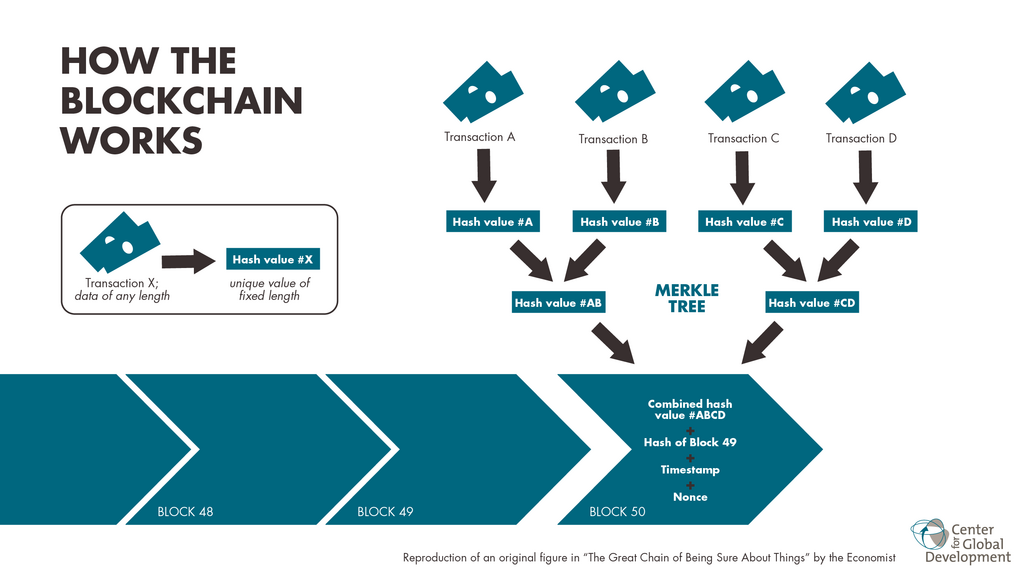
Each block in the chain holds three key pieces of information:
- Data: A list of transactions or records.
- A Hash: A unique, fingerprint-like code for the block. It’s generated from the block's data. If even one tiny detail in the data changes, the hash changes completely.
- The Previous Block's Hash: This is how the blocks are linked together, creating a secure chain.
When a new block is created, it includes the hash of the one that came before it. This forms a chronological chain. Tampering with an old block would change its hash, which would break the link to the next block, and the next, and so on. The discrepancy would be obvious to everyone in the network. This chain structure is a core part of what makes a blockchain so secure.
The third crucial component is the network itself, made up of nodes. A node is simply a computer connected to the blockchain network. Each node keeps a full copy of the entire blockchain. When a new block is proposed, nodes check its validity. If it's valid, they add it to their copy of the ledger. This massive duplication is what makes the system so resilient.
The Power of Decentralization
Traditional systems, like a bank, are centralized. The bank holds the master copy of the ledger in its own computers. You have to trust the bank to keep it safe and accurate.
A blockchain is decentralized. There is no master copy; everyone on the network has an identical copy. This removes the need for a central authority.
Why is this so important? A decentralized network is more resilient. If one computer (node) goes offline, the network keeps running. It’s also more transparent, as anyone on the network can typically view the transactions. Finally, it's resistant to censorship because no single entity can block or reverse transactions they don't like.
How Everyone Agrees
If there's no boss, how does the network agree on which new transactions are valid and which new block to add to the chain? This is solved by something called a consensus mechanism. It's a set of rules that all the nodes follow to stay in sync.
There are many types, but two are the most common.
Proof of Work (PoW) This was the first consensus mechanism. In PoW, powerful computers known as "miners" compete to solve a very difficult mathematical puzzle. The first miner to find the solution gets to create the next block and add it to the chain. This process requires a huge amount of computational power and electricity, which is a major drawback. However, it's also what makes the network secure. To attack the network, you'd need to control more than half of its total computing power, which is practically impossible on a large scale.
Proof of Stake (PoS) This is a more energy-efficient alternative. Instead of miners competing with computing power, participants called "validators" lock up, or "stake," their own digital assets as collateral. The network then chooses a validator to create the next block. The more assets a validator stakes, the higher their chance of being chosen. If they act dishonestly, they can lose their staked assets. This financial incentive keeps everyone honest.
Both methods achieve the same goal: they allow a decentralized network to agree on a single version of the truth without needing a central authority. This agreement, combined with the chained structure of the blocks, is what makes the blockchain a trusted system for recording information.
What are the three key pieces of information held within each block of a blockchain?
What is the primary function of a 'consensus mechanism' in a blockchain?
Blockchain technology is a powerful new way of storing and verifying information, moving trust from a central institution to a distributed network.