Cryptocurrency Fundamentals
Introduction to Cryptocurrency
What Is Cryptocurrency?
Cryptocurrency is a type of digital money. Unlike the dollars or euros in your bank account, it doesn't exist in a physical form like paper bills or metal coins. It's entirely virtual, and it uses a special kind of security called cryptography to protect transactions.
cryptography
noun
The art of writing or solving codes. In cryptocurrency, it's used to secure transactions and control the creation of new units.
The most important feature of most cryptocurrencies is that they are decentralized. This means they aren't controlled by any single entity, like a government or a bank. Instead, transactions are verified and recorded by a network of computers spread all over the world.
A fundamental feature of cryptocurrencies is their decentralized nature.
This setup allows people to send and receive money directly with each other, anywhere in the world, without needing a middleman.

A Quick History
The story of cryptocurrency begins in 2008. A person or group using the name Satoshi Nakamoto published a document called a white paper. This paper, titled "Bitcoin: A Peer-to-Peer Electronic Cash System," outlined a new kind of digital money.
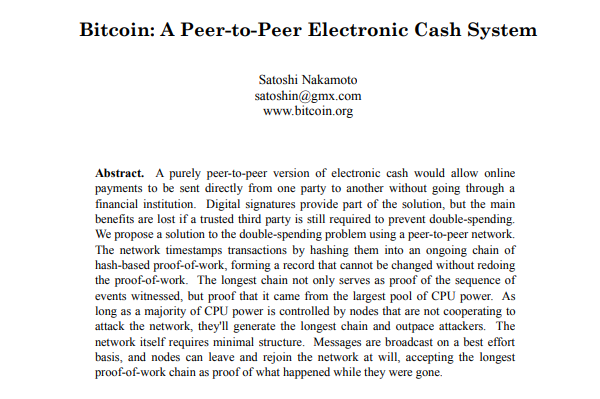
In January 2009, the Bitcoin network came to life. This was the first-ever cryptocurrency. The timing wasn't a coincidence. The 2008 financial crisis had shaken people's trust in traditional banks and financial systems. Bitcoin offered an alternative: a currency that no single authority could control or manipulate.
For a few years, Bitcoin was a niche interest for cryptographers and tech enthusiasts. But as more people learned about it, the idea of decentralized digital currency began to spread. This led to the creation of thousands of other cryptocurrencies, each with its own unique features and goals.
The Power of Decentralization
To understand decentralization, think about how a traditional bank works. A bank is a central authority. It holds all of its customers' money, keeps a private record of every transaction, and has the power to freeze accounts or block payments. You have to trust the bank to manage your money correctly and act in your best interest.
A centralized system has a single point of control and a single point of failure.
A decentralized network is the opposite. There is no central hub. Instead of one private ledger held by a bank, the transaction record is a shared ledger distributed across many computers. Everyone in the network has a copy, and all participants work together to verify that transactions are valid.
This structure is significant for a few reasons. It makes the system more resilient because there's no central server to attack. It also makes it transparent, as the ledger is open for anyone to see. And because no single entity is in charge, it's very difficult for anyone to censor transactions or shut the network down.
How It Works in a Nutshell
So how are cryptocurrencies created, sent, and stored without a bank in the middle? It comes down to a few core concepts.
Creation: New crypto coins are typically generated through a process called "mining." This involves using powerful computers to solve complex mathematical problems. When a problem is solved, the miner is rewarded with newly created coins. This process not only creates new currency but also helps secure the network by verifying transactions.
Transfer: Sending cryptocurrency is like sending an email. To receive funds, you share your public address, which is similar to an email address. To send funds, you use your private key, which acts like a password, to authorize the transaction. The transaction is then broadcast to the network, verified by other participants, and added to the shared public ledger.
Storage: Cryptocurrencies are stored in a digital "wallet." This isn't a wallet in the traditional sense; it doesn't hold your actual coins. Instead, it stores your public and private keys. The public key allows you to receive funds, and the private key proves you own those funds and allows you to spend them. Keeping your private key safe is extremely important. If you lose it, you lose access to your money.
These three functions—creation, transfer, and storage—form the foundation of how cryptocurrencies operate as a self-sustaining, peer-to-peer financial system.
What is the most defining characteristic of most cryptocurrencies?
Who is the pseudonymous creator of Bitcoin, as mentioned in the 2008 white paper?
This introduction covers the basic identity of cryptocurrency. It's a new kind of money, born from a desire for a more open and resilient financial system.