Cryptocurrency Essentials for Informed Beginners
Blockchain Architecture Mechanics
The Ledger in the Cloud
At its heart, a blockchain is a new kind of database. Instead of being stored in one place and managed by one entity, it's a shared, synchronised ledger distributed across a network of computers. This is known as Distributed Ledger Technology or DLT.
Imagine a shared notebook that everyone in a group can see. When someone adds a new entry, everyone else's copy of the notebook updates automatically. No single person owns the notebook, and no one can secretly change a past entry without everyone else noticing. This distributed nature is the first layer of security and transparency.
This setup removes the need for a central authority, like a bank or government, to validate and record transactions. The network itself handles verification.
The computers in this network, called nodes, work together to maintain the ledger's integrity. They communicate directly with each other in a topology. There's no central server that all nodes report to; instead, information propagates across the network from node to node, ensuring there's no single point of failure. If one node goes offline, the network continues to operate without interruption.
Cryptographic Fingerprints
So, how do we ensure the data in this shared ledger hasn't been tampered with? This is where cryptographic hash functions come in. A hash function is a mathematical algorithm that takes an input of any size and produces a fixed-size string of characters. This output is called a hash.
Think of it as a unique digital fingerprint for data. Even changing a single character in the input will produce a completely different hash. This property is crucial for the integrity of the blockchain.
Bitcoin, for example, uses the algorithm. It takes any data—a transaction, a document, an entire block—and condenses it into a 256-bit (64-character) hash. This process is one-way; it's practically impossible to reverse the process to find the original input from its hash.
Each block in the chain contains a header. This header includes several pieces of information, but most importantly, it contains the hash of the previous block. This creates a cryptographic link, forming the 'chain' in blockchain. If someone tries to alter the data in an old block, its hash will change. This change would break the link to the next block, and every subsequent block, making the tampering immediately obvious to the entire network.
Efficiently Verifying Data
A single block can contain thousands of transactions. If you wanted to confirm that your specific transaction was included, would you need to download and search through all of them? That would be slow and inefficient.
To solve this, blockchains use a clever data structure called a (or hash tree). It provides a way to efficiently verify the integrity of a large set of data.
Here's how it works. Instead of hashing the entire list of transactions in one go, you hash each individual transaction. Then, you take pairs of these hashes, combine them, and hash them again. You repeat this process, pairing and hashing the results, until you are left with just one single hash. This final hash is called the Merkle root.
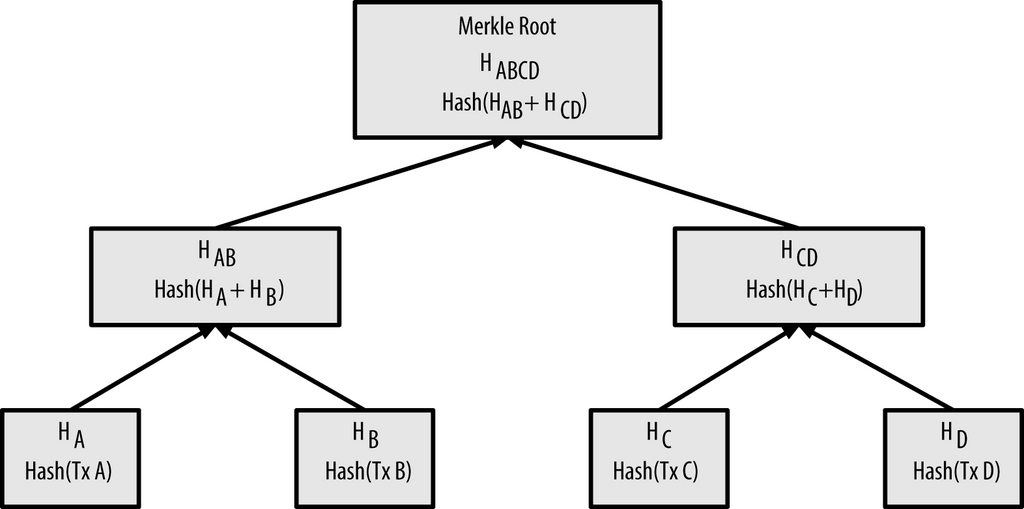
This Merkle root is the only thing that needs to be stored in the block header to represent all the transactions within that block. It acts as a compact summary. To verify if a specific transaction is in the block, a node only needs that transaction's hash and a few other hashes along the 'branch' of the tree leading to the root. This is exponentially more efficient than checking every single transaction.
By storing the Merkle root in the header, the blockchain ensures that not only the block itself is tamper-proof, but every single transaction within it is as well.
What is the fundamental technology that describes a blockchain as a shared, synchronised ledger distributed across a network of computers?
In the context of a blockchain, what is the primary role of a cryptographic hash function like SHA-256?
These architectural components work together to create a system that is decentralised, secure, and transparent. The distributed ledger provides resilience, cryptographic hashes create immutable links, and Merkle trees allow for efficient verification.