Cryptocurrencies Explained
Introduction to Cryptocurrencies
What Is Cryptocurrency?
Think about the money you use every day. Whether it's a dollar bill or a number in your bank account, it's issued and managed by a central authority, like a government or a bank. Cryptocurrency is a different kind of money. It's entirely digital, and it doesn't rely on any central institution to exist or work.
Instead, it's secured by a technology called cryptography. This is a method of protecting information using complex math problems. It ensures that transactions are secure and that no one can create fake currency or spend money they don't have.
Cryptography
noun
The art of writing or solving codes. In the context of digital currencies, it refers to the use of advanced mathematical principles for securing transactions and controlling the creation of new units.
This powerful security is the backbone of all digital currencies, making them a unique way to handle value in the digital world.

No One's in Charge
Traditional currencies are centralized. Your government prints money and a central bank controls its flow. This system is familiar, but it means you're trusting a single entity to manage everything.
Cryptocurrencies are decentralized. There's no CEO, no central bank, and no government controlling the network. It's a global, community-run system. This is one of the most significant differences between digital currencies and the money we've used for centuries.
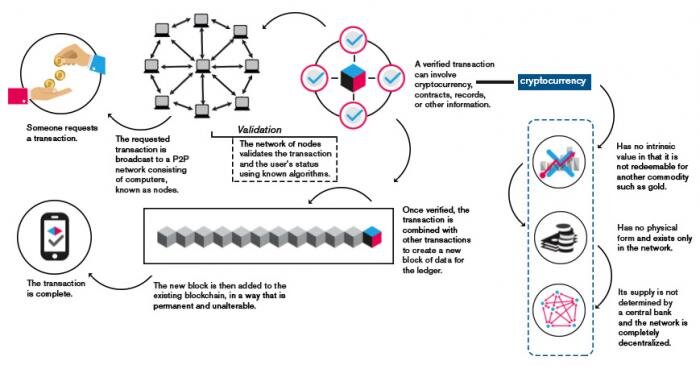
Instead of a central authority, a network of computers all over the world works together to manage and verify every transaction.
This network structure ensures that the currency remains independent and borderless. Anyone with an internet connection can participate, and the rules are set by the community and the underlying code, not by a corporation or government agency.
A Permanent Public Record
So if there's no bank, how are transactions recorded? They're stored on a digital ledger called a blockchain. You can think of it as a shared public notebook that everyone can see but no one can change.
Every transaction is grouped into a "block," which is then added to a continuous "chain" of previous blocks. This creates a permanent and unchangeable record of every transaction that has ever occurred on that network.
Once a transaction is added to the blockchain, it cannot be altered or removed. This property is called immutability, and it's what makes the ledger so trustworthy.
This public ledger means that all transactions are transparent. Anyone can view the flow of funds on the network, which creates a high level of accountability.
Public but Private
Here's a concept that can seem contradictory at first. All transactions are public, but the people involved can remain anonymous. How does that work?
When you use a cryptocurrency, your identity isn't directly tied to your transactions. Instead of your name, you use a unique digital address, which looks like a long string of random letters and numbers. This is often called pseudonymity. While the transaction itself is visible to everyone on the public ledger, your real-world identity remains protected.
Your wallet address is public, but your name isn't. This allows for transparent transactions without revealing personal information.
This creates a unique balance. The network has the transparency needed to verify every transaction and prevent fraud, while users can maintain a degree of privacy.
Ready to check your understanding?
What is the primary characteristic that distinguishes cryptocurrency from traditional currencies like the US Dollar?
What is the name of the digital ledger where all cryptocurrency transactions are recorded?
In short, cryptocurrencies offer a new model for managing value. They operate on a decentralized network, use cryptography for security, and record everything on a transparent, immutable public ledger.