Crypto Tech vs Hype
Understanding Blockchain
What is a Blockchain?
At its heart, a blockchain is a special kind of digital notebook. Imagine a notebook that's shared among a huge group of people. Every time someone wants to add a new entry, like a transaction, they announce it to everyone. The group verifies the entry, and then it's added to a new page. Once a page is full and added to the notebook, it’s sealed shut and can never be changed or removed.
This notebook, or ledger, isn't stored in one central place. Instead, every person in the group has an identical copy. This is the core idea of decentralization.
This structure makes blockchain technology incredibly secure. Because everyone has a copy of the ledger, it's nearly impossible for one person to cheat the system. To alter a record, they would need to change their own copy and also convince the majority of the network to change their copies at the exact same time, which is practically impossible. This shared agreement keeps the ledger honest and trustworthy without needing a bank or government to oversee it.
Building the Chain
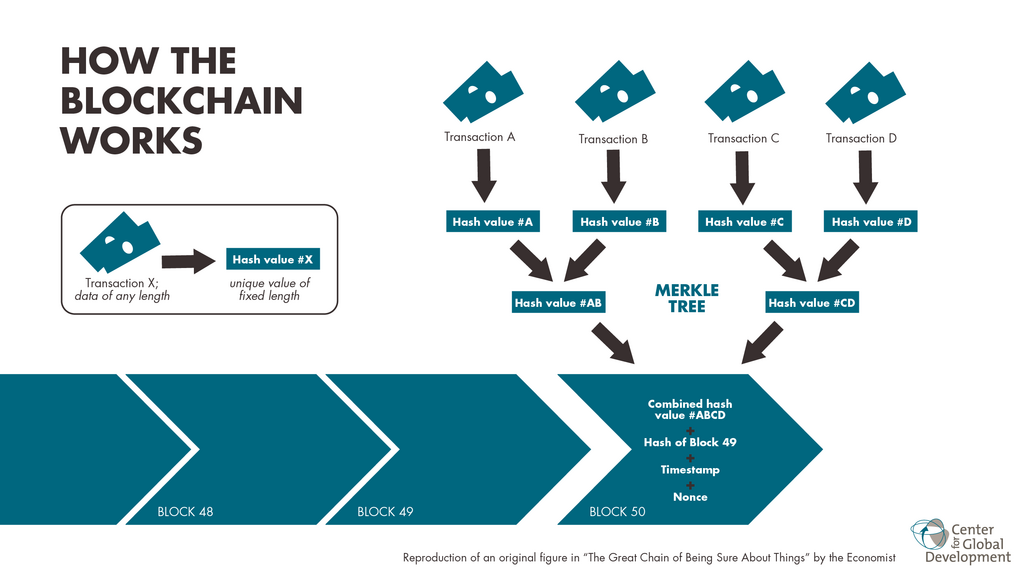
So how does this digital notebook actually work? The name "blockchain" gives us a clue. Information is grouped together into "blocks." Each block contains a list of recent transactions, a timestamp, and a unique code called a hash.
Crucially, each new block also contains the hash of the block that came before it. This is what creates the "chain." The hash acts like a digital fingerprint. If even a tiny detail in a block were changed, its hash would change completely. This would break the link to the next block in the chain, immediately signaling to the entire network that something is wrong.
This cryptographic linking makes the blockchain immutable, meaning it's permanent and unchangeable. Once a block is added to the chain, it's there for good.
Reaching Agreement
Since there's no central boss, how does the decentralized network agree on which new block to add to the chain? This is solved using a consensus mechanism. It's a set of rules that everyone in the network follows to validate transactions and maintain the integrity of the ledger. The two most common types are Proof of Work and Proof of Stake.
Proof of Work (PoW)
noun
A consensus mechanism that requires participants, called miners, to solve a complex mathematical puzzle. The first one to solve it gets to add the next block to the blockchain and is rewarded.
PoW is extremely secure because solving the puzzle requires immense computational power and energy. To attack the network, a bad actor would need to control more than half of the entire network's computing power, which is prohibitively expensive.
Proof of Stake (PoS)
noun
A consensus mechanism where participants, called validators, lock up a certain amount of their cryptocurrency as a 'stake.' Validators are then chosen, often randomly but weighted by the size of their stake, to create the next block.
If a validator approves a fraudulent transaction, they lose their stake, which creates a strong financial incentive to act honestly. PoS uses far less energy than PoW, making it a more environmentally friendly alternative.
| Feature | Proof of Work (PoW) | Proof of Stake (PoS) |
|---|---|---|
| Who validates? | Miners compete to solve a puzzle. | Validators are chosen based on their stake. |
| Energy Use | Very high | Very low |
| Security Model | Relies on computational power. | Relies on economic incentives. |
| Example | Bitcoin | Ethereum |
More Than Just Money
While blockchain was created for Bitcoin, its potential goes far beyond digital currencies. Because it's a secure and transparent way to record information, it can be used in many different industries.
For example, it can be used in supply chain management to track products from the farm to the store, ensuring goods are authentic and haven't been tampered with. It could also be used to create secure and transparent voting systems or to manage medical records while protecting patient privacy.
Another powerful application is smart contracts. These are programs stored on a blockchain that automatically execute when certain conditions are met, removing the need for an intermediary like a lawyer or a bank. For instance, a smart contract could automatically release payment to a freelance worker as soon as their project is approved.
At its core, blockchain is a decentralized digital ledger that records transactions across multiple computers in a secure and transparent manner.
Understanding these fundamentals—the decentralized ledger, the chain of blocks, and the consensus mechanisms—is the key to seeing how blockchain technology provides the secure foundation for cryptocurrencies and many other future innovations.
What is the primary function of a hash in a blockchain block?
Why is a blockchain considered immutable?