Crypto Tech vs Hype
Introduction to Cryptocurrencies
What Is Cryptocurrency?
At its heart, a cryptocurrency is digital money. Unlike the dollars or euros in your bank account, it doesn't exist in any physical form. It’s a purely digital asset that you can send to or receive from anyone else in the world, without needing a bank to approve the transaction.
The “crypto” part comes from cryptography, the practice of secure communication. Every transaction is secured using powerful cryptographic techniques, making them extremely difficult to forge or tamper with. This security is what gives the system its integrity.

The first and most famous cryptocurrency, Bitcoin, was introduced in 2009 by an anonymous person or group named Satoshi Nakamoto. The goal was to create a “peer-to-peer electronic cash system” that could operate without a central authority. Since then, thousands of different cryptocurrencies, often called altcoins, have been created.
Think of it like digital cash that's secured by complex math instead of a bank vault.
The Magic Notebook Called Blockchain
Cryptocurrencies are built on a technology called blockchain. Imagine a digital notebook that is shared among a vast network of computers. Every time someone sends or receives cryptocurrency, the transaction is recorded as a new entry in this notebook.
After a certain number of transactions, they are collected into a “block.” This new block is then mathematically linked to the previous one, forming a chain of blocks, or a blockchain. This structure makes the history of transactions permanent and unchangeable. Once a block is added to the chain, its data cannot be altered without altering all subsequent blocks, which is practically impossible.
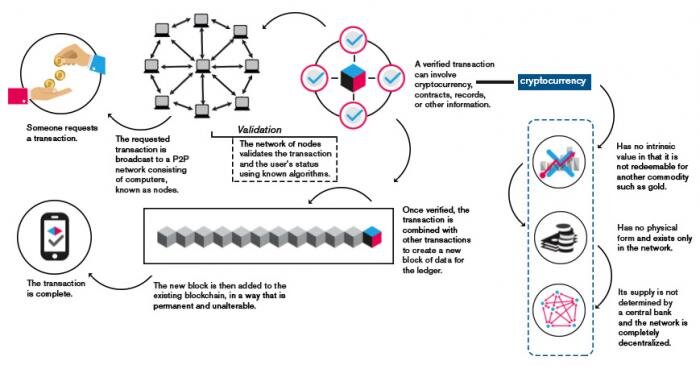
Because this digital ledger is distributed across many computers worldwide, it’s not controlled by any single person or company. This is the core idea of decentralization.
Why No Central Bank?
Traditional finance relies on trusted third parties, like banks, to manage our money and validate transactions. Decentralization removes the need for this middleman. The network itself, made up of its users, validates transactions.
This is significant for a few reasons. It can make sending money across borders faster and cheaper. It also gives individuals full control over their own funds, a concept known as self-custody. There's no central entity that can freeze your account or block a payment.

But if there's no central authority, how does everyone agree on which transactions are valid? This is where consensus mechanisms come in.
Agreeing on the Truth
A consensus mechanism is a set of rules that allows the distributed network to agree on the state of the ledger. It’s how the network ensures that all transactions are legitimate and that nobody is spending the same digital coin twice. The two most common methods are Proof of Work and Proof of Stake.
Proof of Work (PoW)
other
A consensus mechanism where network participants, called miners, compete to solve a complex mathematical puzzle. The first one to solve it gets to add the next block to the blockchain and is rewarded with cryptocurrency.
PoW requires immense computational power, which makes the network very secure but also consumes a lot of energy.
Proof of Stake (PoS)
other
A consensus mechanism where participants, called validators, are chosen to create a new block based on the number of coins they hold and are willing to "stake" as collateral. Validators are rewarded for successfully adding a block.
PoS is much more energy-efficient than PoW, as it doesn't rely on computational competition. Instead, it relies on an economic incentive: validators who act dishonestly risk losing their staked coins.
These core concepts—digital assets secured by cryptography, a decentralized ledger, and consensus mechanisms—are the foundation of the entire cryptocurrency world.
Ready to check your understanding?
What is the core technology that most cryptocurrencies are built on?
According to the text, what is the primary advantage of decentralization in cryptocurrency?
Understanding these fundamentals is the first step in navigating the complex and evolving landscape of digital currencies.