Cross-Border Payments Explained
Introduction to Cross-Border Payments
Money Without Borders
When you buy a coffee, you make a domestic payment. The money moves from your bank to the coffee shop's bank, all within the same country. But what happens when the person or business you're paying is in another country? That's a cross-border payment.
cross-border payment
noun
A financial transaction where the sender and the recipient are based in separate countries.
Think of it as sending a digital package. Instead of shipping a physical item, you're sending financial information and value across a national border. This could be anything from a large corporation paying an overseas supplier to you sending birthday money to a cousin living abroad.
Within the European Union's Euro area, this concept is especially powerful. Countries like France, Germany, Italy, and Spain all use the Euro. While they are separate nations with their own banking systems, sending money between them is a daily occurrence. A payment from a bank account in Lisbon to one in Berlin is a cross-border transaction, even though both use the same currency.
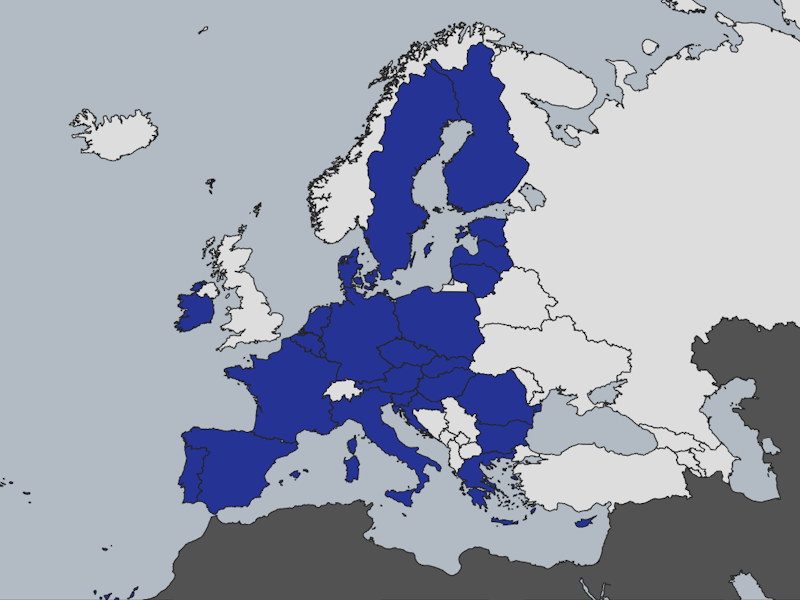
These transactions are the lifeblood of the EU's single market. They allow a small business in Greece to sell its products to customers in Finland. They let a student from Ireland study in the Netherlands and receive funds from home. They make it possible for tourists to travel and pay for services seamlessly. Without efficient cross-border payments, the economic integration of the Eurozone wouldn't be possible.
The Basic Journey
So, how does the money actually get from point A to point B? At its core, a cross-border payment is a series of messages and settlements between banks. Your bank doesn't just put Euros in an envelope and mail them. Instead, it sends a secure instruction to the recipient's bank.
This instruction contains all the necessary details: who is sending the money, who is receiving it, the amount, and the bank account numbers for both parties. The two banks then have to "settle" the transaction, which means the actual funds are moved between them to finalize the payment.
For the process to be smooth, the banks need a common language and trusted networks to communicate through. This coordination is what allows your payment to arrive safely and accurately, whether you're paying for a hotel reservation in another country or sending a gift to a friend.
While the concept is simple, the underlying systems that make it happen are complex. However, for users within the Eurozone, the goal is to make a cross-border payment feel just as easy as a domestic one.
Within the Eurozone, cross-border payments connect economies and people, making the single market a daily reality.
We've now seen what a cross-border payment is and why it's so important, especially in an integrated economic area like the Eurozone. Next, we'll dive into the specific steps and systems that make these transactions possible.
What is the defining characteristic of a cross-border payment?
Why are efficient cross-border payments considered essential for the EU's single market?