Critical Appraisal of Medical Research
Study Design Hierarchies
Ranking the Evidence
When faced with a pile of medical research, how do you know which study to trust most? Not all research is created equal. The 'Hierarchy of Evidence' is a framework that helps rank different study designs based on how well they protect against bias. Think of it as a pyramid.
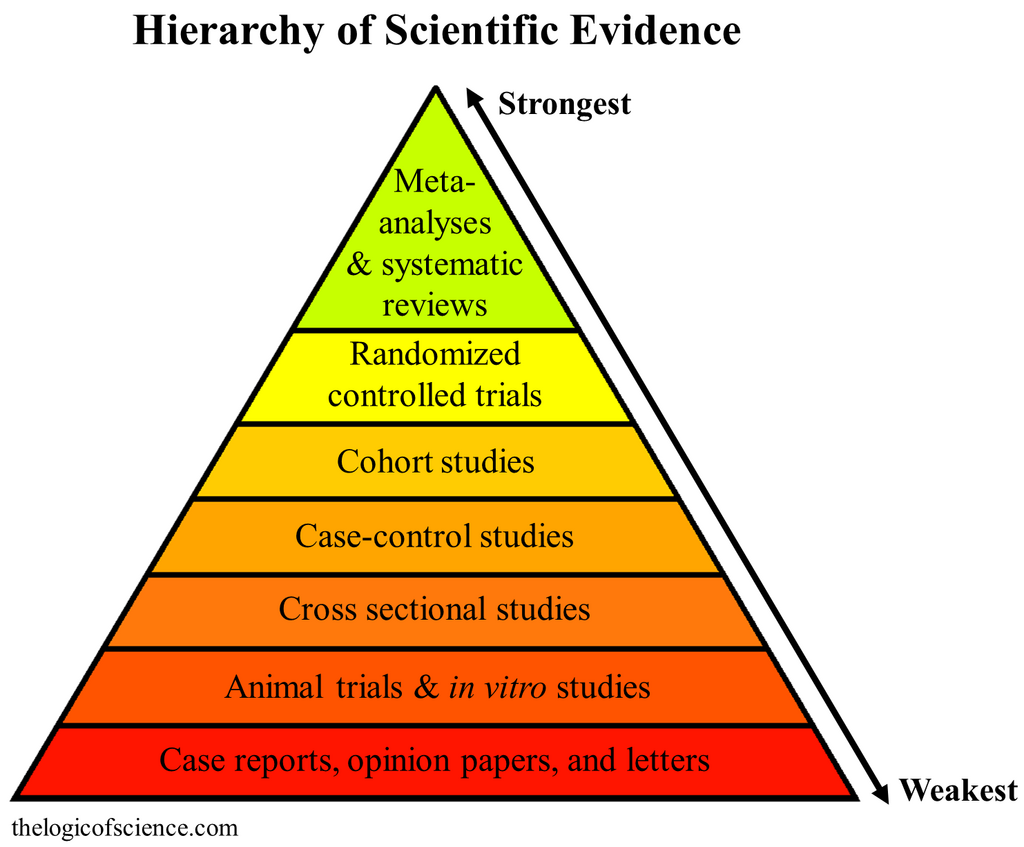
At the top are study types that synthesise existing research, like systematic reviews. Below them are the primary studies where new data is collected. The higher a study design sits on the pyramid, the more confidence we can have in its findings because the design itself minimises the chances of systematic error. It’s a guide, not a rigid rule, for judging the internal validity of a study—how likely the results are to be true for the people in that specific study.
The Gold Standard and Its Challengers
At the peak of primary research sits the Randomised Controlled Trial (RCT). In an RCT, participants are randomly assigned to either receive an intervention (like a new drug) or a control (like a placebo or standard treatment). Randomisation is the key. It works to ensure that the groups are as similar as possible in every way except for the intervention being tested. This design is powerful because it helps to isolate the effect of the intervention, making it less likely that other factors (confounders) are responsible for the results.
An RCT is our best tool for answering the question: 'Does this treatment work?'
But RCTs aren't always possible or even desirable. Sometimes it’s unethical to randomise people to a harmful exposure, like smoking. Other times, a condition might be so rare that gathering enough patients for an RCT is impossible. This is where observational studies come in. Instead of assigning interventions, researchers simply observe what happens to groups of people.
There are two common types:
-
Cohort Studies: These studies follow a group (or cohort) of people over time. They compare outcomes for those who were exposed to something (e.g., a new medication in the real world) versus those who were not. They are forward-looking (prospective) and great for studying the causes of a disease or the long-term effects of a treatment.
-
Case-Control Studies: These are retrospective. They start with the outcome (e.g., patients who have a specific disease) and look backward in time to find exposures that might be linked to it. They are useful for studying rare diseases because you start with the known cases.
When the Pyramid Flips
This brings us to a crucial point: a well-conducted observational study can be more valuable than a poorly executed RCT. An RCT with a high dropout rate, flawed randomisation, or one that studies a highly selective group of patients might have poor internal validity and results that don't apply to the general population. This failure to apply to real-world scenarios is a weakness in external validity—how well the study's results can be generalised to other people, places, or times.
| Study Type | Best For | Key Weakness |
|---|---|---|
| RCT | Testing if a treatment works (efficacy) | Can be expensive, slow, and may not reflect the 'real world' (lower external validity). |
| Cohort Study | Studying long-term effects and risk factors | Can be slow and expensive. Prone to confounding if groups differ in important ways. |
| Case-Control Study | Investigating rare diseases or outbreaks | Relies on memory or records, which can be inaccurate (recall bias). Prone to confounding. |
An observational study might be the superior choice for assessing long-term safety. An RCT might follow patients for a few months, but a large cohort study can track them for decades, picking up on rare or delayed side effects that the original trial missed. For questions about harm or prognosis, observational designs are often the only ethical and practical option.
At the bottom of the pyramid are case series and expert opinion. A case series is simply a descriptive report on a group of patients with the same condition or treatment. It can't prove causation but can be invaluable for identifying new diseases or unexpected effects, often forming the basis for questions that lead to more rigorous studies. Expert opinion, while not formal evidence, is based on years of clinical experience and can fill gaps where high-quality evidence doesn't yet exist.
What is the primary purpose of the 'Hierarchy of Evidence' in medical research?
Why are Randomised Controlled Trials (RCTs) considered the 'peak' of primary research designs?