CRISPR Gene Editing Explained
Introduction to CRISPR
A Bacterial Immune System
The story of CRISPR doesn't start in a high-tech lab, but in the microscopic world of bacteria. For billions of years, bacteria have been at war with viruses called bacteriophages. To survive, they evolved a clever and surprisingly precise defense system—an adaptive immune system that can remember and destroy viral invaders.
Scientists first noticed strange, repeating DNA sequences in bacteria in the late 1980s. They named them Clustered Regularly Interspaced Short Palindromic Repeats, or CRISPR. These repeating segments were separated by unique "spacer" sequences, which turned out to be pieces of DNA from past viral infections. The bacterium essentially keeps a library of mugshots of its enemies.
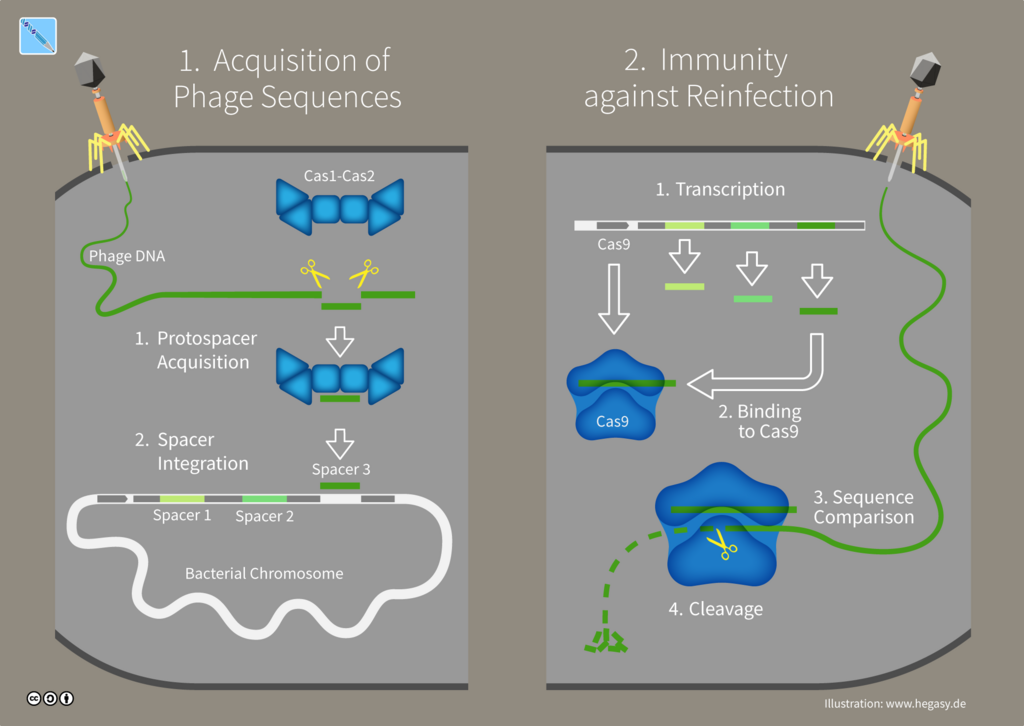
Alongside the CRISPR DNA sequences, scientists found a set of genes they called CRISPR-associated, or Cas genes. These genes produce proteins, or enzymes, that act as the enforcers. When a virus attacks again, the bacterium makes a copy of the viral mugshot from its CRISPR library. This copy, in the form of an RNA molecule, teams up with a Cas protein. Together, they patrol the cell, searching for a genetic match. If they find the invading virus, the Cas protein acts like a pair of molecular scissors and snips the viral DNA, disabling it.
From Defense to Tool
The breakthrough came when scientists realized they could harness this bacterial defense system for a new purpose: editing the DNA of any organism. By creating a synthetic guide molecule, they could direct the DNA-cutting enzyme to almost any gene they wanted.
The most commonly used system is called CRISPR-Cas9. It has two essential components that work together.
Guide RNA (gRNA)
noun
A small, engineered piece of RNA that acts as a guide. One end is designed to match a specific DNA sequence in the target genome.
Think of the guide RNA as a GPS coordinate. It tells the cutting enzyme exactly where to go.
Cas9
noun
An enzyme that acts like molecular scissors. It cuts the double-stranded DNA at the precise location specified by the guide RNA.
The Cas9 protein is the muscle. It holds onto the guide RNA and does the actual cutting, but only when the guide RNA confirms it's at the right spot.
So, what CRISPR is, and an easy way to think about, it's like a molecular pair of scissors that can go through that long, long genome and find specific places, make small cuts, and edit it.
The Editing Process
The process is remarkably straightforward. First, researchers design a guide RNA that matches the gene they want to edit. They then package this guide RNA together with the Cas9 protein and introduce the complex into a living cell.
Inside the cell, the guide RNA leads the Cas9 enzyme on a search through the genome. When it finds the exact DNA sequence that it's programmed to match, the Cas9 protein locks on and cuts both strands of the DNA double helix. This creates a double-strand break.
The cell's natural DNA repair machinery immediately gets to work fixing this break. This is where the editing happens. The cell has two main ways to repair the DNA, and scientists can leverage either one.
-
Non-Homologous End Joining (NHEJ): This is the cell's quick-and-dirty repair method. It often sticks the two cut ends of the DNA back together, but in the process, it can accidentally add or delete a few DNA letters. This small error is often enough to disable, or "knock out," the targeted gene.
-
Homology Directed Repair (HDR): This is a more precise repair pathway. If scientists provide a new DNA template along with the CRISPR-Cas9 complex, the cell can use this template to repair the break. This allows them to replace the original sequence with a new one, effectively correcting a faulty gene or inserting a new one.
From its discovery as a curious pattern in bacterial DNA to its development as a revolutionary gene-editing tool, CRISPR has transformed our ability to interact with the code of life.