CRISPR Cas9 Gene Editing Explained
Introduction to CRISPR/Cas9
A Bacterial Defense System
The story of CRISPR doesn't start in a high-tech lab, but inside a humble bacterium. For years, scientists noticed strange, repeating patterns in the DNA of bacteria. These were clusters of identical DNA sequences, separated by unique, non-repeating segments called spacers. It was a genetic puzzle.
These regions were named Clustered Regularly Interspaced Short Palindromic Repeats, or CRISPR for short.
Researchers also found a set of genes nearby that were always associated with these CRISPR sequences. They named them Cas genes, for "CRISPR-associated." It was clear the repeats and the genes were connected, but their purpose was a mystery. The breakthrough came when scientists realized the unique spacer DNA wasn't bacterial at all—it was a perfect match for the DNA of viruses that attack bacteria.
This discovery revealed that CRISPR is a sophisticated immune system. Bacteria use it to remember and fight off invading viruses, much like our own bodies develop immunity after an infection.
Molecular Mugshots
When a virus attacks a bacterium, it injects its own DNA to take over the cell. If the bacterium survives, its Cas proteins get to work. They find the foreign DNA, cut out a small piece, and carry it back to the bacterium's own genome. This viral snippet is then stitched into the CRISPR array as a new spacer. It's like the cell is taking a molecular mugshot of its attacker and filing it away for future reference.
This is the adaptation phase. The CRISPR locus becomes a genetic library of past infections.
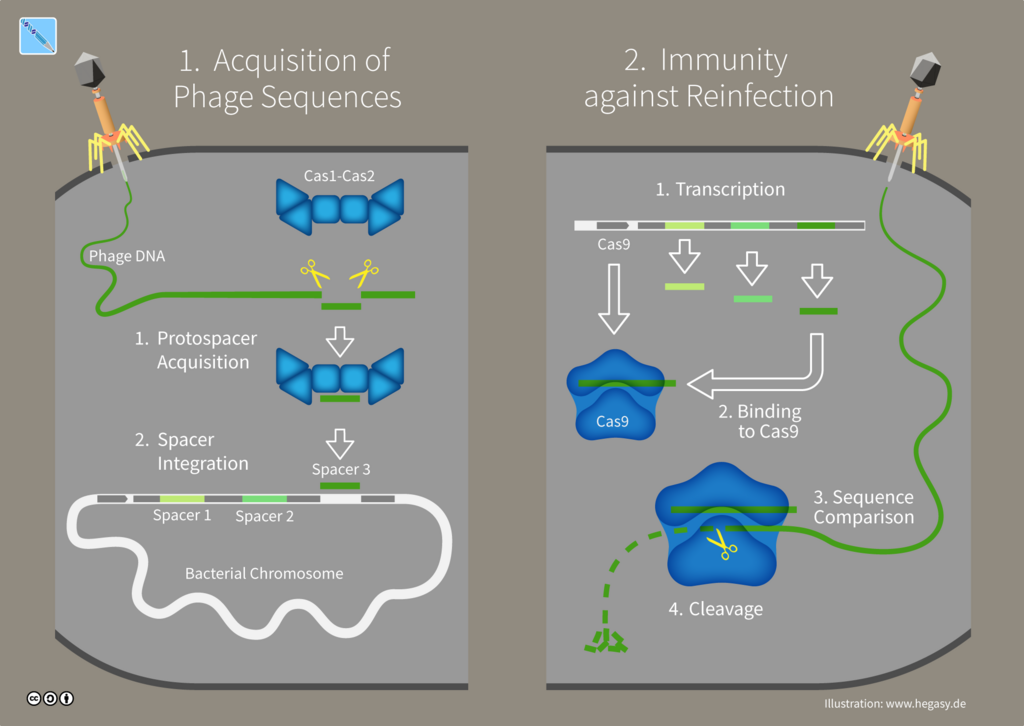
Later, if the same type of virus attacks again, the cell is ready. It transcribes the entire CRISPR array—repeats and spacers—into a long strand of RNA. This RNA is then chopped up into smaller pieces, each containing one viral spacer.
Each of these small RNA molecules acts as a guide. It latches onto a Cas protein, most famously one called Cas9. The guide RNA and the Cas9 protein form a surveillance complex that patrols the cell. The guide RNA's job is to look for a perfect match to its viral sequence. When it finds one, the Cas9 protein acts like a pair of molecular scissors, precisely cutting the viral DNA and neutralizing the threat. This is the interference phase.
Harnessing the System
Scientists realized that this bacterial defense mechanism was incredibly powerful. It could find and cut DNA at a very specific location. The key question was: could this system be programmed to cut any DNA sequence, not just viral DNA?
CRISPR is essentially a find and replace function for DNA, and in the hands of scientists, it's a super powerful molecular tool for rewriting the code of life.
The answer was yes. Researchers figured out they could replace the natural guide RNA with a custom-made one. By synthesizing a guide RNA that matches a target gene in a human, plant, or animal cell, they could direct the Cas9 protein to that exact spot in the genome.
Once guided to the target, the Cas9 protein does what it does best: it cuts the DNA. This creates a double-strand break. The cell's natural DNA repair machinery then takes over to fix the break. It is this repair process that allows scientists to make changes to the gene, effectively editing the genome.
By simplifying this ancient bacterial system into a two-part tool—the Cas9 protein and a programmable guide RNA—scientists created a technology for editing DNA with unprecedented ease and precision.