Crafting Compelling Novel Outlines
Understanding Novel Structure
Building the Blueprint
Every great story, from a blockbuster film to a bestselling novel, has a hidden skeleton holding it all together. This is its narrative structure. Think of it as the architectural blueprint for your story. It ensures the walls don't collapse and the roof doesn't cave in, giving you a solid foundation before you start decorating with characters, dialogue, and plot twists.
Without a structure, a story can feel like a random series of events, leaving the reader confused and unsatisfied. With one, you create a sense of momentum and purpose. It guides the reader from the first page to the last, making the journey feel both surprising and inevitable. We'll start with one of the oldest and most reliable blueprints: the three-act structure.
The Three-Act Structure
This framework is beautifully simple. It divides a story into three distinct parts: the beginning, the middle, and the end. Or, more formally, the Setup, the Confrontation, and the Resolution.
The classic storytelling arc—introduction, conflict, climax, and resolution—provides a clear framework for conveying your message.
Act 1: The Setup This is where we meet the protagonist in their ordinary world. We learn who they are, what they want, and what's holding them back. Near the end of this act, an inciting incident occurs. This is the event that kicks off the story, disrupting the hero's life and forcing them to act.
Act 2: The Confrontation This is the longest part of the novel. The protagonist enters a new, unfamiliar world and faces a series of escalating challenges. They might gain new skills, meet allies, and face enemies. The stakes get higher and the tension builds, pushing the hero toward a major turning point, often a moment where all seems lost.
Act 3: The Resolution Here, the story races toward its climax, the final showdown between the hero and the main antagonistic force. After the climax, the loose ends are tied up. We see the aftermath of the hero's journey and learn what their new normal looks like. It's the satisfying conclusion the reader has been waiting for.
This structure provides a basic rhythm for your story. It ensures you have a clear beginning, a meaty middle full of conflict, and a satisfying end. It’s a powerful tool for pacing your narrative and keeping readers engaged.
The Hero's Journey
The Hero's Journey is another classic storytelling pattern, but it focuses more on the protagonist's transformation. It was popularized by mythologist Joseph Campbell, who noticed that myths from around the world often shared a fundamental structure. This framework is less about dividing the story into acts and more about mapping out the key stages of a character's adventure.
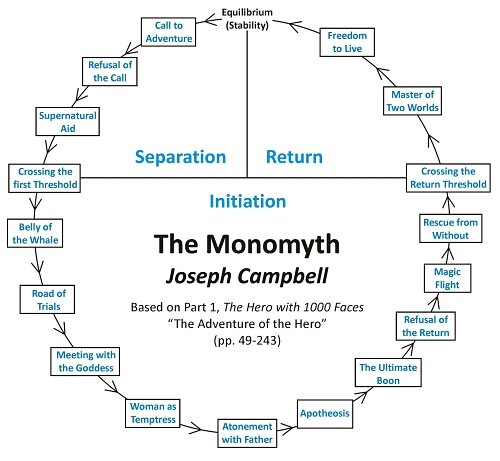
While Campbell's original model has 17 stages, it's often simplified for novels and films. Here are the core beats you’ll recognize from countless stories:
- The Ordinary World: We meet the hero in their normal, everyday life.
- The Call to Adventure: Something happens that disrupts the hero's world and presents them with a challenge or quest.
- Refusal of the Call: The hero is hesitant or afraid to accept the challenge.
- Meeting the Mentor: The hero encounters a wise figure who provides guidance, training, or a crucial tool.
- Crossing the Threshold: The hero finally commits to the adventure and enters a new, special world.
- Tests, Allies, and Enemies: The hero faces trials, makes friends, and confronts foes, learning the rules of the new world.
- The Ordeal: The hero faces their greatest fear or a life-or-death crisis. This is the central crisis of the story.
- The Reward: Having survived the ordeal, the hero obtains a reward, whether it's an object, knowledge, or insight.
- The Road Back: The hero begins the journey back to their ordinary world, but the danger is not over yet.
- The Resurrection: The hero has one final, climactic test. They must use everything they've learned to succeed.
- Return with the Elixir: The hero returns home, transformed, and brings something back to benefit their community.
Notice how the Hero's Journey can be mapped onto the three-act structure. The Ordinary World and Call to Adventure fit into Act 1. The Tests and Ordeal make up Act 2. The Road Back and Resurrection form Act 3.
These frameworks aren't rigid rules you must follow. They are tools. Understanding them helps you structure your ideas, ensure your character has a compelling arc, and create a narrative that resonates with readers. Once you master the blueprint, you can start bending it, combining elements, and building something uniquely your own. This solid foundation is what makes it possible to layer in complexity, like shocking plot twists, without the whole story falling apart.
Ready to check your understanding of these narrative blueprints?
What is the primary function of a narrative structure in a story?
In the Three-Act Structure, the 'Inciting Incident' occurs at the end of which act?