Crafting Compelling Fiction
Introduction to Fiction Writing
The Building Blocks of Story
Every story you've ever loved, from a fairy tale to a blockbuster movie, is built from the same five basic ingredients: plot, character, setting, dialogue, and point of view. Think of them as the flour, sugar, and eggs of fiction. You can mix them in endless combinations, but you need them all to bake a satisfying cake.
Plot Is What Happens
Plot is the sequence of events that make up your story. It’s the answer to the question, “What happens next?” A plot isn’t just a random list of events; it’s a chain of cause and effect. Event A happens, which causes Event B, which then leads to Event C.
This structure gives a story momentum and keeps the reader turning the pages. Without a plot, you just have a collection of scenes. With a plot, you have a journey.
This journey needs travelers, which brings us to the next essential element.
Characters Drive the Action
Characters are the heart of your story. They are the people (or creatures, or sentient robots) who experience the plot. While the plot is what happens, the characters are who it happens to. Great stories are memorable because their characters feel real.
To create a compelling character, start with a simple question: What do they want? A goal gives a character purpose and drives their actions. Then, ask why they want it. That gives them motivation. Finally, give them a flaw or an obstacle. Nobody is perfect, and challenges make a character's journey interesting.
A princess who wants to rescue a dragon from a knight is more interesting than a knight who wants to rescue a princess from a dragon.
Setting Is Where It Happens
The setting is the time and place of your story. It's the world your characters inhabit. But a setting is much more than just a backdrop; it should feel like an active part of the narrative.
The right setting can establish a story's mood. A creaky, abandoned mansion creates a sense of dread, while a sunny beach suggests relaxation. Setting can also create conflict. Imagine a character trying to find water in a vast desert or trying to stay warm during a blizzard. The environment itself becomes an obstacle they must overcome.
Dialogue Is How They Speak
Dialogue is the conversation between your characters. It’s a powerful tool that can accomplish several things at once. Good dialogue reveals a character's personality, moves the plot forward, and provides important information without feeling like an info-dump.
Each character should have a unique way of speaking. A shy librarian won't talk like a bold starship captain. Pay attention to how people talk in real life. They interrupt each other, use slang, and often say what they don't mean. Your dialogue should sound natural, not like a formal speech.
Instead of having a character say, "I am very angry," show it through their words. "Don't talk to me right now," they might say through clenched teeth.
Point of View Is Who Tells the Story
Point of View, or POV, is the perspective from which the story is told. It determines what the reader knows and when they know it. The two most common POVs are first person and third person.
First Person: The narrator is a character in the story. They use pronouns like "I," "me," and "my." This POV is intimate and personal, as the reader only sees the world through that one character's eyes.
Third Person: The narrator is outside the story. They use pronouns like "he," "she," and "they." This perspective can focus closely on one character's thoughts and feelings or provide a broader view of multiple characters.
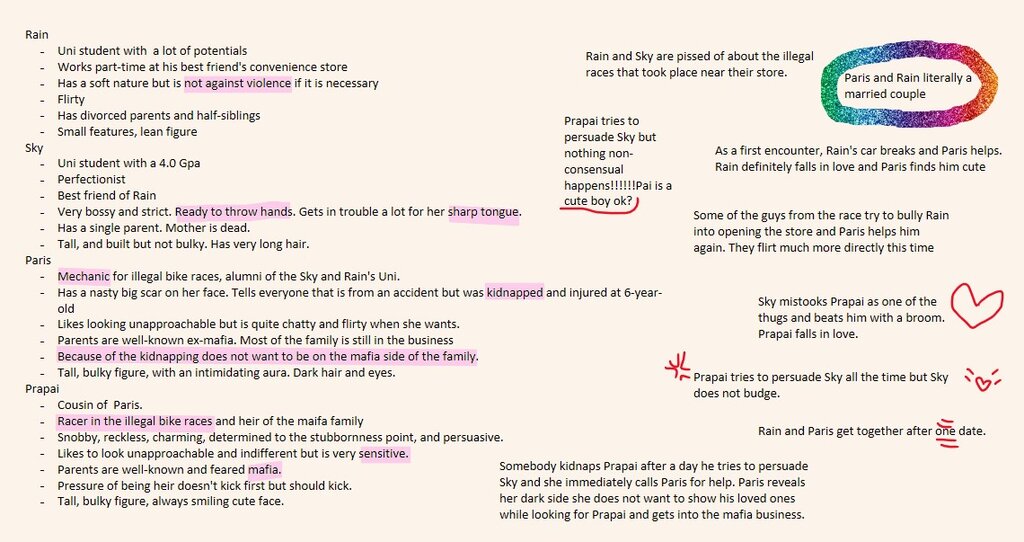
Start by creating a storyline with 5-20 bullet points.
Choosing a POV is one of the most important decisions a writer makes. It shapes the reader's entire experience of the story. Now, let's review these core concepts.
Ready to test your knowledge?
What is the defining characteristic of a story's plot?
According to the text, asking 'What do they want?' is the first step to creating a compelling character because it gives them a ______.
Understanding these five elements is the first step toward writing your own compelling stories. By weaving them together, you can create worlds and characters that will stay with readers long after they've finished the last page.