Crafting Award-Winning Film Scripts
Introduction to Screenwriting
The Blueprint of a Movie
A screenplay is not a novel. A novelist can spend pages exploring a character's inner thoughts and feelings. A screenwriter doesn't have that luxury. A screenplay is a blueprint, a set of instructions for a team of people who will build a movie.
Think of it this way: the script needs to communicate everything the audience will see and hear on screen. It’s a technical document as much as it is a creative one. Every word serves the final product, which is a visual and auditory experience. The screenwriter is the first architect of that experience, laying the foundation upon which the director, actors, and designers will build.
The screenplay serves as the foundation for television production, defining narrative structure, character development, and dialogue.
Because of this, screenplays follow a very specific format. This isn't just to be difficult; the standardized format helps production teams estimate screen time and budget. A single page of a properly formatted screenplay roughly translates to one minute of screen time.
The Anatomy of a Script
Every screenplay is built from the same basic components. Once you learn to recognize them, reading a script becomes second nature.
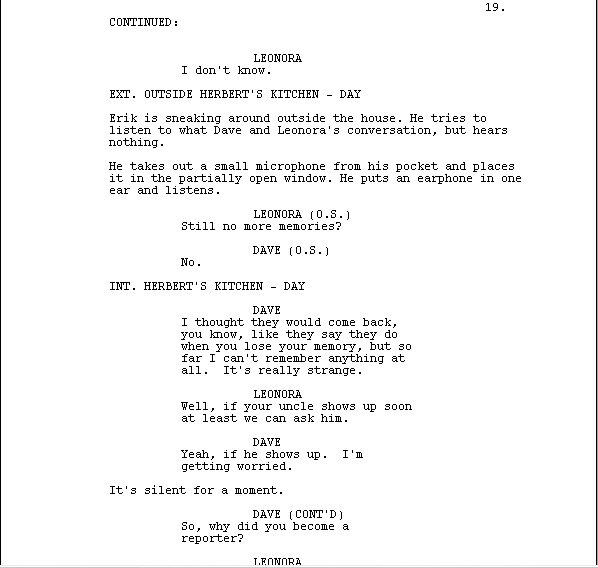
Let's break down the key elements you see in that example.
| Element | Purpose | Example |
|---|---|---|
| Scene Heading | Tells us where and when the scene takes place. Also called a slugline. | INT. COFFEE SHOP - DAY |
| Action Line | Describes what the characters do and what we see and hear. Always in the present tense. | ANNA sips her coffee, staring out the window. |
| Character Name | Indicates who is speaking. Always in ALL CAPS and centered above the dialogue. | ANNA |
| Dialogue | The words the character speaks. | "I think it's going to rain." |
These four elements are the fundamental building blocks. A scene heading establishes the setting, action lines build the world and show what's happening, and character names and dialogue let us know who is speaking and what they are saying. Master these, and you've mastered the language of screenwriting.
Show, Don't Tell
This is the most important rule in screenwriting. Since you can't get inside a character's head, you have to show their emotions and intentions through their actions, expressions, and words. The script is a guide for what can be filmed.
You wouldn't write:
Mark felt a wave of regret. He wished he had never sent the text message.
You can't film a feeling. How would an actor portray that? How would a director shoot it? Instead, you have to translate that internal feeling into external action.
Mark stares at his phone, his thumb hovering over the 'delete' button. He runs a hand through his hair, pacing the length of his small apartment. He stops, picks up a pillow, and screams into it.
Now we see Mark's regret. We understand his internal state through his actions. This is visual storytelling. It engages the audience by letting them interpret the character's behavior, rather than just being told what the character feels.
What is the primary function of a screenplay?
Why is the standardized formatting of a screenplay so important in the film industry?
Understanding these core concepts is the first step. With a solid grasp of the format and the principle of visual storytelling, you have the foundation to start writing scenes that can come to life on screen.