Crafting a 3D Cinematic Animated Short
Cinematic Storyboarding
From Words to Frames
Your script has a soul; the storyboard gives it a body. It's the technical blueprint that translates narrative beats into a sequence of images. This isn't about creating beautiful drawings. It's about planning a visual flow. Stick figures are fine, as long as they communicate the essential information: character position, action, and camera angle.
Tools like Storyboarder or Blender's Grease Pencil are designed for this. They let you quickly sketch panels, add notes about timing and camera movement, and even create a rough animatic to check the pacing. For our 1-minute cricket story, every single frame must work hard to build the inspirational tone. If a shot doesn't contribute to the feeling of struggle and eventual triumph, it doesn't belong.
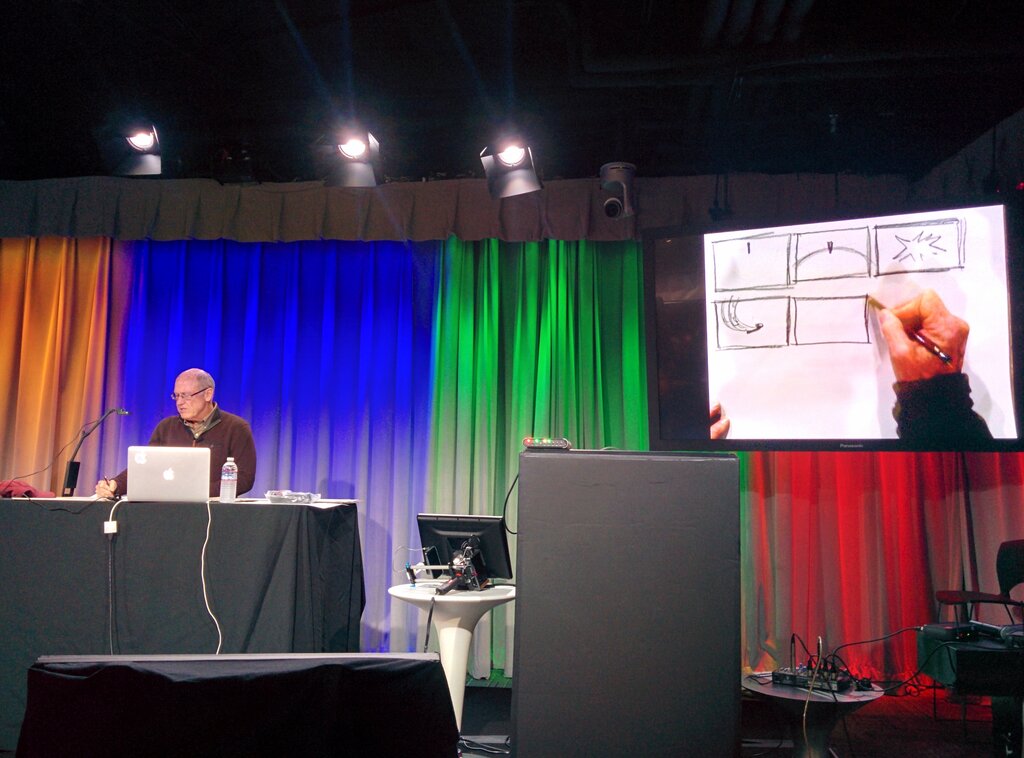
Think of a storyboard as a comic strip of your video, with illustrations or sketches that represent key scenes, along with accompanying notes on camera angles, actions, and dialogue.
We're not just illustrating scenes; we are designing emotions. Each panel should answer critical questions: What is the most important thing in this frame? What should the audience feel right now? How does this shot connect to the one before it and the one after it?
Directing the Viewer's Eye
Camera composition is the grammar of visual storytelling. Simple choices can dramatically alter the audience's perception of a character or moment. To make our cricketer feel heroic, we can use a low-angle shot, looking up at them as they take their stance. This visually communicates power and stature. To convey intense focus, we can use an extreme close-up on their eyes, just before the bowler releases the ball.
Lens choice, or focal length in a 3D environment, also plays a key role. A wide-angle lens (e.g., 24mm) can capture the vastness of the cricket pitch in an establishing shot, making the player seem small and isolated against the challenge. A telephoto lens (e.g., 85mm or higher) can flatten the space and isolate the batsman, blurring the background to focus the viewer's attention entirely on their determined expression.
Framing guides the audience's attention. The Rule of Thirds is a fundamental principle where you imagine the frame divided by two horizontal and two vertical lines. Placing key elements along these lines or at their intersections creates a more balanced and visually interesting composition than simply centering the subject.
For our cinematic, we'll use a standard widescreen aspect ratio, like 2.39:1, to create that classic film look. This wider frame gives us more room for dramatic compositions, allowing us to place the cricketer on one side of the frame while showing the opposing team or the vast, empty field on the other, emphasizing the scale of their challenge.
Blocking the Montage
The training montage is a classic storytelling device for showing progress over time. In our 1-minute film, it needs to be incredibly efficient. We're looking for a rhythmic sequence of 5-7 short, impactful shots that show our cricketer's dedication. Each shot should be distinct.
Here’s a possible sequence:
- Wide Shot: The cricketer alone on the pitch at dawn, stretching.
- Medium Shot: At the nets, practicing their batting form. The camera tracks with the swing of the bat.
- Close-up: Sweat dripping from their brow.
- Dynamic Shot: Low angle, tracking shot of them sprinting across the field.
- Detail Shot: A close-up of their hands gripping the bat tightly.
- Medium Shot: Studying videos of opposing bowlers on a tablet late at night.
- Hero Shot: Back on the pitch, looking confident and ready, the sun now high in the sky.
This sequence has a clear arc: it starts with quiet preparation, builds with intense action, and ends on a note of confidence. The variety in camera angles and subjects (action, emotion, intellect) keeps the montage from feeling repetitive.
The key to a good montage is visual rhythm. Vary the duration of each shot. A quick succession of 1-second shots can build energy, while holding on a 3-second shot of the character's determined face can add emotional weight.
Pacing is everything in a short narrative. A 1-minute film has no room for wasted frames. By creating an animatic—a slideshow of your storyboard panels timed to a rough soundtrack or music—you can feel the rhythm of the film before you've modeled a single asset. Does the montage feel rushed? Does the final shot linger long enough to feel triumphant? This is the stage to answer those questions.
Now that we've covered the core concepts of translating a script to a storyboard, let's test your understanding.
What is the primary purpose of a storyboard in the filmmaking process?
To make a character feel powerful and heroic, the most effective camera angle would be a low-angle shot.
With these principles, your storyboard becomes more than a plan; it becomes the first draft of your film's visual language.