Craft Your Professional CV
Understanding CV Basics
What Is a CV?
A Curriculum Vitae, or CV, is a detailed document that outlines your entire academic and professional history. Think of it less as an advertisement and more as a comprehensive record. Its purpose is to give a full, chronological account of your career.
Curriculum Vitae
noun
A Latin phrase meaning "course of life." It's a comprehensive document detailing one's academic and professional achievements.
Unlike a résumé, which is tailored to a specific job, a CV is a static, all-encompassing document. It grows with you over time as you accumulate more publications, presentations, and experiences. It provides a complete picture of your life's work.
CV vs. Résumé
The biggest point of confusion for many is the difference between a CV and a résumé. While both are used in job applications, they serve different purposes and are used in different contexts. The key distinction is depth and length.
A résumé is a short, targeted summary of your skills and experiences, usually one to two pages long. It’s customized to highlight the qualifications most relevant to the specific job you’re applying for. A CV, on the other hand, is a much longer document that lists everything. It’s not uncommon for the CV of an experienced academic to be ten pages or longer.
| Feature | CV (Curriculum Vitae) | Résumé |
|---|---|---|
| Purpose | Provide a complete record of academic and professional history. | Highlight skills and experience relevant to a specific job. |
| Length | Can be multiple pages; length grows with experience. | Typically 1-2 pages. |
| Content | Exhaustive list of publications, research, awards, etc. | A targeted summary of relevant skills and work history. |
| Customization | Rarely customized. | Always customized for the specific job application. |
When to Use a CV
So, when should you use a CV instead of a résumé? The answer largely depends on the field and the location.
In the United States and Canada, CVs are primarily used for academic, medical, and scientific positions. Résumés are the standard for most other jobs.
You'll almost always need a CV when applying for:
- Faculty positions at a college or university
- Research roles in a lab or scientific institution
- Fellowships or grants
- Admission to graduate school programs
Outside of North America, particularly in Europe, the UK, and parts of Asia, the term "CV" is often used to mean what Americans would call a résumé. However, for academic and research positions in these regions, the long-form, detailed CV is still the standard.
Standard CV Sections
While the exact structure can vary, most CVs follow a similar format and include a standard set of sections. This isn't an exhaustive list, but it covers the core components you'd expect to see.
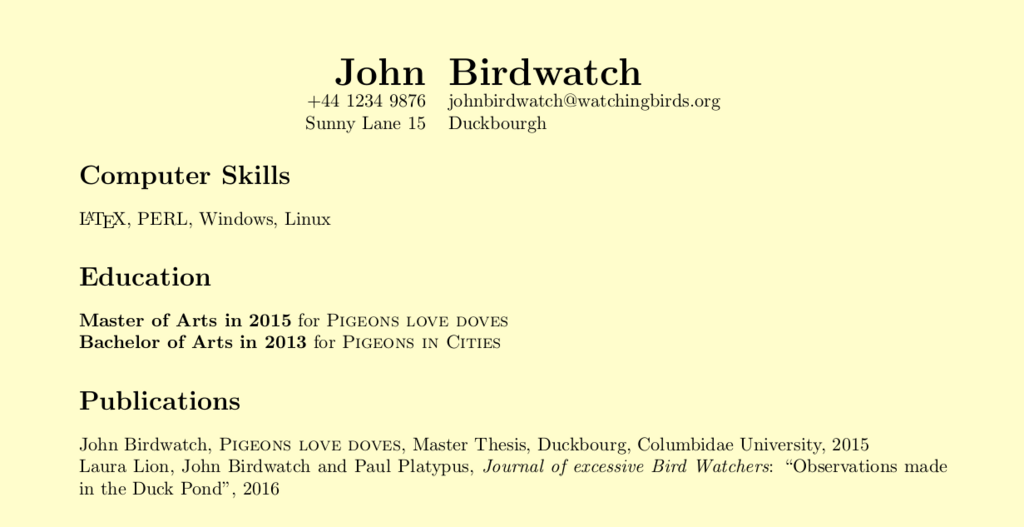
Common sections include:
- Contact Information: Full name, address, phone number, and email.
- Education: Degrees earned, institutions, and graduation dates in reverse chronological order.
- Professional Appointments: Academic or research positions held.
- Publications: A list of any published books, articles, or papers.
- Presentations: Talks or posters presented at conferences.
- Awards and Honors: Any relevant accolades you've received.
- Research Experience: A summary of your research projects and interests.
- Teaching Experience: Courses taught and any other teaching-related roles.
- Professional Memberships: Affiliations with any professional organizations.
- References: A list of people who can speak to your qualifications.
The order and inclusion of these sections can be adjusted based on the role you're applying for. Always prioritize the information that is most relevant to the application.
Understanding these basics is the first step. A CV is your professional story, told in full detail.