Craft Your Personal Learning Agenda
Understanding Personalized Learning
What Is Personalized Learning?
Traditional education often feels like a one-way street. A teacher stands at the front of the room, delivering the same lesson to every student at the same time. But what if learning could be tailored to you, specifically? That’s the core idea behind personalized learning.
At its core, personalized learning emphasizes a student-centered approach, allowing learners to take an active role in their educational journey.
Instead of a one-size-fits-all model, personalized learning customizes the educational experience to fit each student's unique strengths, needs, and interests. It’s not about letting students do whatever they want. It’s about creating a flexible path that helps them reach their goals in a way that makes sense for them.
The Core Benefits
When learning is tailored to an individual, engagement naturally increases. Students are more motivated when they see the relevance of what they’re studying and have a say in how they learn it. This approach respects that everyone learns differently and at a different pace.
By focusing on individual needs, personalized learning can help close achievement gaps. Students who are struggling with a concept can get more support, while those who have mastered it can move on to new challenges. This leads to deeper understanding and better retention of information, rather than just memorizing facts for a test.
The Building Blocks
Personalized learning isn't just a single strategy; it's a combination of several key components that work together to create a student-centered environment.
Flexible Learning Environments
This goes beyond rearranging desks. A flexible learning environment is one that can adapt to different activities and learning styles. It might mean having quiet spaces for individual work, collaborative areas for group projects, and stations with different resources. The goal is to give students choice in where and how they work best.
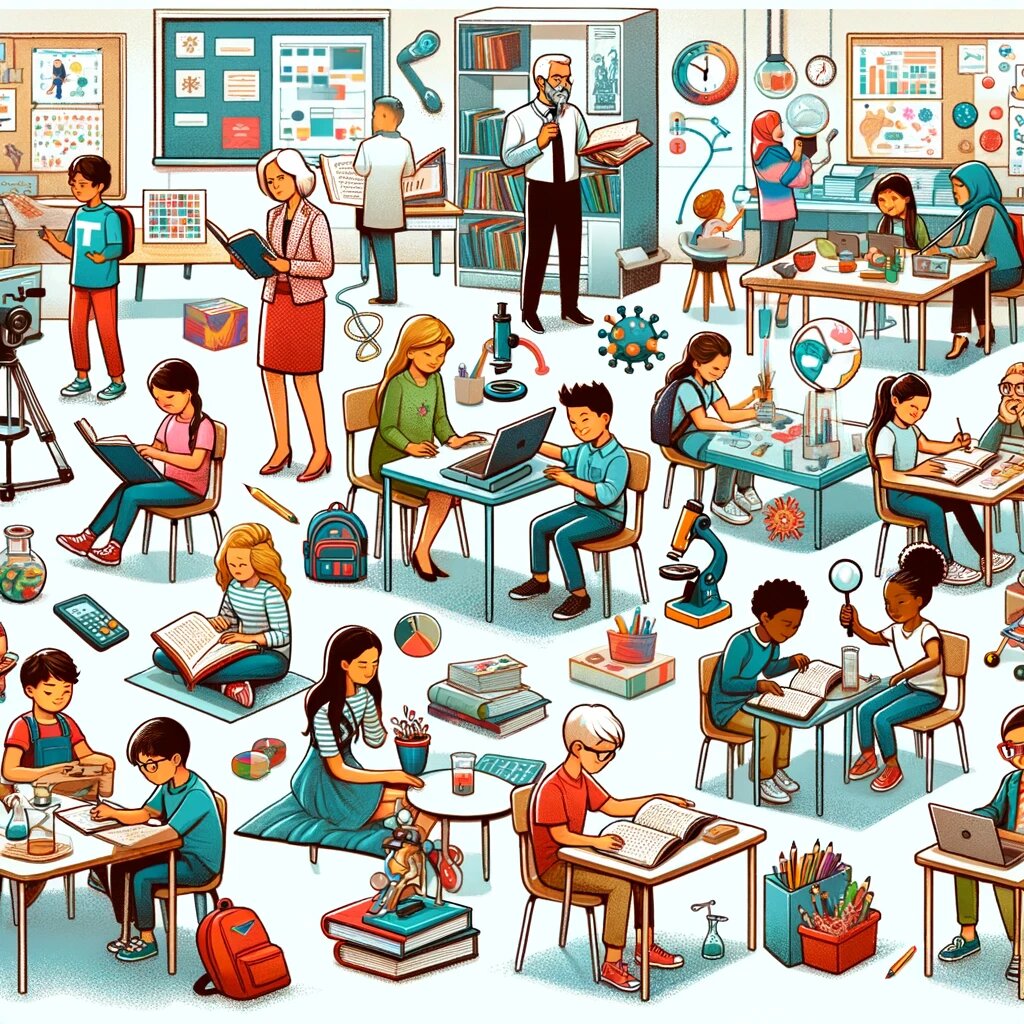
The environment isn't just physical. It also includes the digital tools and resources available, allowing learning to happen anytime, anywhere.
Redefined Teacher Roles
In a personalized setting, the teacher's role shifts dramatically. They are no longer just a source of information, but a guide and facilitator.
In personalized learning, teachers take on the role of facilitators and coaches, guiding students on their learning journey rather than imposing previously-established goals and restrictions.
Teachers work with students to set goals, find resources, and track progress. They spend more time providing one-on-one support and leading small group discussions, tailoring their instruction to the immediate needs of their students.
Authentic, Project-Based Learning
Instead of abstract worksheets, students engage in projects that tackle real-world problems. This approach makes learning meaningful and helps students develop critical skills like problem-solving, collaboration, and creativity. For example, instead of just reading about ecosystems, students might work together to design a sustainable garden for their school.
Student-Driven Pathways
This component gives students a voice and a choice in their education. They work with their teachers to set their own learning goals and decide how they want to demonstrate their understanding. A student might choose to write a research paper, create a video, or build a model to show what they've learned. This ownership increases motivation and helps students become self-directed, lifelong learners.
Competency-Based Progression
In many traditional classrooms, students move on to the next unit when the calendar says it's time, whether they've mastered the material or not. Competency-based progression changes that. Students advance only after they have demonstrated mastery of a concept or skill. This ensures that no one is left behind and that learning is built on a solid foundation.
competency
noun
The ability to apply a set of related knowledge, skills, and abilities to successfully perform critical work functions or tasks in a defined work setting.
This model focuses on the outcome—what the student knows and can do—rather than the time spent in a seat.
Ready to check your understanding?
What is the primary goal of personalized learning?
In a personalized learning setting, the teacher's role primarily shifts from a source of information to a...
By combining these elements, personalized learning creates a more dynamic, responsive, and effective educational experience for every student.