Cozumel Island Geological Origins
Island Formation
Birth of an Island
Islands seem to appear from nowhere, lonely dots in a vast ocean. But their origins are often dramatic, involving immense geological forces. Many of the world's islands are born from fire, the products of underwater volcanoes.
Earth's crust is made of massive, slow-moving pieces called tectonic plates. Where these plates pull apart or where one pushes under another, molten rock, or magma, from the mantle below can find a path to the surface. When this happens underwater, a submarine volcano begins to form. Eruption after eruption, layers of lava and ash build up. Over thousands or even millions of years, this growing mountain can finally break the ocean's surface. A new island is born.
Another way volcanic islands form is through "hotspots." These are fixed points deep within the Earth's mantle that are unusually hot. As a tectonic plate drifts over a hotspot, the magma punches through the crust, forming a chain of islands. The Hawaiian Islands are a classic example of this process.
Living Islands
Not all islands are born of fire. Some are patiently built by living creatures. In the warm, clear, shallow waters of the tropics, vast underwater cities are constructed by tiny animals called coral polyps.
Polyp
noun
A small, soft-bodied marine animal, typically living in a colony. Coral polyps secrete a hard calcium carbonate skeleton, which accumulates over generations to form coral reefs.
These polyps are related to jellyfish and sea anemones. They build hard skeletons of calcium carbonate, the same material that makes up chalk and limestone. A single polyp is tiny, but they live in huge colonies. When a polyp dies, its skeleton remains, and a new polyp builds its home on top. Over centuries and millennia, these skeletons accumulate, forming the massive structures we know as coral reefs.
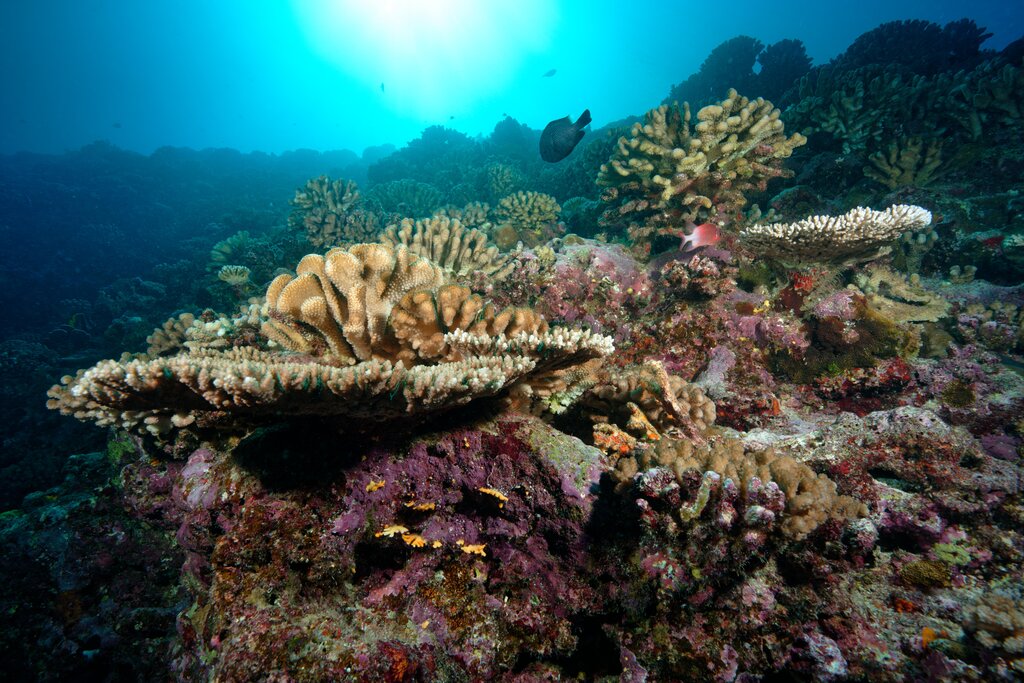
The process of island formation from coral reefs often follows a specific pattern, first described by Charles Darwin. It begins with a volcanic island.
- Fringing Reef: A reef grows in the shallows right off the coast of the new volcanic island.
- Barrier Reef: Over a very long time, the volcanic island slowly sinks, a process called subsidence. The coral continues to grow upward, keeping pace with the sinking land. This creates a lagoon of water between the island and the reef.
- Atoll: Eventually, the volcanic island may sink completely beneath the waves, leaving only a ring-shaped coral reef with a central lagoon. This is an atoll.
Whether through the violent eruption of a volcano or the slow, steady work of countless tiny organisms, islands represent new land where life can take hold.
Ready to test your knowledge? Let's see what you've learned about how islands are made.
What are the two primary ways islands are formed, as described in the text?
The Hawaiian Islands are a classic example of an island chain formed by...
Understanding these fundamental creation processes is the first step in exploring the unique geology and ecosystems of any island.