Course Creation for Quizzes
Understanding Course Objectives
What Are Learning Objectives?
Learning objectives are clear, simple statements that describe what a student will be able to do after completing a lesson or course. Think of them as the destination on a road trip. You wouldn't start driving without knowing where you're going. Likewise, you shouldn't build a course without knowing what you want your students to achieve.
Establishing learning objectives should be the starting point for your course.
These objectives act as a promise to the learner and a guide for you, the creator. They shape your content, influence your assessments, and ensure everything in your course serves a purpose. The focus is always on the student's capability. It’s not about what the course will cover, but about what the student will be able to do.
Align With Your Audience
Effective learning objectives are not one-size-fits-all. They must be tailored to your target audience's existing knowledge and goals. An objective that's perfect for a beginner might be too simplistic for an expert, and an expert-level objective would be frustrating for a newcomer.
For example, consider two courses on the Python programming language. One is for absolute beginners, and the other is for experienced developers. Their learning objectives would be drastically different.
| Beginner's Guide to Python | Advanced Python for Machine Learning |
|---|---|
| Define what a variable is. | Implement a custom neural network layer. |
| List three different data types. | Evaluate the performance of different models. |
| Write a simple 'Hello, World!' program. | Design a data pipeline for a large dataset. |
The beginner objectives focus on foundational knowledge and basic skills. The advanced objectives target complex application and creation. Always ask: Who is this course for, and what do they need to accomplish?
Make Them Measurable
An objective is only useful if you can measure whether it has been met. Vague goals like "understand the topic" or "learn about history" are impossible to assess. How do you know when someone truly "understands" something? You need concrete, observable actions.
This is where action verbs come in. Using precise verbs forces you to define exactly what the student must do to demonstrate their knowledge. Frameworks like Bloom's Taxonomy provide a helpful hierarchy of these verbs, from simple recall to complex creation.
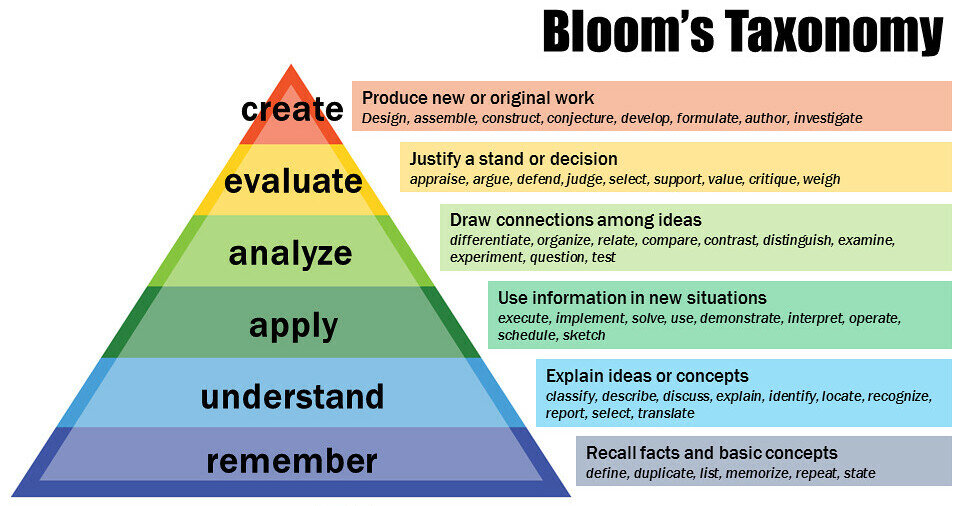
Let's compare a weak objective with a strong one.
Weak: Students will appreciate the role of functions.
Strong: Students will be able to write a function that accepts two arguments and returns their sum.
The strong objective is measurable. You can look at the student's code and see if they successfully wrote the function. The weak one is a feeling, not a skill.
A great way to check your objectives is with the SMART framework. A good objective is:
- Specific: It targets a precise area for improvement.
- Measurable: It can be tested and quantified.
- Achievable: It is realistic for the student to accomplish.
- Relevant: It aligns with the overall course goal and the student's needs.
- Time-bound: It can be accomplished within the scope of the lesson or course.
Let's review the key concepts before you test your knowledge.
Ready to try it yourself? This quiz will help you practice identifying and refining learning objectives.
What is the primary focus of a well-written learning objective?
Which of the following is the STRONGEST learning objective?
By setting clear, measurable, and audience-appropriate objectives, you lay the foundation for a course that is focused, effective, and successful for your learners.