Course Content Creation Essentials
Introduction to Instructional Design
What Is Instructional Design?
Instructional design is the practice of systematically creating learning experiences that are effective, engaging, and meet specific goals. Think of it as the architecture of education. Just as a builder needs a blueprint to construct a building, an educator needs a plan to build a successful course.
Instructional design is the process of planning, structuring, and creating learning experiences so people actually learn and take action, not just consume information.
Without this thoughtful process, content can become a random collection of facts and figures. With it, content transforms into a guided journey that helps learners acquire new skills and knowledge. The primary goal is to make learning more efficient and impactful by focusing on the needs of the learner from the very beginning.
Frameworks for Learning
To create a structured learning experience, instructional designers often use models. These are proven frameworks that provide a step-by-step process for building courses. They act like a recipe, ensuring all the necessary ingredients are included in the right order.
Instructional design models help instructional designers make sense of abstract learning theory and enable real world application.
One of the most well-known models is ADDIE. It’s an acronym that stands for the five phases of the development process: Analysis, Design, Development, Implementation, and Evaluation.
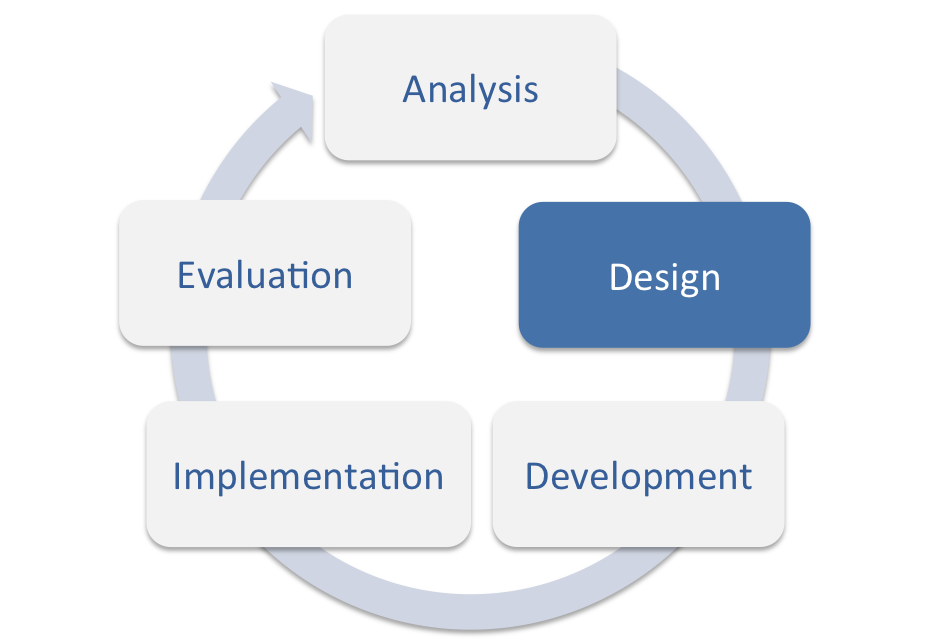
Here’s a quick breakdown of what happens in each phase:
- Analysis: This is the discovery phase. You identify your audience, their existing knowledge, and what they need to learn. You also define the overall learning goal.
- Design: Here, you create the blueprint. You write learning objectives, choose instructional methods, and plan the course structure and assessments.
- Development: This is where the course materials are created. It involves writing text, recording videos, and building activities based on the design plan.
- Implementation: The course is delivered to the learners. This could be in a classroom, online, or through a blended format.
- Evaluation: You measure the effectiveness of the course. Did the learners achieve the objectives? What worked well, and what could be improved? This feedback is crucial for refining the course.
Aligning Goals and Activities
A core principle of instructional design is the tight alignment between what you want learners to achieve and how you help them get there. This involves connecting learning objectives with instructional strategies.
Objective
noun
A clear, specific statement that describes what a learner will be able to do at the end of a course or lesson.
Instructional strategies are the activities, materials, and methods you use to teach the content. If your objective is for a student to bake a cake, your strategy wouldn't be to have them just read about baking. Instead, you might provide a recipe, show a video demonstration, and then have them practice baking in a kitchen.
Every part of your course should serve a purpose and directly support a learning objective.
| Learning Objective | Instructional Strategy |
|---|---|
| Identify the capitals of all 50 U.S. states. | Use flashcards and interactive map quizzes. |
| Write a persuasive essay. | Provide examples, a structural template, and a peer-review activity. |
| Perform a basic CPR procedure. | Use a video demonstration followed by hands-on practice with a mannequin. |
When strategies and objectives are aligned, learners have a clear path to success. They understand what is expected of them and are given the right tools to meet those expectations.
What is the primary goal of instructional design?
In which phase of the ADDIE model are the course materials, such as text and videos, actually created?
By understanding these fundamentals, you can begin to see how well-designed courses are built not by chance, but by a deliberate and thoughtful process.