Cosmos to Consciousness Origins
Big Bang Theory
The First Moments
Roughly 13.8 billion years ago, everything in the known universe was compressed into an unimaginably hot, dense point called a singularity. This wasn't a point sitting in space; it was the origin of space and time itself. The Big Bang wasn't an explosion in the typical sense, but rather the rapid expansion of spacetime from this initial state.
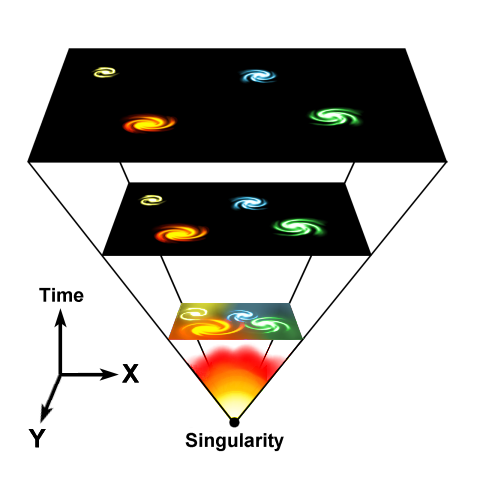
In the very first fraction of a second, the universe underwent a period of hyper-accelerated expansion known as cosmic inflation. It ballooned from subatomic size to something larger than a grapefruit almost instantaneously. This incredible growth smoothed out the universe, laying the groundwork for the large-scale structures we see today.
For a fraction of a second after the big bang occurred 13.8 billion years ago, most physicists believe, the newborn universe dramatically ballooned in size, jumping from being smaller than a proton to being bigger than a softball.
A Primordial Soup
Immediately following inflation, the universe was a scorching, dense soup of fundamental particles. It was too hot for atoms to form. Instead, quarks, electrons, and their antimatter counterparts zipped around in a sea of energy-packed photons.
As the universe continued to expand, it also cooled. Within the first microsecond, the temperature dropped enough for quarks to bind together, forming the protons and neutrons that make up the nuclei of all atoms today.
For a few minutes, the universe was a nuclear furnace. The temperature and density were just right for protons and neutrons to fuse together, creating the first atomic nuclei. This process is called Big Bang Nucleosynthesis.
By the end of this phase, the universe's ordinary matter was roughly 75% hydrogen nuclei and 25% helium nuclei by mass, with trace amounts of lithium. This elemental ratio is still observed today and is a key piece of evidence for the Big Bang.
The First Light
Even though nuclei had formed, the universe was still too hot for electrons to be captured into stable orbits. It remained an opaque plasma of free-floating electrons and nuclei, which constantly scattered photons (particles of light). Light couldn't travel far without bumping into an electron.
About 380,000 years after the Big Bang, the universe cooled to about 3,000 Kelvin. At this point, electrons could finally combine with nuclei to form the first neutral atoms, primarily hydrogen and helium. This event is called recombination.
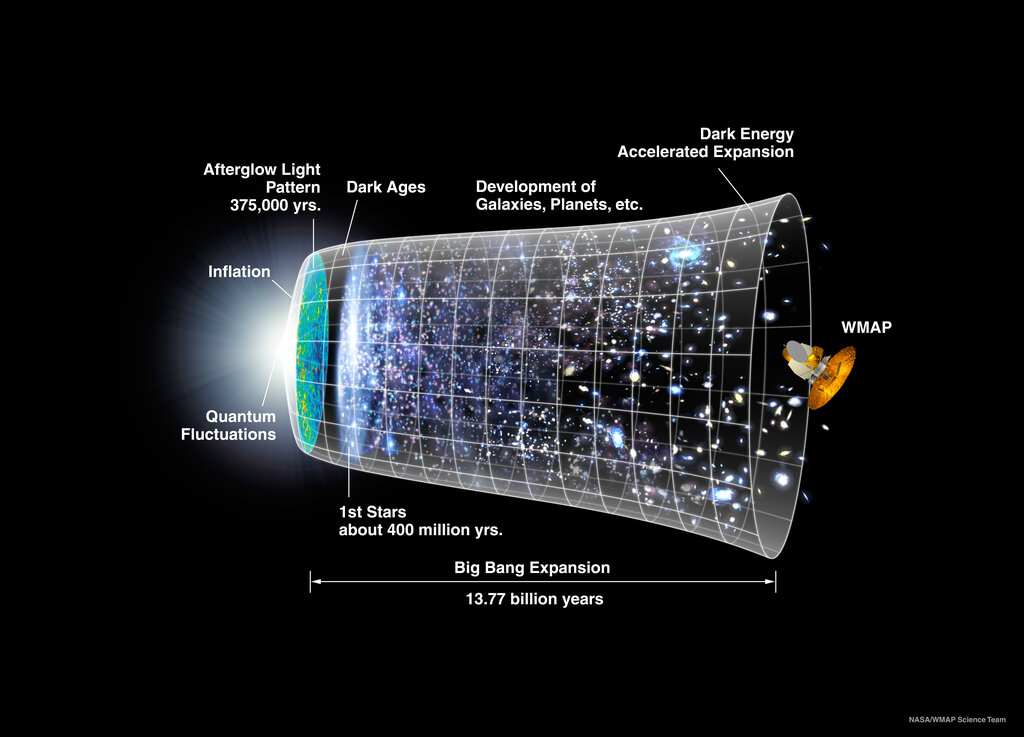
With the electrons now bound to atoms, the photons were suddenly free to travel unimpeded through space. This burst of light, released everywhere at once, is what we now detect as the Cosmic Microwave Background (CMB). It’s the oldest light in the universe, a faint afterglow from a time when the cosmos was still in its infancy.
The CMB is not perfectly uniform. It contains tiny temperature fluctuations that correspond to slight differences in density in the early universe. These small variations were the seeds from which all future structures, like stars and galaxies, would eventually grow.
Ready to check your understanding of the universe's first moments?
According to the Big Bang theory, what was the state of the universe at the very beginning?
What was the primary result of the period known as cosmic inflation?
The Big Bang theory provides a powerful framework for understanding our cosmic origins, from the initial expansion to the creation of the first atoms that would eventually form everything we see around us.