Cosmology and Cosmic Inflation
Introduction to Cosmology
The Expanding Universe
Our universe began about 13.8 billion years ago. It started as an incredibly hot, dense point, much smaller than a single atom. From that moment, it began expanding, and it hasn't stopped since. This event is known as the Big Bang.
When astronomers talk about the Big Bang, they usually do not refer to the very beginning of the Universe (time zero), but to the incredibly hot and compact state of the Universe in the first couple of minutes of its existence.
It's a common misconception to think of the Big Bang as an explosion in space. Instead, it was an expansion of space itself. Every point in the universe began moving away from every other point. An easy way to visualize this is to imagine baking a loaf of raisin bread. As the dough rises, every raisin moves away from every other raisin. No single raisin is the center of the expansion.
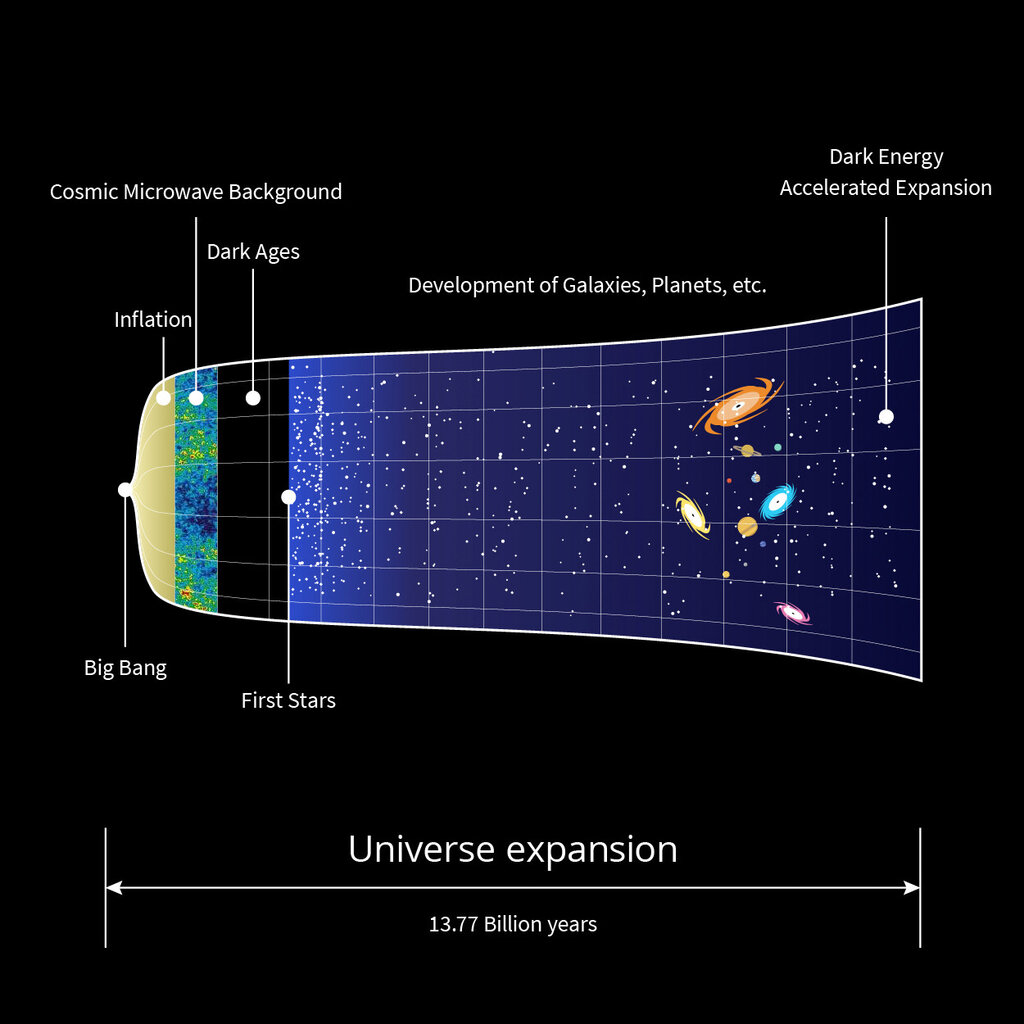
This expansion cooled the universe, allowing energy to condense into matter. In the first few minutes, the building blocks of atoms, like protons and neutrons, formed. Over hundreds of thousands of years, these particles came together to create the first simple atoms, mainly hydrogen and helium.
An Echo of Creation
For the first 380,000 years, the universe was a scorching, opaque fog of charged particles and light. Light couldn't travel far without bouncing off a particle, like car headlights in a dense fog. As the universe expanded and cooled, protons and electrons finally combined to form neutral atoms. This event, called recombination, cleared the fog. For the first time, light could travel freely across the cosmos.
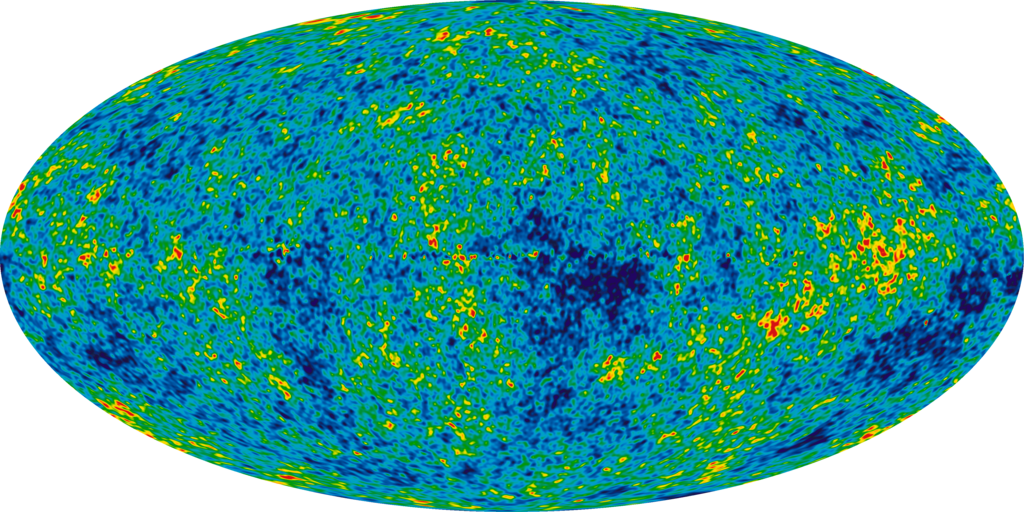
That ancient light is still traveling today. It fills the entire universe as a faint glow of radiation called the Cosmic Microwave Background (CMB). It's the oldest light we can see, an echo of the universe's infancy. The CMB is remarkably uniform in temperature, about 2.7 Kelvin ( °C), but it has minuscule temperature fluctuations. These tiny variations, just one part in 100,000, were the seeds from which all future cosmic structures would grow.
The Cosmic Web
Over billions of years, gravity acted on those tiny density fluctuations in the early universe. Regions that were slightly denser pulled in more matter, growing larger and more massive. This process formed the vast, intricate structure we see today, often called the cosmic web.
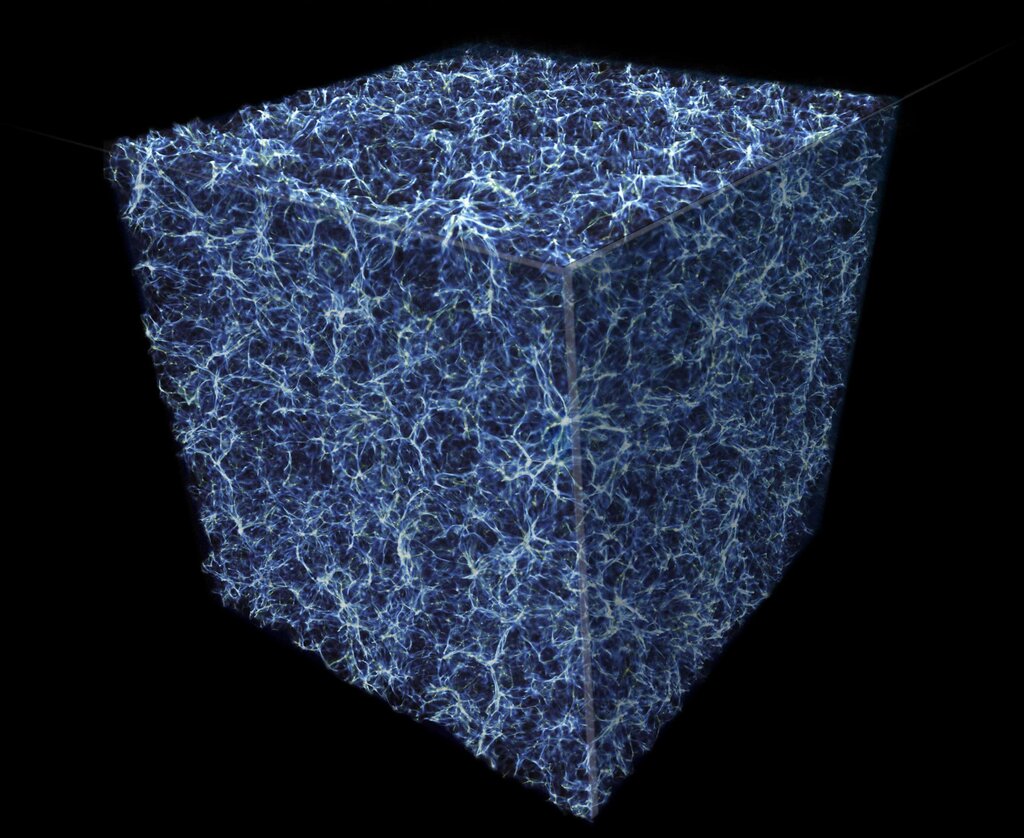
The universe isn't a random scattering of galaxies. Instead, it's organized into a colossal network. There are massive clusters of galaxies bound together by gravity, and even larger structures called superclusters. These are connected by long, thin filaments of galaxies and gas, stretching across millions of light-years. In between these filaments are vast, nearly empty regions called cosmic voids. Our own Milky Way galaxy sits in a filament on the edge of the Laniakea Supercluster.
The Dark Side of the Universe
When astronomers measured the rotation of galaxies and the gravitational pull within galaxy clusters, they found a problem. The visible matter, like stars, gas, and dust, wasn't nearly massive enough to account for the gravitational effects they observed. There had to be something else there, something we can't see.
Dark Matter
noun
A mysterious substance that does not emit or interact with electromagnetic radiation (like light), making it invisible. Its presence is inferred from its gravitational effects on visible matter.
This invisible substance was named dark matter. It's believed to be the gravitational scaffolding that allowed the cosmic web to form. Without dark matter, there wouldn't be enough gravity to pull ordinary matter together to form the galaxies and clusters we see today.
In the late 1990s, another cosmic mystery emerged. Astronomers observing distant supernovae expected to see the universe's expansion slowing down due to gravity. Instead, they found the exact opposite: the expansion is speeding up.
Dark Energy
noun
A hypothetical form of energy that is believed to be responsible for the observed accelerating expansion of the universe. It appears to be a property of space itself.
The cause of this acceleration is attributed to something called dark energy. Unlike gravity, which pulls things together, dark energy pushes space apart. It seems to be an intrinsic property of space itself, meaning that as space expands, more dark energy comes into existence, pushing everything apart even faster.
Together, dark matter and dark energy make up about 95% of the universe. The stuff we are made of—stars, planets, and people—accounts for less than 5%. Our understanding of the cosmos has grown immensely, but its two biggest components remain a profound mystery.
Ready to test your knowledge? Let's see what you've learned about the story of our universe.
Which statement best describes the Big Bang?
What is the Cosmic Microwave Background (CMB)?
From the initial expansion to the mysteries of dark matter and dark energy, these concepts form the foundation of modern cosmology. They paint a picture of a dynamic, evolving universe that we are only just beginning to fully comprehend.