Cosmological Evolution and the Big Bang
Cosmic Inflation Mechanics
The Engine of Expansion
The standard Big Bang model describes an expanding universe, but it leaves a few crucial questions unanswered. To solve them, cosmologists proposed a brief, astonishingly rapid burst of expansion just a fraction of a second after the universe began. This period is called cosmic inflation.
This wasn't an expansion of matter into empty space; it was an expansion of spacetime itself. The driving force behind this event is thought to be a hypothetical scalar field called the . Like other fields in physics, it permeated all of space. But unlike the electromagnetic field, the inflaton field had a peculiar property: its potential energy created a repulsive gravitational force.
This repulsive gravity caused the universe to double in size at least 90 times in a sliver of a second, expanding from subatomic to macroscopic scales almost instantly.
Imagine a ball rolling slowly down a very shallow, nearly flat hill. The hill represents the inflaton's potential energy. As long as the field's value (the ball's position) remained high on this plateau, its energy density stayed nearly constant, fuelling the exponential expansion. The scale factor of the universe, , grew at an incredible rate during this time.
Solving Cosmic Puzzles
Before the theory of inflation, cosmologists faced two major conundrums: the horizon problem and the flatness problem.
The asks why distant regions of the universe, which appear to have never been in causal contact, have almost the exact same temperature. If two points are 13.8 billion light-years away from us in opposite directions, the total distance between them is 27.6 billion light-years. Light hasn't had time to travel between them, so how did they synchronise their temperatures?
Inflation solves this neatly. Before the rapid expansion, the entire observable universe was a tiny, causally connected patch. Everything was in thermal equilibrium. Inflation then stretched this uniform region to enormous proportions, preserving the even temperature across vast, now-disconnected, areas.
The addresses the geometry of spacetime. According to general relativity, the universe can be closed (like a sphere), open (like a saddle), or flat. For our universe to be as flat as it appears today, its initial density right after the Big Bang had to be fine-tuned to an impossible degree, differing from the critical density by less than one part in $10^{60}$. Any tiny deviation would have been magnified over billions of years, resulting in a universe that either recollapsed immediately or expanded so fast that galaxies never formed.
Inflation acts like a cosmic steamroller. It stretched the fabric of spacetime so profoundly that any initial curvature was flattened out, just as the surface of a tiny balloon becomes flatter and flatter as you inflate it to the size of the Earth. The part of the universe we can see appears flat because we're observing a minuscule patch of a much larger, potentially curved, cosmos.
From Ripples to Galaxies
If inflation made the universe so perfectly smooth and flat, where did structures like galaxies and galaxy clusters come from? The answer lies in the quantum world.
During the Planck epoch, the universe was a sea of roiling quantum energy. Tiny, spontaneous quantum fluctuations caused fleeting variations in the energy density of the inflaton field. These were subatomic ripples, appearing and disappearing in an instant.
Inflation leads to a profound connection between the quarks and the cosmos: quantum fluctuations in the inflaton field on the subatomic scale get blown up to astrophysical size by the rapid expansion and become the seeds for all the structure we see today.
Normally, these fluctuations would cancel out. But inflation was so fast that it caught these ripples and stretched them to astronomical scales before they could vanish. Tiny variations in density were suddenly magnified across the cosmos.
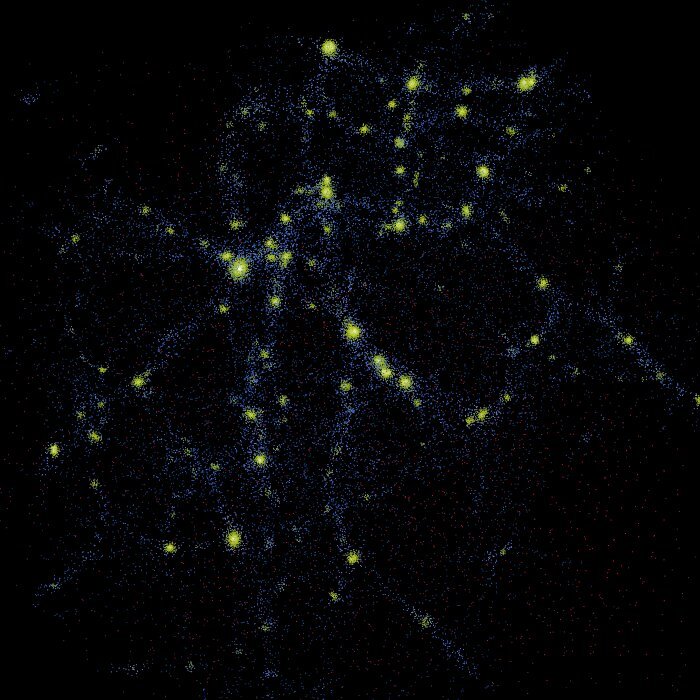
Regions that were slightly denser had slightly more gravity. Over hundreds of millions of years, these denser patches attracted more and more matter, eventually collapsing to form the first stars, galaxies, and the vast cosmic web we observe today. The maps of the Cosmic Microwave Background radiation show these primordial temperature variations, a direct snapshot of the quantum seeds that built our universe.
The Graceful Exit
Inflation couldn't last forever. For our universe to exist, the inflaton field had to decay, converting its immense potential energy into the matter and radiation of the standard hot Big Bang. This transition is known as reheating.
Returning to our analogy, the ball rolling down the gentle slope eventually reached a steeper part of the hill leading to a deep valley. As the inflaton field rolled into this minimum potential energy state, it began to oscillate rapidly around the bottom. These oscillations decayed, much like a swinging pendulum slows due to friction. The energy wasn't lost; it was transferred into a bath of elementary particles, heating the universe to extreme temperatures and kicking off the next phase of cosmic evolution.
With reheating complete, the story of the Big Bang as we traditionally know it begins. A hot, dense plasma of quarks, leptons, and bosons filled a now vast and geometrically flat universe, seeded with the tiny density variations needed to build the cosmos.
Let's review the key mechanics of this pivotal cosmic moment.
What is the primary role of the hypothetical inflaton field during the period of cosmic inflation?
How does the theory of inflation solve the 'flatness problem'?
Cosmic inflation provides a powerful explanation for some of the deepest mysteries of our universe's origins, connecting the quantum jitters of the smallest scales to the grandest structures we can see.