Cosmic Origins
Introduction to Cosmology
The Biggest Questions
Where did everything come from? What is it made of? How will it all end? Humans have asked these questions for thousands of years. Today, the scientific field dedicated to answering them is called cosmology.
Cosmology
noun
The scientific study of the origin, evolution, and eventual fate of the universe.
Cosmologists study the universe as a single, connected object. They investigate its grand structure, from the tiniest moments after its birth to the vast web of galaxies we see today. It’s a bit like being a detective at the scene of the ultimate crime: the beginning of existence itself. The clues are written in the light from distant stars and the faint afterglow of creation.
The Scale of Everything
The universe is unimaginably vast. Thinking about its size can be dizzying, so let's build up the scale step by step, starting from our home.
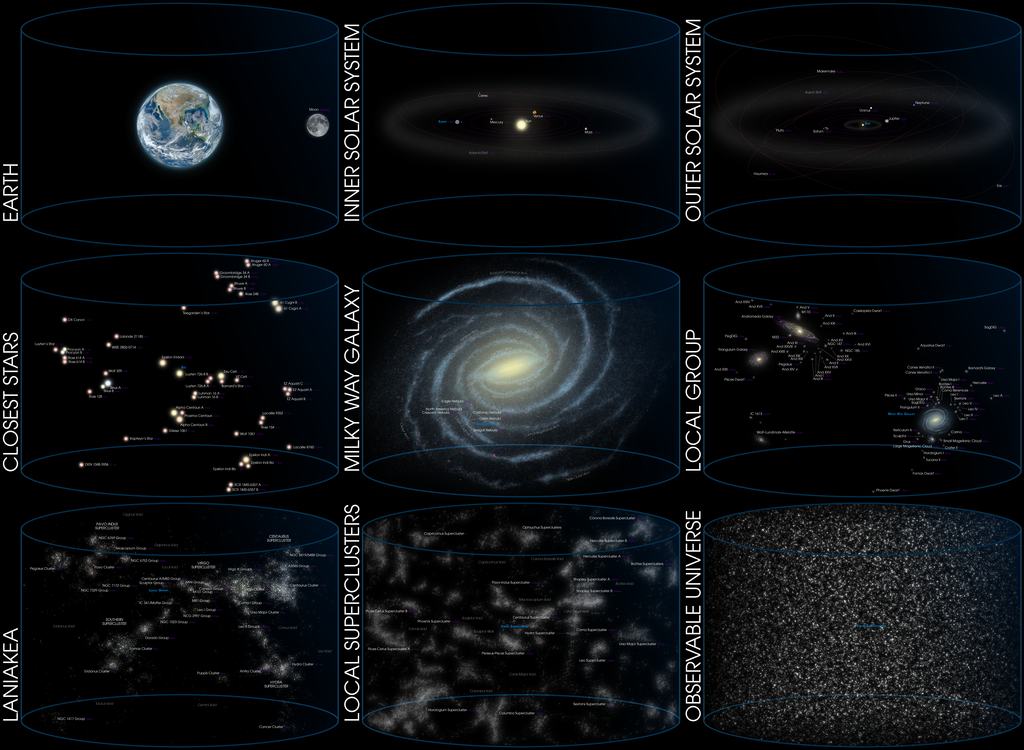
We live on a planet, Earth, which is part of a solar system. Our solar system is just one of billions in the Milky Way galaxy. And the Milky Way is just one of hundreds of billions of galaxies in the part of the universe we can see.
This region is called the observable universe. It's a sphere with us at the center, but that doesn't mean we're in a special spot. It just means there’s a limit to how far we can see. The universe is about 13.8 billion years old, so light from any object farther than 13.8 billion light-years away simply hasn't had time to reach us yet. That distance marks our cosmic horizon.
Cosmic Messengers
So how do we study things that are billions of light-years away? We rely on cosmic messengers, primarily light. When we look at a distant galaxy, we are not seeing it as it is today. We are seeing it as it was when the light left it, perhaps millions or even billions of years ago.
Looking out into space is the same as looking back in time. This is a powerful tool. It allows astronomers to see galaxies in their infancy and piece together the story of how the universe grew up.
Telescopes are time machines. The farther they look, the deeper they see into the past.
Scientists study light by breaking it down into its different colors, a spectrum. The spectrum of a star or galaxy can tell us what it's made of, how hot it is, and how it's moving. One crucial observation is that light from almost all distant galaxies is stretched to longer, redder wavelengths. This phenomenon is called redshift, and it's the key piece of evidence that our universe is expanding.
Space and Time
Modern cosmology is built on Albert Einstein's theory of general relativity. One of its most profound ideas is that space and time are not separate things. They are woven together into a single, four-dimensional fabric called spacetime. Massive objects like stars and galaxies warp this fabric, and this warping is what we feel as gravity.
This concept is fundamental to understanding the universe. The expansion of the universe isn't galaxies flying apart through space. It's space itself that is stretching, carrying the galaxies along with it. The study of the universe is ultimately the study of spacetime and everything within it.
Let's review these foundational concepts before moving on.
What is the primary focus of the scientific field of cosmology?
What fundamentally limits the size of the "observable universe"?