Cosmic Inflation Explained
Big Bang Theory
The Beginning of Everything
Our universe began in an instant. About 13.8 billion years ago, everything we know—all space, time, matter, and energy—was concentrated into an infinitesimally small, hot, and dense point. This starting point is often called the initial singularity.
Singularity
noun
A point in spacetime where the density of matter and the gravitational field are predicted to be infinite. In the context of the Big Bang, it represents the initial state of the universe.
From this single point, the universe didn't explode into an existing space. Instead, space itself began to expand rapidly, carrying all the energy and matter with it. This was not an explosion in the conventional sense, but the start of an ongoing expansion that continues today.

From Hot Soup to First Atoms
In its first moments, the universe was a chaotic, searingly hot soup of pure energy. As it expanded, it also cooled down. This cooling was critical. Within the first second, some of this energy converted into the fundamental building blocks of matter: subatomic particles like protons, neutrons, and electrons.
For the next few minutes, the universe was still incredibly hot and dense, like the core of a star. In this cosmic furnace, protons and neutrons fused together to form the nuclei of the first elements. This process is called Big Bang Nucleosynthesis.
By the time the universe was about three minutes old, the basic ingredients of matter were set. Almost all the hydrogen and helium that exists today was created in this short period.
However, it was still too hot for stable atoms to form. Electrons zipped around freely, unbound to any nuclei. The universe was an opaque, glowing fog. It took another 380,000 years of cooling for things to calm down enough for electrons to be captured by nuclei, forming the first stable, neutral atoms of hydrogen and helium. At this point, the universe became transparent for the first time.
Echoes of the Beginning
The Big Bang theory isn't just a good story; it's supported by powerful evidence. One of the most important pieces is the Cosmic Microwave Background (CMB). This is the faint, leftover heat from the Big Bang, a kind of afterglow that fills the entire universe.
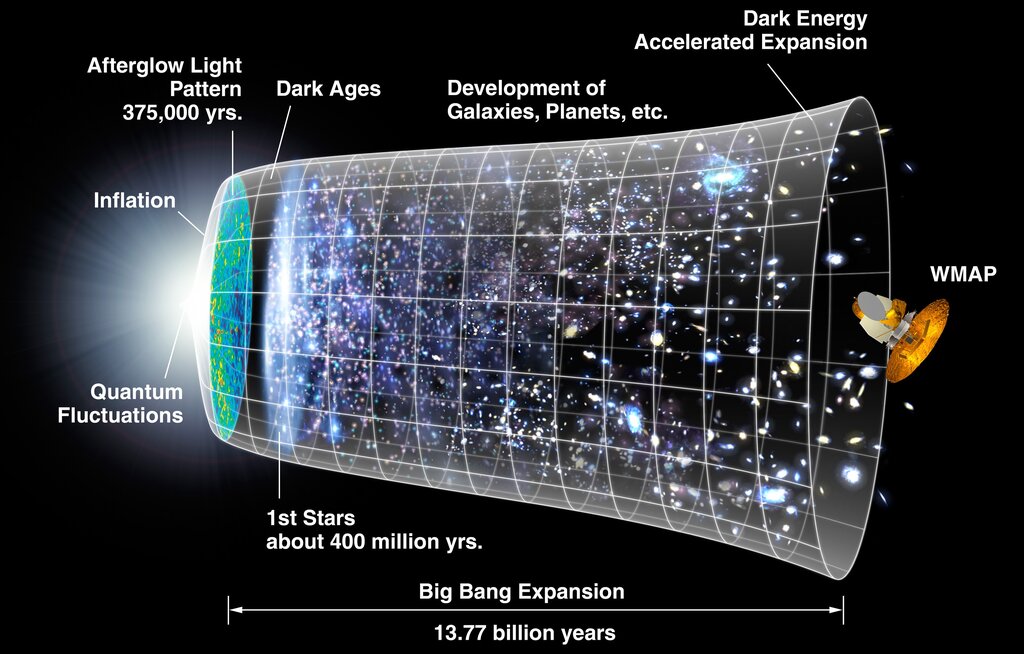
When the universe became transparent, light was finally able to travel freely through space. The CMB is that very first light, stretched out over billions of years of cosmic expansion into the microwave part of the spectrum. It's a snapshot of the infant universe, and its existence is a direct prediction of the Big Bang model.
One of the most compelling pieces of evidence for the Big Bang is the Cosmic Microwave Background (CMB) radiation.
Another key piece of evidence is the abundance of light elements. The theory predicts very specific amounts of hydrogen and helium that should have been created in the first few minutes. When astronomers look at the oldest stars and most distant galaxies, the amounts of hydrogen and helium they observe match these predictions with remarkable accuracy.
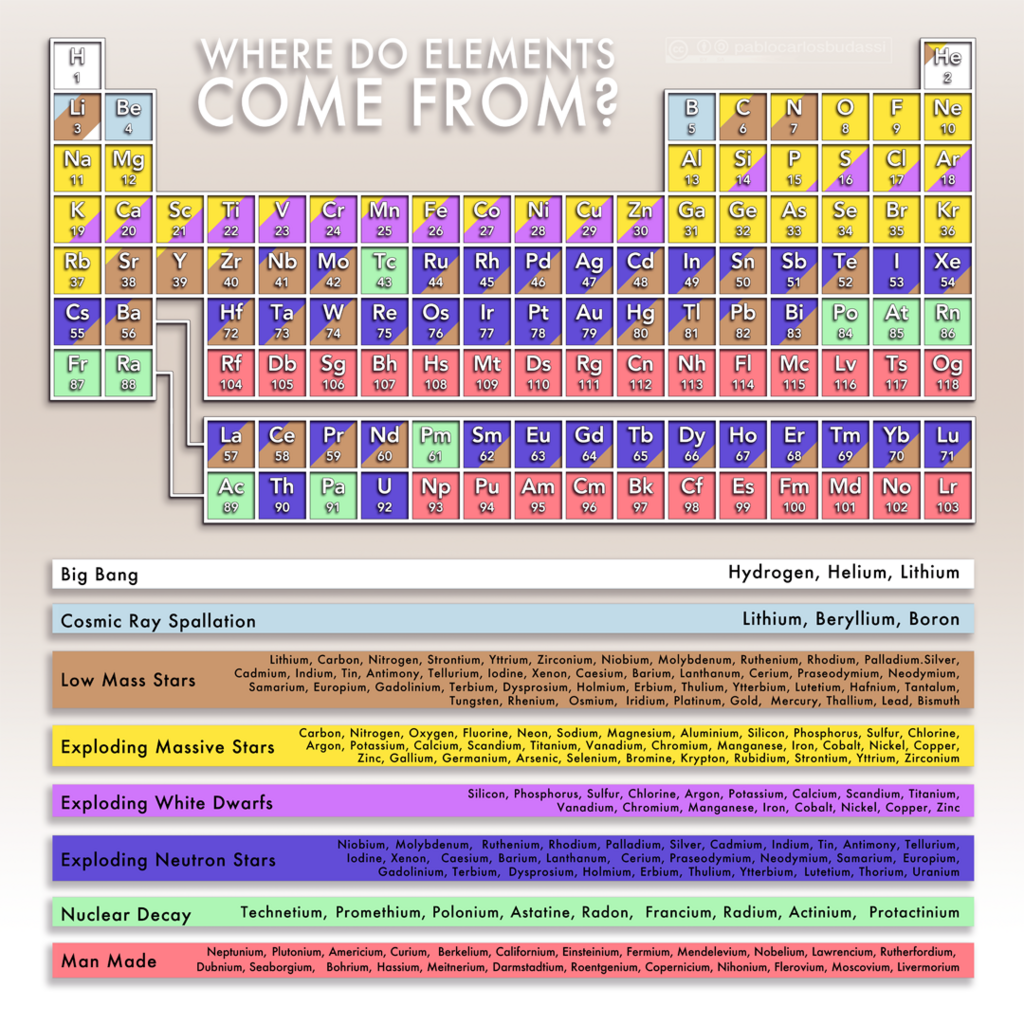
These two pillars of evidence, the CMB and the precise mix of the first elements, provide strong support for the idea that our universe began with a Big Bang.
Which statement best describes the expansion of the universe immediately following the Big Bang?
What is the Cosmic Microwave Background (CMB)?
The Big Bang theory provides the foundation for our entire understanding of cosmic history, describing how a hot, dense beginning evolved into the vast and complex universe we see today.