Cosmic Creation Energy and Matter
Big Bang Theory
The First Moment
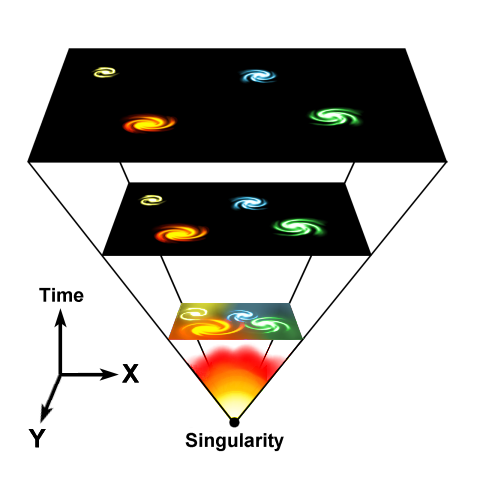
About 13.8 billion years ago, everything in the known universe was compressed into a single, unimaginably hot and dense point. This state is often called the initial singularity. It contained all the matter and energy that would eventually become galaxies, stars, planets, and everything on them.
The Big Bang wasn't an explosion in space. It was the expansion of space itself.
In the very first fraction of a second, the universe underwent an incredible growth spurt called cosmic inflation. In a sliver of time too small to comprehend, space expanded exponentially, faster than the speed of light. Imagine a tiny dot on a balloon. As you inflate the balloon, the dot grows and the surface of the balloon stretches out. Inflation stretched the fabric of spacetime in a similar way, smoothing out the universe and setting the stage for everything that followed.
A Primordial Soup
As space expanded, it also cooled down. The extreme energy that filled the universe began to transform into matter, a process governed by Einstein's famous equation, . This didn't happen all at once. The first things to emerge were the most basic building blocks of reality: fundamental particles.
For the first few microseconds, the universe was a chaotic, sizzling soup of quarks, electrons, photons, and other elementary particles. It was too hot for protons and neutrons to form. Particles and their antimatter counterparts were constantly being created and destroyed, popping in and out of existence in a flicker of energy.
Forces Go Their Separate Ways
Today, we experience four fundamental forces of nature: gravity, electromagnetism, and the strong and weak nuclear forces. But physicists believe that in the extreme conditions of the early universe, these forces were united as a single 'superforce.'
As the universe expanded and cooled, this unified force began to split apart in a process called symmetry breaking. Gravity was the first to separate. A fraction of a second later, the strong nuclear force broke away. Finally, the electromagnetic and weak forces went their separate ways. This separation of forces was a critical step that allowed for the structure we see in the universe today.
Echoes of the Beginning
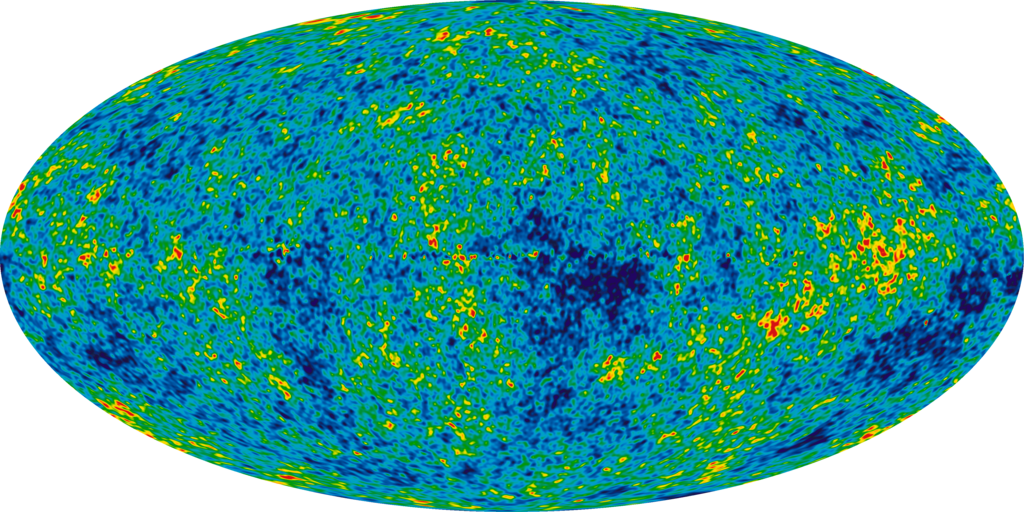
The Big Bang theory is not just a compelling story; it's supported by a wealth of evidence. One of the strongest pieces is the Cosmic Microwave Background (CMB). This is a faint glow of radiation that fills all of space. It's the leftover heat from the Big Bang, a sort of 'afterglow' from when the universe was just 380,000 years old. Before this time, the universe was an opaque fog of charged particles and light. As it cooled enough for atoms to form, light was set free to travel across the cosmos, and we can still detect it today as the CMB.
Another key piece of evidence is the abundance of light elements. The theory predicts how much hydrogen and helium should have been created in the first few minutes after the Big Bang. When astronomers measure the amounts of these elements in the universe, the numbers match the predictions with remarkable accuracy. This tells us our understanding of that primordial furnace is on the right track.
Finally, the fact that the universe is still expanding supports the theory. Astronomers observe that distant galaxies are moving away from us, and the farther away they are, the faster they are moving. This is exactly what you would expect to see if the entire universe began from a single point and has been expanding ever since.
Ready to check your understanding of the universe's first moments?
What does the theory of cosmic inflation describe?
Which of the following is considered the 'afterglow' of the Big Bang, providing strong evidence for the theory?
From a tiny point to a vast cosmos, the Big Bang theory provides a powerful explanation for the origin and evolution of our universe. It connects the infinitesimally small world of particles with the grand scale of galaxies.