Cosmic Architecture and Evolution
Stellar Evolution Cycles
The Stellar Balancing Act
A star's life is a constant battle between two colossal forces. Gravity relentlessly tries to crush everything inward, while the outward pressure from nuclear fusion pushes back. This delicate balance, known as hydrostatic equilibrium, is what keeps a star stable for billions of years.
For stars like our Sun, the primary fusion process is the proton-proton chain, where hydrogen nuclei are fused directly into helium. But in stars more massive than about 1.3 times our Sun, a different, more powerful engine takes over. Higher core temperatures and pressures unlock the , a catalytic process where carbon, nitrogen, and oxygen act as middlemen to fuse hydrogen into helium much more efficiently.
This furious burning in massive stars creates heavier elements but also seals their fate. They burn through their hydrogen fuel far more quickly. When the hydrogen in the core is exhausted, the outward fusion pressure falters. Gravity begins to win, and the core contracts and heats up, igniting helium fusion and causing the star's outer layers to swell dramatically, turning it into a red giant or supergiant.
The Point of No Return
As a star exhausts its fuel, gravity continues to squeeze the core. For lower-mass stars, this crush is eventually halted by a quantum mechanical phenomenon called electron . The electrons are packed so tightly that the laws of quantum mechanics prevent them from being squeezed any further. This creates an incredibly dense stellar remnant: a white dwarf.
A white dwarf is a dead star, no longer producing energy. It's simply cooling down over trillions of years. However, there's a limit to how much mass degeneracy pressure can support.
This is the , calculated to be about 1.44 times the mass of our Sun. If a white dwarf's core exceeds this mass, electron degeneracy pressure fails catastrophically. The core collapses in an instant, triggering a runaway thermonuclear explosion that obliterates the entire star. This is a Type Ia supernova. It often happens in binary systems where a white dwarf siphons material from a companion star, pushing it over the limit.
The Supernova Forge
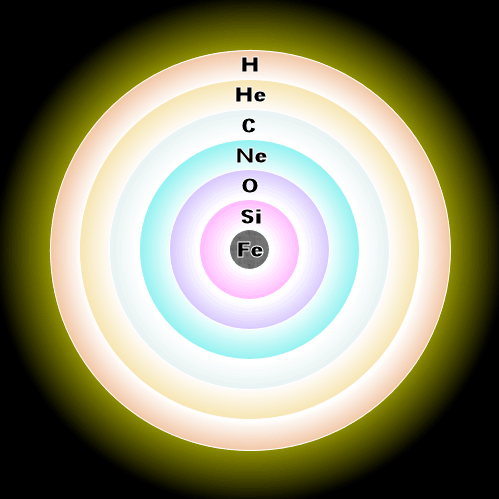
Massive stars (those more than eight times the Sun's mass) have a much more dramatic end. They fuse progressively heavier elements in their cores—carbon, neon, oxygen, silicon—until they create a core of iron. Iron is the ultimate stellar ash; fusing it consumes energy rather than releasing it. Fusion stops, and the outward pressure vanishes.
In less than a second, the iron core collapses under its own immense gravity, shrinking from the size of Earth to a ball just a few kilometres across. The core's temperature skyrockets. This sudden collapse and rebound create a titanic shockwave that blasts the star's outer layers into space. This is a Type II supernova.
The explosion is so violent that it forges elements heavier than iron—gold, platinum, uranium—and scatters them across the galaxy. These elements become the raw materials for new stars, planets, and even life.
The iron in your blood and the calcium in your bones were all forged in the heart of an exploding star billions of years ago. We are, quite literally, made of stardust.
What's left behind depends on the mass of the collapsing core. If it's between about 1.4 and 3 solar masses, the collapse is halted by neutron degeneracy pressure, forming an incredibly dense object called a neutron star. A teaspoon of neutron star material would weigh billions of tonnes.
If the core's mass is greater than about 3 solar masses, nothing can stop the gravitational collapse. It continues to shrink until it becomes a singularity, a point of infinite density. This creates a black hole, a region of spacetime where gravity is so strong that not even light can escape.
Time to see if you've grasped the life and death of stars.
What is the term for the delicate balance between the inward pull of gravity and the outward push of fusion pressure that keeps a star stable?
In stars significantly more massive than our Sun, the primary process for fusing hydrogen into helium is the _______.
From the quiet hum of the CNO cycle to the cataclysmic blast of a supernova, the death of a star is also a moment of creation, seeding the universe with the building blocks for the next stellar generation.