Core Tenets of Buddhist Philosophy
Dependent Origination Logic
The Web of Causation
You've encountered the Four Noble Truths, which diagnose the reality of suffering and outline the path to its end. But what is the underlying logic that powers this cycle of suffering, or samsara? The answer is a principle called Pratītyasamutpāda, often translated as Dependent Origination or Interdependent Co-arising. This isn't a simple, linear chain of cause and effect like one domino knocking over the next. It's a complex, self-reinforcing web where every phenomenon arises only because of specific supporting conditions. Nothing exists in a vacuum. The philosopher famously used this principle to build his case for emptiness (śūnyatā), arguing that because everything is dependently arisen, nothing possesses a permanent, independent self.
When this is, that is. When this arises, that arises. When this is not, that is not. When this ceases, that ceases.
This elegant formula captures the essence of conditionality. It's a universal law that applies to everything from the formation of a star to a fleeting thought. When applied to our own experience, it reveals the precise mechanics of how suffering is constructed, moment by moment.
The Twelve Links of Suffering
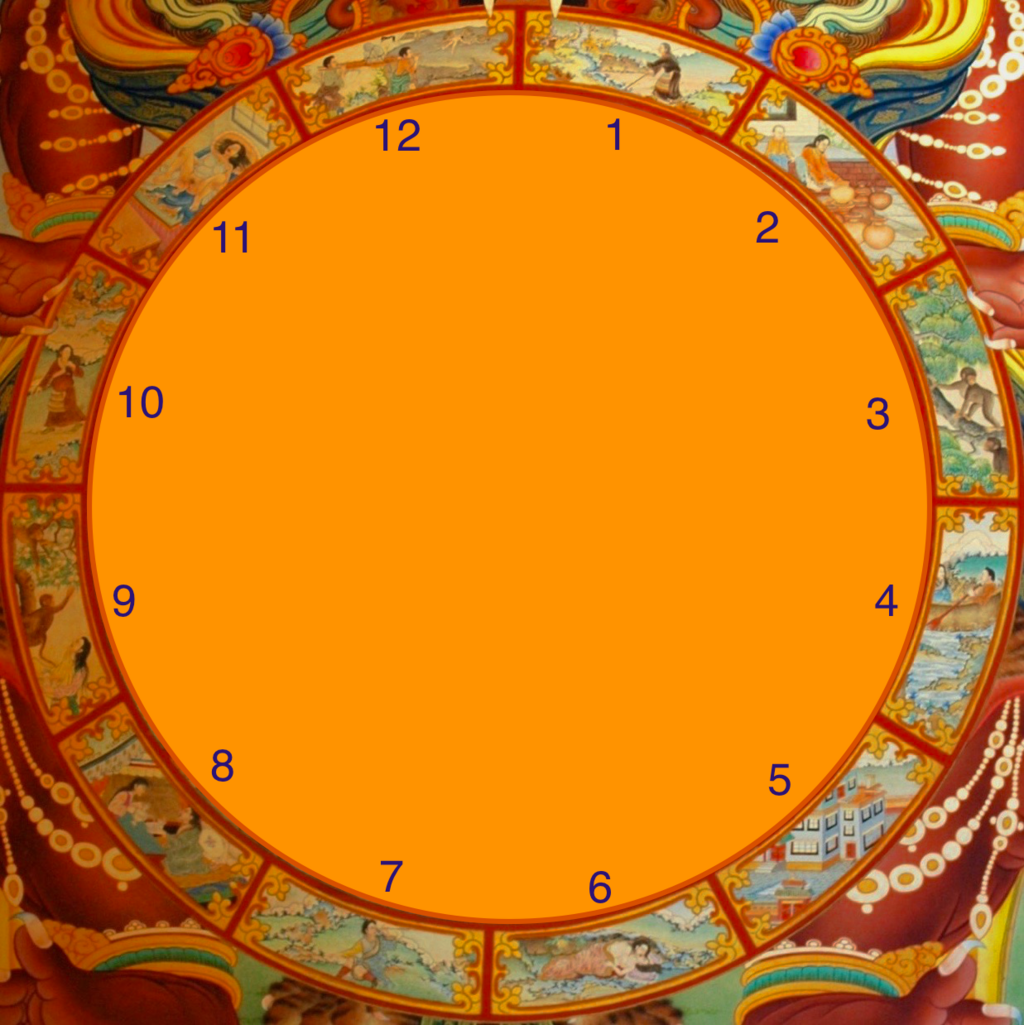
To make this abstract principle concrete, Buddhist teachings break it down into a twelve-part chain called the Twelve Nidānas (links). These links describe how a being is bound to the cycle of rebirth and suffering. They form a feedback loop, not a straight line, where the end feeds back into the beginning.
| Link | Sanskrit/Pali Name | Meaning |
|---|---|---|
| 1 | Avidyā | Ignorance (of the Four Noble Truths) |
| 2 | Saṃskāra | Formations (Volitional Actions) |
| 3 | Vijñāna | Consciousness |
| 4 | Nāmarūpa | Name and Form (Mind and Body) |
| 5 | Ṣaḍāyatana | Six Sense Bases (Eyes, Ears, etc.) |
| 6 | Sparśa | Contact |
| 7 | Vedanā | Feeling (Pleasant, Unpleasant, Neutral) |
| 8 | Tṛṣṇā | Craving or Thirst |
| 9 | Upādāna | Clinging or Grasping |
| 10 | Bhava | Becoming (Existence) |
| 11 | Jāti | Birth |
| 12 | Jarāmaraṇa | Aging and Death |
It begins with ignorance (Avidyā)—a fundamental misunderstanding of reality. This ignorance conditions our actions (Saṃskāra), which in turn shapes our consciousness (Vijñāna), and so on, through the sensory experiences that lead to craving (Tṛṣṇā) and clinging (Upādāna). This process fuels our continued existence (Bhava), leading inevitably to birth, aging, and death, which creates the conditions for ignorance to arise once more. This cycle is famously depicted in the Buddhist painting, or Bhavacakra.
Impermanence and Emptiness
Dependent Origination is deeply tied to the Three Marks of Existence: impermanence (anicca), suffering (dukkha), and not-self (anatta). The connection is especially clear with impermanence. If everything that exists is subject to change and decay, it cannot possibly have a fixed, independent, or inherent identity. Its existence is contingent—it depends on the coming together of conditions, and it ceases when those conditions fall away.
Think of a flame. A flame is not a static 'thing'. It is a process that depends on fuel, oxygen, and heat. Take away any one of these conditions, and the 'flame' disappears. The flame has no inherent existence; it is a dependently arisen phenomenon. The same is true for the 'self'. It's a process, not a permanent entity. This lack of inherent, independent existence is the meaning of emptiness (śūnyatā).
Because phenomena are impermanent, they must be dependent. Because they are dependent, they must be empty of inherent existence.
Understanding this logic is transformative. It reveals that the links in the chain of suffering are not inevitable laws but conditional patterns. If you can remove a condition, you can stop the effect. By cutting the link of ignorance through wisdom, the entire samsaric feedback loop unravels.
Let's test your understanding of how these concepts fit together.
What is the core idea of Pratītyasamutpāda, or Dependent Origination?
The philosopher Nāgārjuna famously used the principle of Dependent Origination to argue for the concept of śūnyatā. What does śūnyatā mean in this context?
This principle is the engine of samsara, but it is also the key to liberation. By seeing how things truly are—as conditional, impermanent, and interconnected processes—we can cease to cling to them, breaking the cycle for good.