Core Principles and Applications of Chemistry
Quantum Atomic Structure
Beyond Fixed Orbits
The old picture of an atom, with electrons circling the nucleus like tiny planets, is a useful starting point. But it's not the whole story. In reality, electrons don't follow neat, predictable paths. Instead, they exist in a cloud of probability. We can't say exactly where an electron is at any given moment, only where it's likely to be.
This fundamental shift in thinking comes from the , one of the cornerstones of quantum mechanics. It states that there's a limit to how well we can know certain pairs of properties simultaneously. For an electron, we can't know both its exact position and its exact momentum (its velocity and direction) at the same time. The more precisely we measure one, the less precisely we know the other.
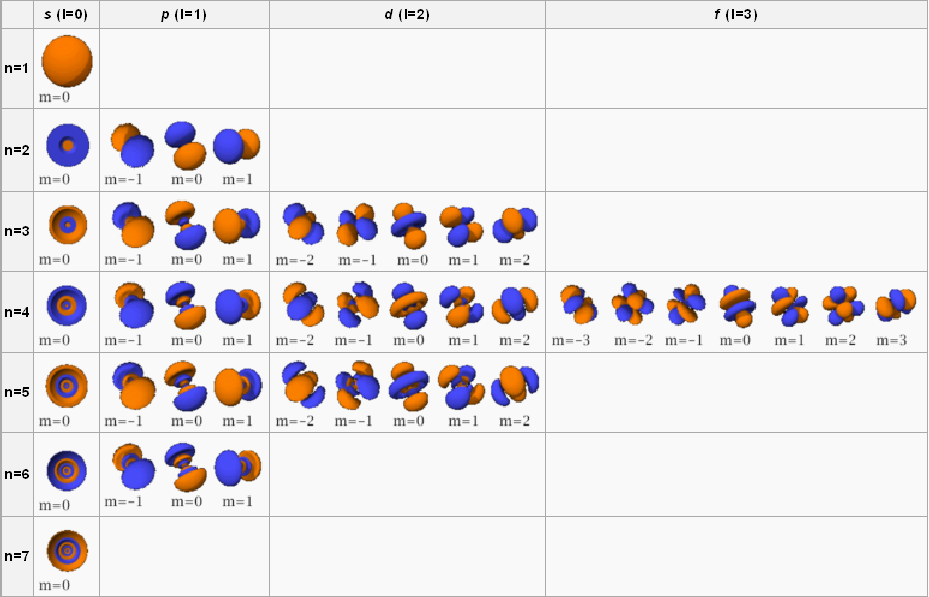
Because of this uncertainty, we talk about orbitals: three-dimensional regions around the nucleus where an electron has a high probability of being found.
An Electron's Address
If orbitals are the 'houses' where electrons live, quantum numbers are their specific addresses. Every electron in an atom has a unique set of four quantum numbers that describe its energy, shape, orientation, and spin. No two electrons in the same atom can have the exact same set. This is known as the Pauli Exclusion Principle.
| Quantum Number | Symbol | Describes | Possible Values |
|---|---|---|---|
| Principal | Energy level & size | (positive integers) | |
| Angular Momentum | Orbital shape (subshell) | ||
| Magnetic | Orbital orientation | ||
| Spin | Electron spin | or |
The principal quantum number, , tells us the main energy level, or shell, of the electron. Higher values of mean the electron is, on average, farther from the nucleus and has more energy. This corresponds to the rows (periods) in the periodic table.
The angular momentum quantum number, , defines the shape of the orbital. These shapes are so important they have letter names: is an 's' orbital (spherical), is a 'p' orbital (dumbbell-shaped), is a 'd' orbital, and is an 'f' orbital. The magnetic quantum number, , then specifies the orbital's orientation in 3D space. For example, the three p orbitals () are aligned along the x, y, and z axes.
Filling the Orbitals
With the rules in place, we can determine the electron configuration of any atom, which is the specific arrangement of its electrons in orbitals. This arrangement follows a few key principles that lead to the lowest possible energy state for the atom.
First, the (from the German for "building up") states that electrons fill the lowest-energy orbitals available before moving to higher-energy ones. The general order of filling is 1s, 2s, 2p, 3s, 3p, 4s, 3d, 4p, and so on.
A common mistake is thinking the 4s orbital has more energy than the 3d. While its principal quantum number is higher, orbital interactions cause the 4s orbital to actually be slightly lower in energy than the 3d, which is why it fills first.
When filling orbitals within the same subshell (like the three p orbitals or the five d orbitals), we follow Hund's Rule. This rule says that you place one electron in each orbital of the subshell before you start pairing any of them up. Furthermore, all the unpaired electrons will have the same spin (either all or all ). Think of it like people getting on a bus: everyone takes an empty row before someone sits next to a stranger. This arrangement minimizes the electrostatic repulsion between electrons, making the atom more stable.
Together, these principles explain the structure of the periodic table. Elements in the same column (group) have similar valence electron configurations, which is why they have similar chemical properties.
Forces at Play
An electron doesn't feel the full positive charge of the nucleus. The inner-shell electrons get in the way, creating a screening or shielding effect. This reduces the pull the outermost (valence) electrons feel.
The net positive charge experienced by an electron is called the effective nuclear charge (). We can estimate it with a simple formula:
is crucial for understanding periodic trends. As you move from left to right across a period, the number of protons () increases, but the number of inner-shell electrons () stays the same. This means increases, pulling the valence electrons closer to the nucleus and making the atom smaller.
This stronger pull also explains why it's harder to remove an electron (higher ionization energy) and why atoms have a stronger attraction for bonding electrons (higher electronegativity) as you move across a period.
Which principle states that it's impossible to know both the exact position and the exact momentum of an electron at the same time?
Which of the following sets of quantum numbers () is NOT allowed for an electron in an atom?