Core Pillars of Computer Science
Low Level Architecture
The CPU's Rhythm
At its heart, a Central Processing Unit (CPU) has one primary job: to execute instructions. It doesn't understand your high-level code directly. Instead, it works with a stream of simple machine code instructions, a binary language translated from your program by a compiler. To process these, the CPU follows a relentless, clock-driven rhythm known as the instruction cycle, or the fetch-decode-execute cycle.
It's a simple, four-step dance: fetch an instruction, decode what it means, execute the action, and then write back the result.
First, the CPU fetches an instruction from a memory address. The address of the next instruction is kept in a special register called the Program Counter. Once fetched, the instruction is placed in the Instruction Register.
Next, the CPU's control unit decodes the instruction. It's like a translator figuring out what operation needs to be performed—is it an addition, a data move, or a comparison? The control unit then directs the necessary signals to other parts of the CPU.
Then, the instruction is executed. This is where the work gets done. The Arithmetic Logic Unit (ALU) might perform a calculation, or data might be moved between registers. Finally, the result of the execution is written back, either to a CPU register or to a location in memory. This cycle repeats billions of times per second.
The Memory Speed Ladder
Fetching instructions and data from memory seems simple, but there's a catch: modern CPUs are incredibly fast, while main memory (RAM) is relatively slow. If the CPU had to wait for RAM every single time it needed something, the entire system would grind to a halt. This is known as the and it's a fundamental problem in computer architecture.
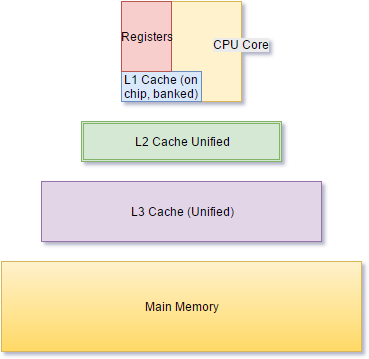
To solve this, engineers created a memory hierarchy. The idea is to place small amounts of extremely fast memory closer to the CPU to store frequently used data. This creates a tiered system, a ladder of memory types, each faster and smaller than the last.
At the very top are registers, tiny storage locations built directly into the CPU. They are the fastest memory available, holding the immediate data the CPU is working on, like the two numbers being added or the result of a comparison. Accessing a register is virtually instantaneous.
Just below registers are the caches: L1, L2, and sometimes L3. A is a small, fast memory that stores copies of data from frequently used main memory locations. When the CPU needs data, it checks L1 first. If it's there (a 'cache hit'), great! If not (a 'cache miss'), it checks L2, then L3, and finally, it has to make the slow trip to RAM. Each cache hit saves precious time, dramatically speeding up execution.
Organising Memory
Beyond the caches, the main memory (RAM) is where a program's data lives during execution. But RAM isn't just one big, messy drawer. When a program runs, the operating system allocates it a virtual memory address space, which is typically divided into several segments. Two of the most important are the Stack and the Heap.
| Feature | The Stack | The Heap |
|---|---|---|
| Speed | Very Fast | Slower |
| Size | Fixed, relatively small | Flexible, much larger |
| Allocation | Automatic (by compiler) | Manual (by programmer) |
| Data Lifetime | Temporary (function scope) | Persistent (until freed) |
| Example Data | Local variables, function calls | Objects, large data structures |
The Stack is a highly organised region of memory where data is stored in a Last-In, First-Out (LIFO) order. When a function is called, a 'stack frame' is pushed onto the top of the stack. This frame holds the function's local variables, arguments, and the return address. When the function finishes, its frame is popped off the stack, and all its local data is gone. This process is extremely fast because it just involves moving a single pointer, the stack pointer. However, the stack has a fixed size, and trying to put too much on it can lead to a error.
The Heap, in contrast, is a large, less organised pool of memory available for dynamic allocation. This is where you store data that needs to persist beyond a single function call, or whose size isn't known at compile time. Requesting memory from the heap is slower than using the stack, as the system needs to find a suitable free block of memory. It's the programmer's responsibility to manage this memory—allocating it when needed and, crucially, freeing it when it's no longer in use to prevent memory leaks.
Understanding this low-level architecture—from the CPU's cycle to the hierarchy of memory and how it's organised—is key to writing efficient code. Choices you make in a high-level language have a direct impact on cache hits, stack usage, and ultimately, how fast your program runs on the physical hardware.
What is the correct sequence of steps in the CPU's instruction cycle?
In the memory hierarchy, which type of memory is the fastest for the CPU to access?