Core Frameworks in Philosophical Thought
Systemic Classical Thought
From Questions to Systems
The Socratic method of relentless questioning laid the groundwork for Western philosophy, but it was his successors who began organizing these questions into complete systems of thought. Instead of just asking what virtue is, they started to build frameworks that connected the nature of reality, the purpose of human life, and the ideal way to live. This shift from inquiry to system-building marks a crucial evolution in classical thought.
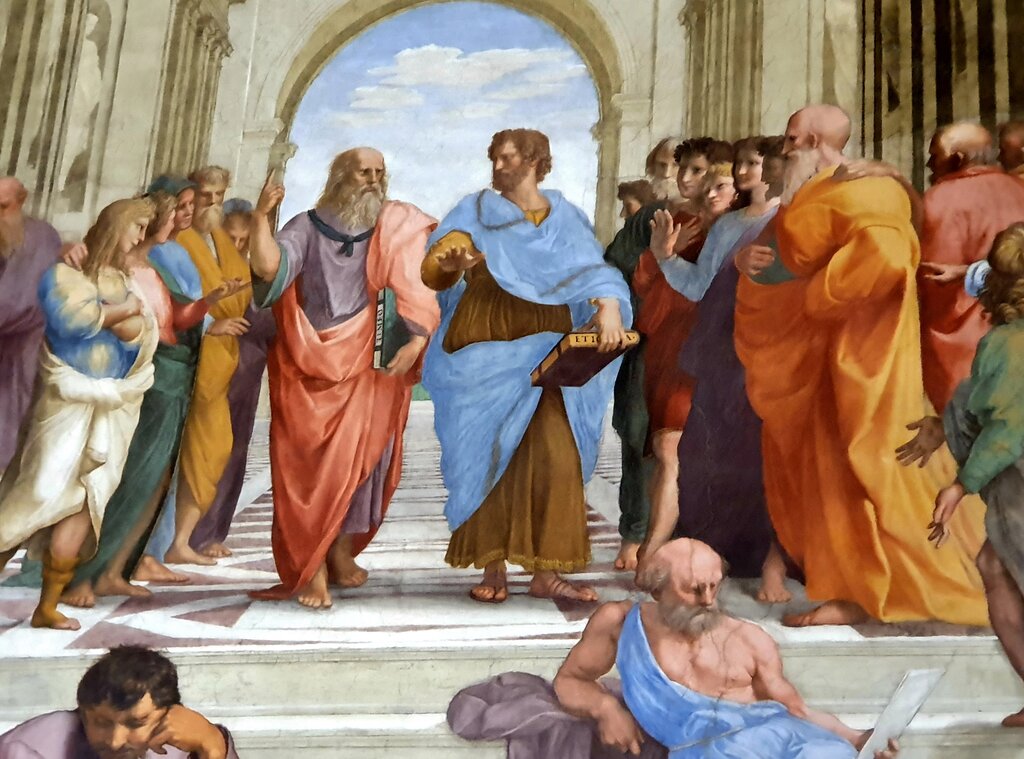
Aristotle was central to this transition. He introduced the concept of teleology, the idea that everything in the universe has an inherent purpose or final cause, which he called its telos. For a knife, the telos is to cut. For an acorn, it is to become an oak tree. For humans, Aristotle argued, our telos is to live a life governed by reason. Achieving this purpose leads to what he termed eudaimonia—a state of human flourishing.
This wasn't just a philosophical exercise. By linking what a thing is to what it is for, Aristotle created a bridge between metaphysics (the study of being) and ethics (the study of how to live).
This connection is the core of his virtue ethics. Virtues are the character traits and habits—like courage, temperance, and justice—that enable a person to fulfill their rational purpose. Being virtuous isn't about following a set of divine rules; it's about acting in a way that perfects our nature as rational beings. The 'good life' is the life of virtuous activity, which naturally results from understanding our own teleology. His system provided a logical, self-contained explanation for how to live, derived from the nature of life itself.
Reality and the Good Life
Aristotle's focus on the observable world put him at odds with his teacher, Plato. This disagreement created one of the most significant divides in philosophical history. Plato was a realist about abstract concepts, believing in a higher reality of perfect 'Forms'—the ideal blueprints for everything we see. For him, the physical world was a mere shadow of this true reality. The good life, therefore, was about using reason to turn away from the flawed physical world and contemplate the perfect Form of the Good.
Aristotle, in contrast, was more of an empiricist. He argued that reality is the world we experience through our senses. There was no separate realm of Forms; the 'form' of a thing existed within the thing itself. This ontological stance—his theory of what is real—directly shaped his ethics. You don't discover goodness by looking to another world; you find it by studying the functions and purposes of things in this world, including ourselves.
This fundamental division extended into political philosophy. In his book The Republic, Plato designed an ideal state ruled by 'philosopher-kings.' These rulers, through their superior ability to grasp the Forms, would be best equipped to organize society justly. The state's structure was a mirror of the human soul, with each class corresponding to a different aspect of the psyche—reason, spirit, and appetite. The goal was a top-down system where social harmony was achieved through rational design based on abstract principles.
The Stoic Synthesis
Later, the Stoics took the idea of a unified system even further. Building on Socratic and Aristotelian ideas, they developed a philosophy where physics, logic, and ethics were inseparable parts of a single, coherent whole. For the Stoics, the universe was a single living entity, a rational organism governed by a divine fire or logos (reason).
As Stoicism developed, it became characterized by a few key tenets: the importance of virtue as the highest good, the practice of rational thought, and the belief that individuals should focus on what lies within their control.
Their physics—the belief in a rational, deterministic cosmos—directly informed their ethics. If the universe is rational, then the good life consists of living in agreement with nature. This meant using our own reason to understand the world's logic and accept our place within it. Emotions like fear, anger, and desire were seen as irrational judgments that arose from fighting against the natural order. By mastering one's inner world, one could achieve a state of tranquility (apatheia) regardless of external circumstances. For the Stoics, understanding 'what is' wasn't just an academic question; it was the only path to living well.
What is the core idea of Aristotle's concept of teleology?
According to Aristotle, achieving eudaimonia (human flourishing) is the result of:
These classical systems show a profound effort to create a unified understanding of existence. They established a lasting tradition in Western thought: the idea that questions about reality and questions about how we should live are not separate, but are two sides of the same coin.