Core Concepts in Modern Artificial Intelligence
Advanced Machine Learning Techniques
Beyond a Single Expert
Imagine you need to make a tough decision. Would you rely on the advice of a single expert, or would you feel more confident polling a committee of diverse experts? Most of us would choose the committee. A single expert might have blind spots, but a group can combine their strengths and cancel out individual weaknesses. Machine learning often works the same way.
While a single, well-trained model can be powerful, it often hits a performance ceiling. The next step is to combine multiple models into an ensemble. This approach, known as ensemble methods, is a cornerstone of advanced machine learning because it consistently produces more accurate and robust predictions.
The Power of Teamwork
Ensemble methods build a strong predictor by strategically combining several weaker ones. Two of the most effective techniques are Random Forests and Gradient Boosting.
A Random Forest is an ensemble of many decision trees. Instead of relying on one complex tree, it builds hundreds or even thousands of smaller, simpler trees. Each tree is trained on a random sample of the data and considers only a random subset of features for each split. To make a prediction, the forest takes a vote: each tree
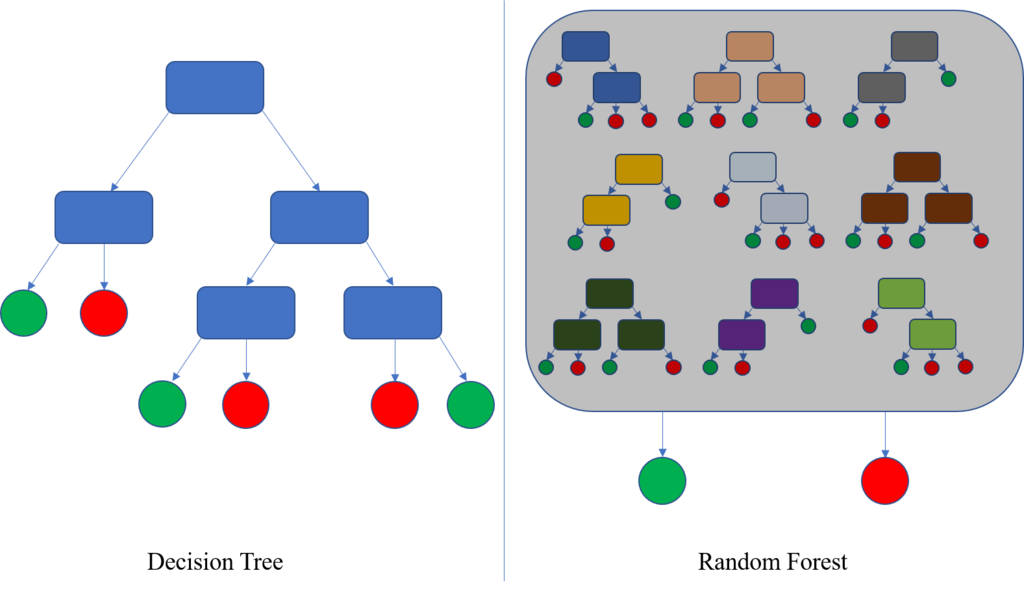
This randomness is key. It ensures the trees are different from one another, capturing different patterns in the data and reducing the risk of overfitting, where a model learns the training data too well but fails to generalize to new, unseen data.
Gradient Boosting takes a different, more collaborative approach. It builds models sequentially, one after another. The first model makes a prediction, and the second model is trained to correct the errors of the first. The third model then corrects the errors of the combined first and second models, and so on. Each new model focuses on the mistakes of the team that came before it, gradually building a highly accurate predictor. It's like a team of builders where each new worker patches up the small imperfections left by the previous one, resulting in a flawless final structure.
Finding the Best Dividing Line
Another powerful technique is the Support Vector Machine (SVM). For classification tasks, an SVM's goal is to find the best possible dividing line, or hyperplane, that separates data points into different classes.
But what makes a dividing line "best"? An SVM seeks the hyperplane that has the maximum possible margin, or empty space, between itself and the nearest data points from each class. These closest points are called support vectors, because they
By maximizing this margin, the SVM creates a decision boundary that is as robust as possible, making it less sensitive to the specific location of individual training points.
What if the data can't be separated by a straight line? SVMs use a clever technique called the kernel trick. They project the data into a higher-dimensional space where a linear separation becomes possible. Imagine trying to separate red and blue marbles mixed together on a plate; a simple line won't work. But if you could toss them into the air (a third dimension), you could easily slide a piece of paper between them. The kernel trick does something similar mathematically, allowing SVMs to solve complex, non-linear problems.
How Good Is Your Model?
Creating a powerful model is only half the battle. We also need to rigorously evaluate its performance. While overall accuracy is a good start, it doesn't tell the whole story, especially when dealing with imbalanced datasets (where one class is much more common than another).
Consider a model that screens for a rare disease. If the disease affects only 1% of the population, a model that always predicts "no disease" would be 99% accurate, but completely useless. To get a clearer picture, we use more nuanced metrics.
| Metric | Question it Answers | Use Case |
|---|---|---|
| Precision | Of all the positive predictions, how many were actually correct? | Minimizing false positives (e.g., spam detection). |
| Recall | Of all the actual positives, how many did we find? | Minimizing false negatives (e.g., medical diagnosis). |
| F1-Score | What is the harmonic mean of Precision and Recall? | Balancing precision and recall is important. |
The F1-score is particularly useful when you need a balance between precision and recall, as it combines both into a single number. A high F1-score indicates that the model has both low false positives and low false negatives.
Fine-Tuning for Peak Performance
Before we can be confident in our evaluation metrics, we need to ensure our testing process is sound. A common mistake is to train and test a model on the same data, which is like giving a student the answers before an exam. A better approach is to split the data into a training set and a testing set.
Cross-validation takes this a step further. In k-fold cross-validation, the data is split into 'k' subsets, or folds. The model is trained on k-1 folds and tested on the remaining fold. This process is repeated k times, with each fold serving as the test set once. The final performance is the average across all k trials. This gives a much more reliable estimate of how the model will perform on unseen data.
Finally, most models have settings, called hyperparameters, that aren't learned from the data but are set before training begins. Examples include the number of trees in a random forest or the 'k' in k-fold cross-validation. The process of finding the optimal combination of these settings is called hyperparameter tuning.
Techniques like Grid Search systematically work through all possible combinations of hyperparameter values, while Random Search tests random combinations, which is often more efficient. By combining robust evaluation like cross-validation with systematic hyperparameter tuning, we can build models that are not just powerful, but also reliable and optimized for the task at hand.
What is the primary advantage of using an ensemble method, like a Random Forest, over a single decision tree?
How does the training process of Gradient Boosting differ from that of a Random Forest?
These advanced techniques represent the tools data scientists use to push the boundaries of model performance, moving from good predictions to great ones.