Conversational Levantine Arabic Essentials
Arabic Alphabet
The Arabic Alphabet
The Arabic script is written from right to left and has 28 letters. Unlike English, where letters mostly stand alone, Arabic letters are cursive and connect to form words, much like handwriting.
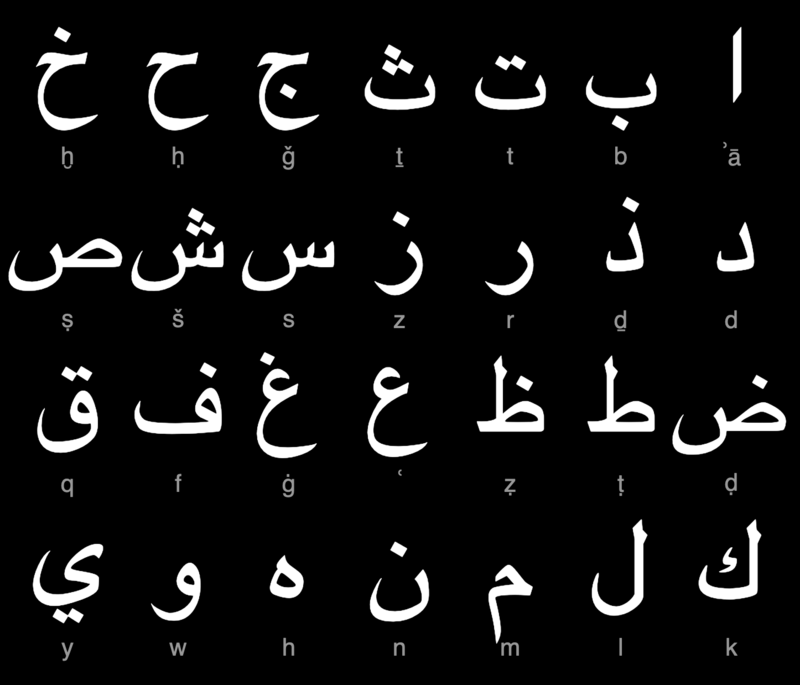
The most important concept to grasp is that a letter's shape changes depending on where it sits in a word. Think of it like a puzzle piece, designed to link up with its neighbors.
Four Forms for Most Letters
Most letters have four distinct shapes based on their position:
- Isolated: When the letter stands alone.
- Initial: When it's the first letter of a word.
- Medial: When it's in the middle of a word, connected on both sides.
- Final: When it's the last letter of a word.
Let's look at the letter ب (bāʾ), which sounds like the 'b' in 'bat'. Notice how its basic shape, a boat with a dot underneath, is adapted to connect to other letters.
| Form | Shape | Example (Word for 'door': باب) |
|---|---|---|
| Isolated | ب | (Stands alone) |
| Initial | بـ | باب (bāb) |
| Medial | ـبـ | (Not in this word) |
| Final | ـب | باب (bāb) |
The small dash shows where the letter connects. The initial form connects to the letter on its left, the medial connects on both sides, and the final form connects to the letter on its right.
The Non-Connecting Letters
Six letters are a bit different. They are sometimes called the 'six selfish letters' because they only connect to the letter before them (to their right). They never connect to the letter that comes after them (to their left).
This creates a small gap in the middle of a word. When you see one of these letters, the letter following it will always start in its initial form, as if it were the beginning of a new word.
These six non-connecting letters are:
| Letter | Name | Sound |
|---|---|---|
| ا | alif | 'a' as in 'car' |
| د | dāl | 'd' as in 'dog' |
| ذ | dhāl | 'th' as in 'that' |
| ر | rāʾ | rolled 'r' |
| ز | zāy | 'z' as in 'zoo' |
| و | wāw | 'w' or 'oo' |
Because they don't connect to the left, these letters effectively only have two forms: an isolated form (used at the beginning of a word or after another non-connector) and a final form (used when connected to a preceding letter).
For example, in the word وَرْد (ward), meaning 'rose,' the و (wāw) doesn't connect to the ر (rāʾ), and the ر (rāʾ) doesn't connect to the د (dāl). All three letters are non-connectors, so the word looks like three separate characters.
The Full Alphabet
Now, let's look at all 28 letters. The table below shows each letter's name, its isolated form, and its sound. Don't worry about memorizing all four forms for every letter just yet. The key is to start recognizing the basic shape of each one.
| Letter | Name | Sound |
|---|---|---|
| ا | Alif | 'a' as in 'car' |
| ب | Bāʾ | 'b' as in 'bat' |
| ت | Tāʾ | 't' as in 'top' |
| ث | Thāʾ | 'th' as in 'think' |
| ج | Jīm | 'j' as in 'jam' |
| ح | Ḥāʾ | Guttural 'h', like breathing on glass |
| خ | Khāʾ | Like the 'ch' in Scottish 'loch' |
| د | Dāl | 'd' as in 'dog' |
| ذ | Dhāl | 'th' as in 'that' |
| ر | Rāʾ | Rolled 'r' |
| ز | Zāy | 'z' as in 'zoo' |
| س | Sīn | 's' as in 'see' |
| ش | Shīn | 'sh' as in 'she' |
| ص | Ṣād | Emphatic 's' |
| ض | Ḍād | Emphatic 'd' |
| ط | Ṭāʾ | Emphatic 't' |
| ظ | Ẓāʾ | Emphatic 'th' as in 'that' |
| ع | ʿAyn | A deep guttural sound from the throat |
| غ | Ghayn | Similar to a French 'r' |
| ف | Fāʾ | 'f' as in 'fan' |
| ق | Qāf | A 'k' sound made deep in the throat |
| ك | Kāf | 'k' as in 'king' |
| ل | Lām | 'l' as in 'light' |
| م | Mīm | 'm' as in 'man' |
| ن | Nūn | 'n' as in 'no' |
| ه | Hāʾ | 'h' as in 'hello' |
| و | Wāw | 'w' or 'oo' sound |
| ي | Yāʾ | 'y' as in 'yes' or 'ee' sound |
The best way to learn these is by practicing. Get a piece of paper and try writing each letter in its isolated form. Pay attention to the dots, which are crucial for distinguishing between letters that share the same basic shape, like ب (b), ت (t), and ث (th).
How many letters are in the Arabic alphabet?
Why do most Arabic letters change their shape?
Recognizing the letters and understanding how they connect is the first major step to reading and writing Arabic. With a little practice, the system will start to feel natural.