Conversational Arabic Essentials
Arabic Script Basics
Right to Left and Always Connected
The first thing to know about the Arabic script is that it flows from right to left. While English marches from the left side of the page to the right, Arabic does the opposite. This takes a little getting used to, but it quickly becomes natural.
The second key feature is that Arabic is almost always cursive. Think of it like English handwriting, where letters in a word are joined together. In Arabic, this isn't just a stylistic choice; it's the standard way of writing. Letters flow into one another to form words, with very few exceptions.
Arabic script is always joined or cursive, ie there is no equivalent of the English text you are now reading, where all the letters have separate forms with spaces between them.
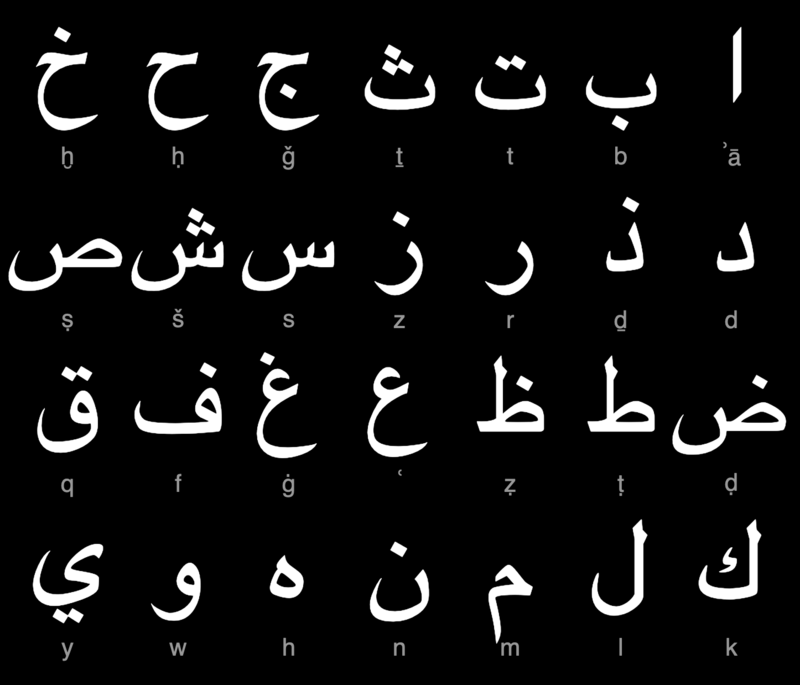
The Arabic alphabet consists of 28 letters. While this might seem like a lot, it's only two more than the English alphabet. Most letters represent consonants, similar to letters like 'b', 't', and 'k' in English. We'll get to vowels in a moment.
Letters Change Shape
Here’s where Arabic script gets really interesting. Because the letters are connected, they change their shape depending on their position in a word. A letter can have up to four different forms:
- Isolated: When the letter stands alone.
- Initial: When it's the first letter in a word.
- Medial: When it's in the middle of a word, connected on both sides.
- Final: When it's the last letter in a word.
This might sound complicated, but there's a clear logic to it. The changes are usually small adjustments that allow the letter to connect smoothly to its neighbors. For example, the letter Baa (ب) looks like a boat with a dot underneath. When it's at the beginning of a word, it loses its final curve to connect to the next letter. In the middle, it's just a simple connector with a dot. At the end, it regains its final curve.
| Letter | Isolated | Initial | Medial | Final |
|---|---|---|---|---|
| Baa (ب) | ب | بـ | ـبـ | ـب |
| Jeem (ج) | ج | جـ | ـجـ | ـج |
| Kaaf (ك) | ك | كـ | ـكـ | ـك |
Notice how the core identity of each letter remains, but its shape adapts to link with other letters. A few letters, sometimes called "non-connectors," only join to the letter before them, never to the letter after. This creates small, natural breaks within words.
Adding the Vowels
So, where are the vowels? Arabic script mainly writes out the consonants and long vowels. Short vowel sounds (like the 'a' in 'cat' or 'u' in 'put') are shown using small marks above or below the letters. These marks are called diacritics.
Here are the three most common ones:
Fatḥah
noun
A short diagonal line above a letter, representing a short 'a' sound.
Kasrah
noun
A short diagonal line below a letter, representing a short 'i' sound.
Ḍammah
noun
A small loop resembling a comma above a letter, representing a short 'u' sound.
In everyday writing like newspapers and websites, these diacritics are often left out. Native speakers can understand the words from context alone, much like an English speaker can read "bldg" and know it means "building." However, in the Qur'an, children's books, and learning materials, you will always see them to ensure correct pronunciation.
Think of diacritics as pronunciation guides. They're essential for learners and for texts where every sound matters.
Let's review these core concepts.
Now, check your understanding of these foundational rules.
What is the primary direction of writing in the Arabic script?
True or False: Connecting letters in Arabic is a stylistic choice, similar to choosing to write in cursive in English.
Understanding these principles of direction, connectivity, and form is the first major step to reading and writing in Arabic. With this foundation, you can begin to recognize letters and piece them together into words.