Consumer Electricity and Solar Power Integration
Electricity Basics
The Language of Electricity
At its heart, electricity is just the movement of tiny particles called electrons. Think of electrical wires like pipes filled with water. The concepts that seem complicated at first become much simpler with this analogy in mind.
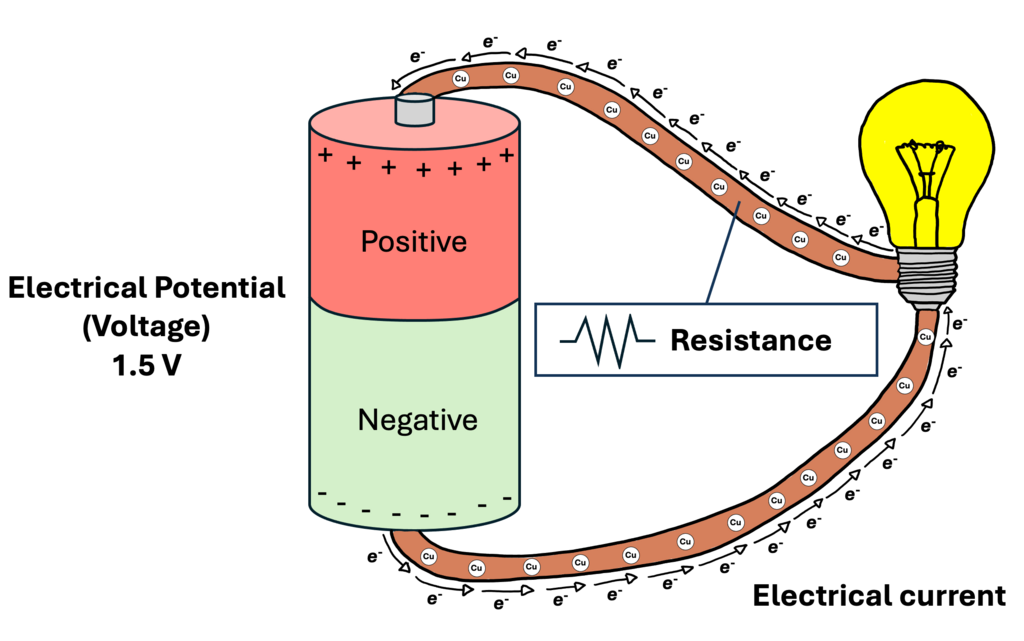
To understand any electrical device, from your phone charger to your refrigerator, you only need to know four basic ideas: voltage, current, resistance, and power. Let's break them down.
Voltage, Current, and Resistance
These three concepts are deeply connected. You can't have one without the others in a working circuit.
Voltage (V) is the pressure that pushes electrons through the wire. In our water analogy, voltage is like the water pressure from the pump. A higher voltage means more push. It's measured in volts.
volt
noun
The unit of electric potential difference or electromotive force.
Current (I) is the rate at which the electrons flow. It's how much charge passes a point in the wire each second. In our analogy, this is the water's flow rate, like gallons per minute. Current is measured in amperes, or amps (A) for short.
Resistance (R) is a measure of how much a material opposes the flow of electrons. A thin pipe has more resistance to water flow than a wide pipe. Similarly, some materials let electrons pass easily (low resistance), while others slow them down (high resistance). This opposition is what allows a light bulb filament to glow or a toaster to get hot. Resistance is measured in ohms ().
ampere
noun
The unit of electric current.
Ohm's Law
These three ideas are tied together by a simple and powerful rule called Ohm's Law. It states that the voltage across a circuit is equal to the current flowing through it multiplied by the resistance.
This relationship is the foundation of circuit analysis. If you know any two of the values, you can always calculate the third. For example, if a small device with a resistance of 100 ohms is powered by a 5-volt USB port, we can find the current.
Using Ohm's Law: . To find the current, we rearrange the formula to . So, .
Power and Work
So, voltage pushes, current flows, and resistance opposes. But how do we measure the actual work being done, like lighting up a room? That's where power (P) comes in. Power is the rate at which electrical energy is converted into another form, like light or heat. It's measured in watts (W).
watt
noun
The unit of power, equivalent to one joule per second.
Calculating power is straightforward. It's simply the voltage multiplied by the current.
Let's say a microwave is plugged into a standard 120V outlet and draws 10A of current while running. The power it consumes is:
, or 1.2 kilowatts (kW).
Since we know Ohm's Law (), we can substitute parts of that equation into the power formula to get other useful versions.
| Formula | When to Use It |
|---|---|
| When you know current and resistance. | |
| When you know voltage and resistance. |
These formulas are what engineers and electricians use every day. They are also what determine the numbers you see on your electricity bill and the specifications printed on all of your devices. Understanding them gives you a new perspective on the powered world around you.
Ready to check your understanding?
In the common analogy of electricity as water flowing through a pipe, what does electrical resistance represent?
Which of the following is the correct formula for Ohm's Law?
By grasping these four pillars—voltage, current, resistance, and power—and the laws that connect them, you've unlocked the fundamental principles of electricity.