Construction Statics and Truss Analysis
Static Equilibrium Principles
Beyond a Simple Push or Pull
In basic mechanics, we often treat objects as single points, or point masses. A force pushes or pulls on this point, and the object moves. But in the real world, especially in construction, we deal with beams, columns, and foundations. These are not points; they are extended objects that have length, width, and height. We model them as , meaning we assume they don’t bend or deform under load.
When a force acts on a rigid body, it doesn't just have the potential to move it left, right, up, or down. It can also make it turn. This turning effect is called a moment, and it's just as important as the force itself for keeping a structure standing still. A building that starts to rotate is just as much a failure as one that collapses downwards.
The Power of Leverage
Imagine using a wrench to tighten a bolt. Pushing on the wrench close to the bolt requires a lot of effort. But if you push on the very end of the handle, the bolt turns much more easily. The force you apply is the same, but its turning effect, the moment, is greater because you increased the distance from the pivot point.
This is the core idea of a moment. It's the product of a force and the perpendicular distance from a pivot point to the line of action of that force. This distance is called the and it acts as a force multiplier.
By convention, moments that cause a counter-clockwise rotation are considered positive, while clockwise rotations are negative. This simple sign convention is crucial for summing up all the turning effects on a component.
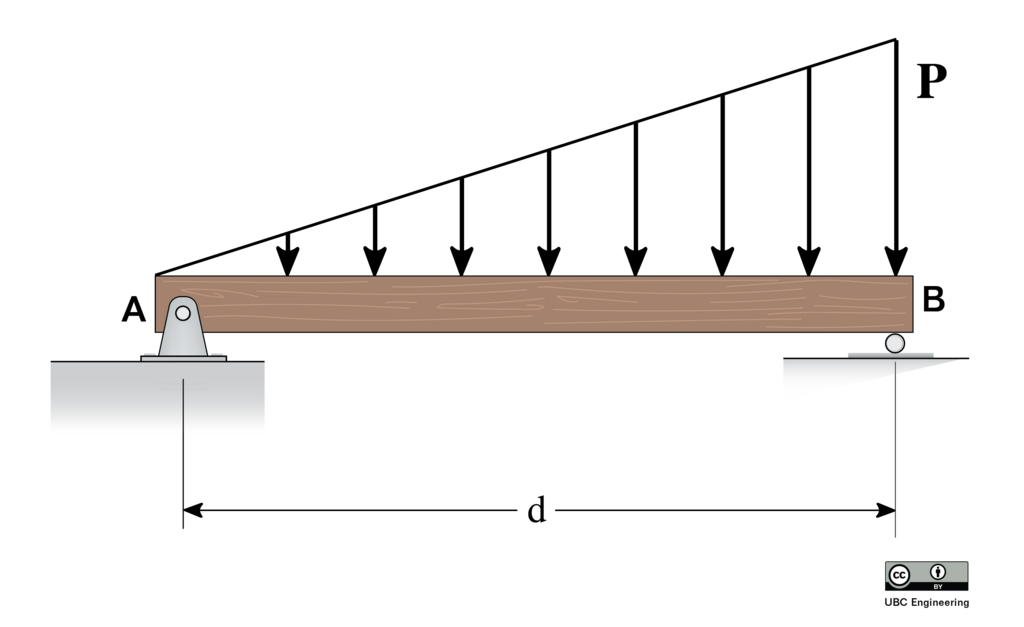
Now that we can account for both linear pushes (forces) and rotational pushes (moments), we can define the conditions for an object to be perfectly still.
The Rules of Staying Still
For a structure to be in static equilibrium, it cannot be moving or rotating. This means the net effect of all forces and all moments must be zero. We can express this with three simple equations for any 2D system:
If these three conditions are met, the object is in static equilibrium. It will not translate, and it will not rotate.
Sometimes, forces work in pairs. Imagine two hands turning a steering wheel. One hand pushes up on the left side while the other pulls down on the right. These two equal and opposite forces are separated by a distance. They don't move the wheel left or right, but they do create a pure turning effect. This is called a or simply a couple.
The magnitude of a couple is the force (F) multiplied by the perpendicular distance (d) between the two forces. Its direction is either clockwise or counter-clockwise.