Constitutional Mechanics and Legal Applications
Federalism Nuances
Dual Sovereignty
In the U.S. system, you're a citizen of two governments at once: your state and the federal government. This is the core of dual sovereignty—a framework where power is divided between these two levels. Neither is completely subordinate to the other; each has its own sphere of authority, creating a constant tension that defines American governance.
This tension is written directly into the Constitution. The Tenth Amendment acts as a guardrail for state power, stating that any authority not explicitly given to the federal government, nor prohibited to the states, is reserved for the states or the people. It's the constitutional basis for states' rights.
The Tenth Amendment: "The powers not delegated to the United States by the Constitution, nor prohibited by it to the States, are reserved to the States respectively, or to the people."
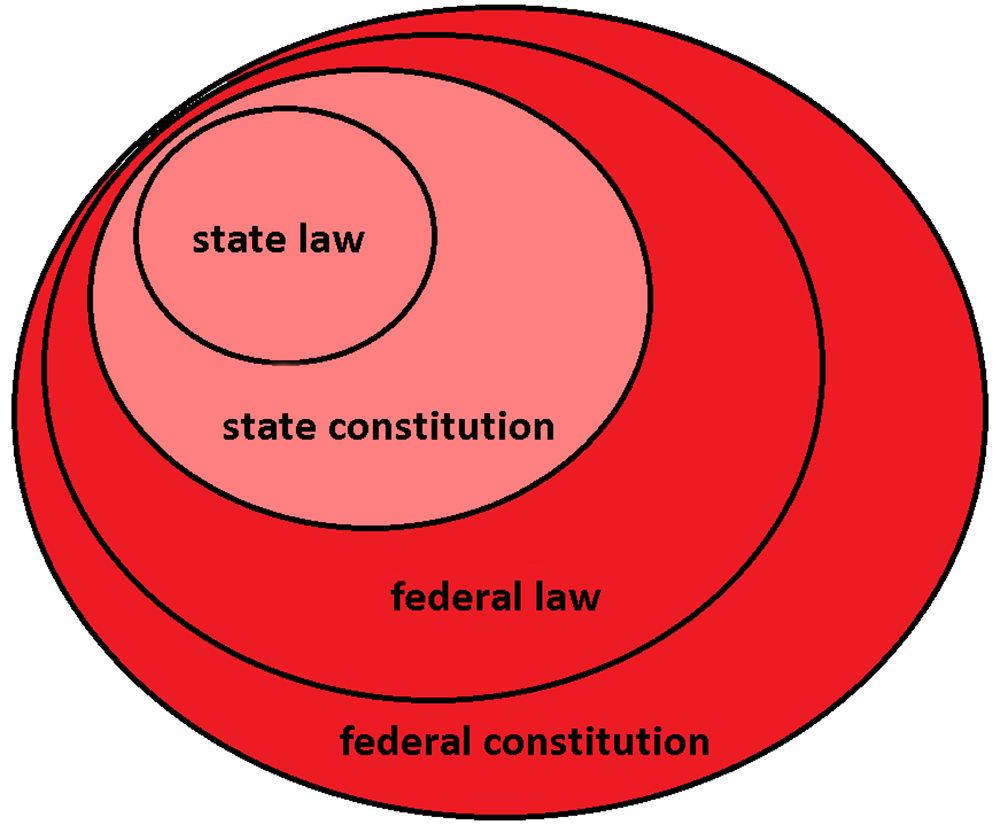
On the other side of the scale is the Supremacy Clause (Article VI, Clause 2). It declares that the Constitution, and federal laws made pursuant to it, are the “supreme Law of the Land.” When a state law conflicts with a valid federal law, the federal law wins. This clause ensures that the federal government can enforce its laws and treaties, preventing a chaotic system where 50 different states could ignore national policy.
The Commerce Clause
The single most important vehicle for the expansion of federal power has been the . Article I, Section 8 of the Constitution gives Congress the power “to regulate Commerce with foreign Nations, and among the several States.” Initially, this was understood to mean regulating the actual transport of goods across state lines.
Over time, the Supreme Court’s interpretation broadened dramatically. The key shift was from regulating commerce between states to regulating economic activity that, in the aggregate, could affect interstate commerce. This interpretation gave the federal government a justification to regulate everything from workplace safety standards to environmental protection.
A famous example is the 1942 case Wickard v. Filburn. The Court ruled that a farmer growing wheat for his own consumption could be regulated by federal quotas because his personal crop, when combined with that of thousands of other farmers, could affect the national wheat market.
The flip side of this is the . This is not a clause in the Constitution, but a legal doctrine inferred from it. It prohibits states from passing legislation that improperly burdens or discriminates against interstate commerce. For example, a state cannot pass a law that taxes goods from a neighboring state at a higher rate than its own goods. This prevents states from engaging in economic protectionism and keeps the national market free and open.
Federalism in Practice
The relationship between state and federal power isn't static. It's often described using two metaphors: layer cake and marble cake.
| Model | Description | Era |
|---|---|---|
| Layer Cake Federalism | Powers are clearly divided, like distinct layers. Each level of government is supreme in its own sphere. | 19th and early 20th century |
| Marble Cake (Cooperative) Federalism | Powers are mixed and responsibilities are shared, like swirls in a marble cake. Often involves federal funding for state-run programs. | Post-New Deal era |
A key tool of cooperative federalism is conditional spending. The federal government often attaches strings to the money it gives to states. These are known as federal mandates. For example, in the 1980s, Congress directed the Secretary of Transportation to withhold a percentage of federal highway funds from any state that did not raise its minimum drinking age to 21. This is a powerful way for the federal government to influence state policy in areas it can't directly control.
Modern issues like healthcare and environmental regulation highlight these tensions. The Affordable Care Act (ACA), a federal law, required states to expand their Medicaid programs or risk losing all federal Medicaid funding. The Supreme Court ruled this was unconstitutionally coercive, making the expansion optional for states. Similarly, when the federal government sets ambitious environmental standards, like vehicle emission limits, some states sue, arguing it infringes on their authority, while others adopt even stricter standards.
What is the principle that a person is a citizen of both their state and the federal government, with power divided between these two levels of government?
The national government successfully pressured states to raise the minimum drinking age to 21 by threatening to withhold federal highway funds. This is an example of what tool of federal influence?
The balance between state and federal power is not a settled question but an ongoing negotiation, shaped by the courts, Congress, and shifting political winds.