Conquering LeetCode Problems
Introduction to Data Structures
Organizing Your Data
Think about how you organize your closet. You might hang shirts, fold pants, and put socks in a drawer. Each method is suited for a different type of clothing. In programming, we organize data in a similar way. These organizational methods are called data structures.
Choosing the right data structure is crucial. It determines how efficiently you can store, access, and modify information. A good choice can make your code run lightning-fast, while a poor one can slow it down to a crawl. Let's look at some of the most fundamental data structures you'll encounter.
The Basic Building Block: Arrays
The simplest data structure is the array. An array is like a row of numbered boxes, all lined up next to each other in memory. Each box holds one piece of data, and you can instantly access any box just by knowing its number, or index.
Indexes almost always start at 0. So, in an array of five items, the boxes are numbered 0, 1, 2, 3, and 4. This direct, numbered access is called random access, and it's what makes arrays incredibly fast for looking up data.
However, arrays have a rigid structure. When you create an array, you often have to decide its size beforehand. If you need to add an element in the middle, you have to shift all the following elements over to make room. This can be a slow process.
Use an array when: You know the size of your data in advance and need to perform frequent lookups by index.
Chains of Data: Linked Lists
What if you don't know how many items you'll need to store? A linked list offers more flexibility. Think of it like a scavenger hunt. You start at the first location, which contains a piece of data and a clue to the next location. You follow the clues one by one until you reach the end.
In a linked list, each element, called a node, contains two things: the data itself and a pointer (the "clue") to the very next node in the sequence. The list can grow and shrink easily because the nodes don't have to be next to each other in memory. You just update the pointers to add or remove a node.
The tradeoff for this flexibility is slower access. To find the 100th item in a linked list, you have to start at the head and follow 99 pointers to get there. There's no way to jump directly to it like you can with an array.
Use a linked list when: You don't know the size of your data, and you'll be doing a lot of insertions or deletions at the beginning or end of the list.
Stacks and Queues
Stacks and queues are abstract data types that are less about storing data and more about controlling access to it. They can be built using either arrays or linked lists underneath.
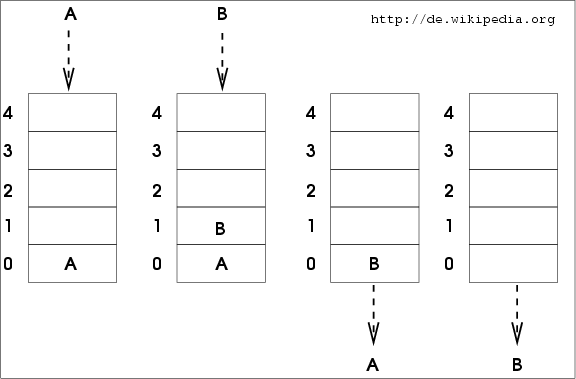
A stack follows the Last-In, First-Out (LIFO) principle. Imagine a stack of books. The last book you place on top is the first one you have to remove to get to the others. This is useful for tasks like tracking function calls in a program or implementing an "undo" feature in a text editor.
The main operations are push (add an item to the top) and pop (remove the item from the top).
A queue, on the other hand, follows the First-In, First-Out (FIFO) principle. Think of a line at a grocery store. The first person to get in line is the first person to be served. Queues are used for things like managing print jobs, handling requests on a server, or processing tasks in the order they were received.
The main operations are enqueue (add an item to the back of the line) and dequeue (remove the item from the front).
Hash Tables
What if you want the fast lookup of an array, but you want to use meaningful keys instead of numeric indexes? For this, we have hash tables (also known as hash maps or dictionaries).
A hash table stores data as key-value pairs. For example, you could store a phone book where the key is a person's name (a string) and the value is their phone number. To do this, the hash table uses a special hash function.
A hash function takes a key (like a name) and converts it into a numeric index that fits within an array. This index is where the corresponding value (the phone number) is stored.
This process makes lookups, insertions, and deletions incredibly fast, usually happening in constant time on average. It's like having a magical index that tells you exactly where to find the information you need.
But what if the hash function generates the same index for two different keys? This is called a collision. Modern hash tables have clever ways to handle collisions, such as storing multiple items at the same index in a linked list. This ensures that even with the occasional collision, the hash table remains efficient.
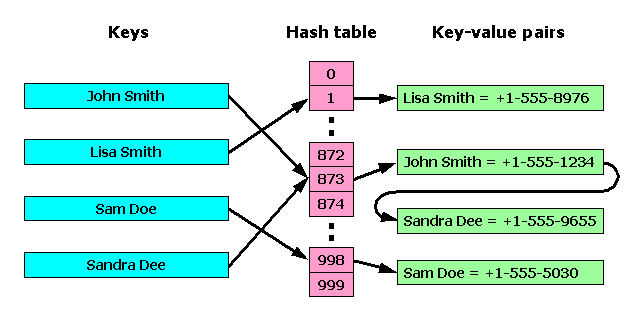
Hash tables are one of the most useful data structures in all of computer science. They are used everywhere, from databases to caching systems to the very programming languages we write code in.
Which data structure is most analogous to a line at a grocery store, where the first person to arrive is the first to be served?
What is the primary advantage of an array over a linked list?
These five structures form the foundation of how we work with data in code. Mastering them will give you the essential tools to start tackling more complex problems.