Conic Sections Unveiled
Introduction to Conic Sections
Slicing a Cone
Imagine a double ice cream cone, one pointing up and one pointing down, with their tips touching. Now, imagine slicing through this double cone with a flat sheet of paper. The shape you create on the edge of the paper is a conic section.
These fascinating curves were first studied by the ancient Greeks around 2,400 years ago. A mathematician named Apollonius of Perga wrote a whole series of books about them. He wasn't just doodling; he was exploring the fundamental geometry of the universe. What he discovered is that by changing the angle of your slice, you can create four distinct types of curves: circles, ellipses, parabolas, and hyperbolas.
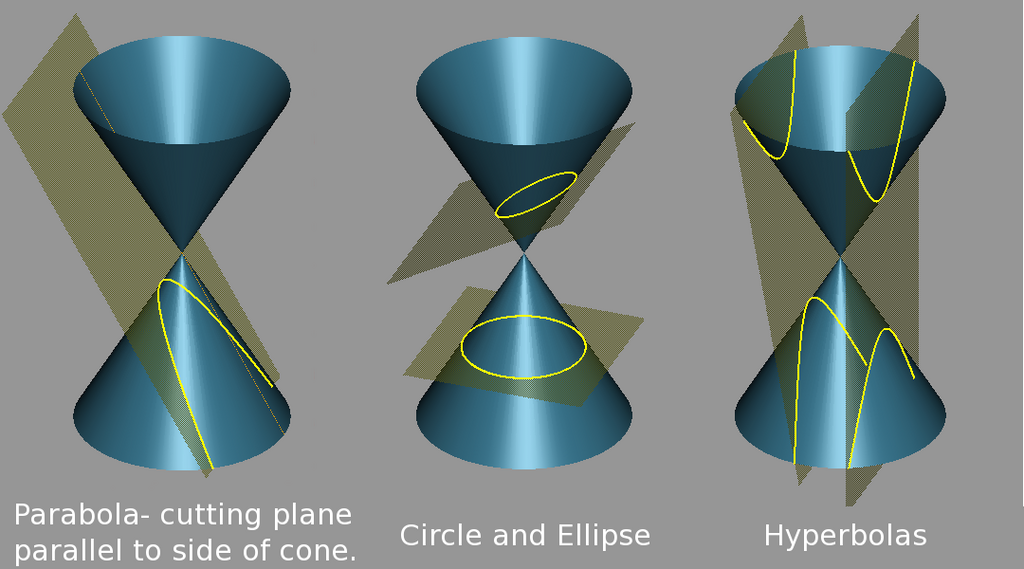
How Each Shape is Formed
The specific conic section you get depends entirely on the angle of your slice (the plane) relative to the cone's central axis.
A circle is formed when the plane is horizontal, slicing straight through the cone perpendicular to its axis. If you look at the cone from directly above, you'd see a perfect circle.
Tilt the plane slightly, and you get an ellipse. It's like a stretched or squashed circle. The more you tilt the plane, the longer the ellipse becomes. The orbits of planets are ellipses, not perfect circles.
A parabola is created when the plane is tilted so that it is exactly parallel to the side of the cone. This creates an open-ended curve. Parabolas don't close back on themselves. They describe the path of a thrown object under gravity.
Finally, if you tilt the plane even more, so much that it's steeper than the side of the cone, it will slice through both the top and bottom cones. This creates a hyperbola, which consists of two separate, symmetrical curves that mirror each other.
Meet the Conics
Let's summarize the four types of conic sections.
| Shape | How It's Formed | Description | Real-World Example |
|---|---|---|---|
| Circle | Plane is perpendicular to the cone's axis. | A perfectly round curve. | A wheel or a coin. |
| Ellipse | Plane is tilted and cuts one cone. | A stretched or elongated circle. | Orbit of a planet. |
| Parabola | Plane is parallel to the side of the cone. | A U-shaped, open curve. | The path of a thrown ball. |
| Hyperbola | Plane intersects both cones. | Two separate, mirrored curves. | The shape of a sonic boom. |
Each of these shapes has unique mathematical properties and its own specific equation, which we will explore later. For now, the key is to understand that these four seemingly different curves are all deeply related. They are all members of the same family, born from the simple act of slicing a cone.
Ready to check your understanding?
Which ancient Greek mathematician is credited with an extensive study of conic sections?
To create a parabola, the slicing plane must be positioned in what way relative to the cone?
Understanding how these shapes are formed provides the foundation for exploring their unique properties and equations.