Congruent Triangles Made Easy
Triangle Basics
The Shape with Three Sides
A triangle is one of the most fundamental shapes in geometry. It's a polygon with three sides, three vertices (corners), and three internal angles. No matter how you draw a triangle—tall, short, wide, or skinny—the three angles inside will always add up to 180 degrees. This is a core rule that never changes.
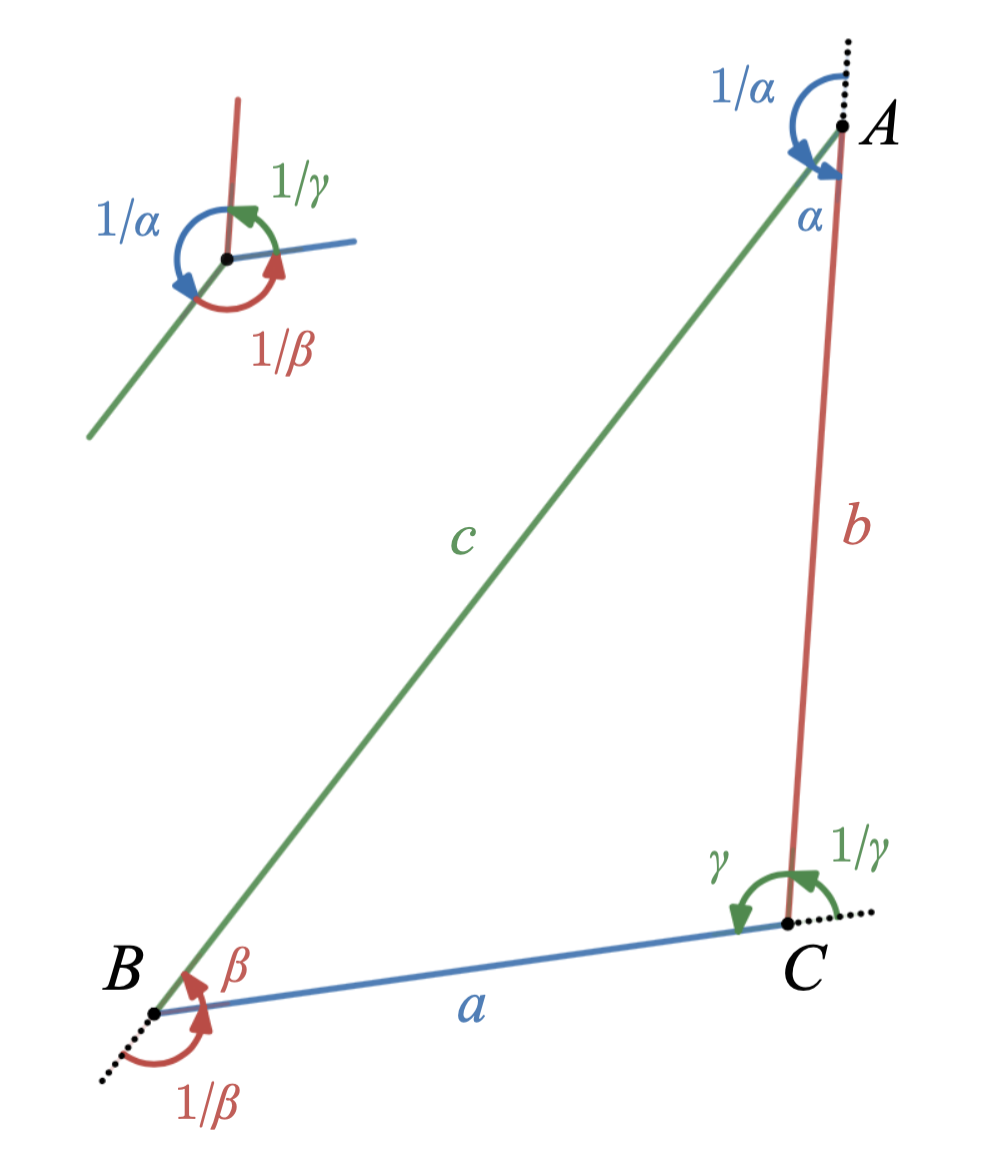
Because they are so simple, triangles are incredibly strong and stable, which is why you see them everywhere in construction, from bridges to roof trusses. To understand them better, we can sort them into different categories based on the length of their sides and the size of their angles.
Naming Triangles by Sides
One way to classify a triangle is by looking at the lengths of its sides. Are they all the same? Are two the same? Or are they all different? Each of these conditions has a specific name.
Equilateral
adjective
A triangle with all three sides of equal length.
The name comes from Latin: aequus (equal) and latus (side). Since all the sides are the same, all the internal angles are also the same: 60° each, adding up to 180°.
Isosceles
adjective
A triangle with at least two sides of equal length.
An isosceles triangle is a bit less symmetrical. The two angles opposite the two equal sides are also equal to each other. Think of it as having a line of symmetry right down the middle.
Scalene
adjective
A triangle with all three sides of different lengths.
This is the most general type of triangle. No equal sides means no equal angles. Every side and every angle is unique.
Naming Triangles by Angles
Besides side lengths, we can also classify triangles by their internal angles. Specifically, we look at the largest angle in the triangle to decide which category it belongs to.
A quick reminder: an angle less than 90° is acute, an angle that is exactly 90° is a right angle, and an angle greater than 90° is obtuse.
Acute
adjective
A triangle where all three angles are less than 90 degrees.
All angles in an acute triangle are sharp. No angle is 90° or larger.
Right
adjective
A triangle that has one angle equal to exactly 90 degrees.
Right triangles are special and form the basis of trigonometry. The 90° angle is usually marked with a small square. A triangle can only have one right angle—if it had two, the angles would already sum to 180° with no room for a third angle.
Obtuse
adjective
A triangle that has one angle greater than 90 degrees.
Just like a right triangle, an obtuse triangle can only have one obtuse angle. The other two angles must be acute.
Two Names for Every Triangle
Every triangle has two names: one from its sides and one from its angles. You can combine them to be more specific. For example, you can have a "right isosceles triangle." This would be a triangle with a 90° angle and two equal sides.
Or you could have a "scalene acute triangle," which means all its sides are different lengths and all its angles are less than 90°.
Knowing these classifications is the first step to working with triangles. It gives you a language to describe them accurately before you start exploring their many other interesting properties.
| Side Name | Angle Name | Combined Example |
|---|---|---|
| Scalene | Acute | Scalene Acute Triangle |
| Isosceles | Obtuse | Isosceles Obtuse Triangle |
| Isosceles | Right | Isosceles Right Triangle |
| Equilateral | Acute | Equilateral Triangle |
Notice that an equilateral triangle is always acute. Since all its angles must be equal, they all have to be 60°. It's impossible for an equilateral triangle to be right or obtuse.
Let's check your understanding of these basic triangle types.
What is the sum of the internal angles of any triangle?
A triangle with no equal sides and no equal angles is called a(n) ___________ triangle.
Understanding these fundamental definitions is key. With this foundation, you can begin to explore more complex geometric relationships.