Confident Conversations and Social Mastery
Social Calibration Dynamics
Matching the Room's Energy
You already know how to say hello. The real skill is knowing when and how. Social calibration isn't about having the perfect opening line; it's about matching the energy of your environment. Every social setting, from a loud party to a quiet coffee shop, has an energy baseline—the average level of intensity and emotion in the room. Your first job is to diagnose it.
Think of it like merging onto a highway. You don't just swerve into traffic. You match the speed of the other cars first. In a high-energy environment, like a birthday party or a packed bar, the baseline is fast and loud. People are animated, speaking quickly, and laughing openly. In a low-energy setting, such as a professional networking event or a small gallery opening, the baseline is slower and more subdued. Conversations are quieter and more focused.
Your goal is to enter the conversation without causing a ripple. You want to slide into the existing dynamic, not cannonball into it. This requires observation before participation.
The Pre-Approach Phase
Before you ever think about what to say, you need to analyze the group dynamics from a distance. This is the pre-approach phase, where you gather data by watching how people interact. Look for the invisible lines of connection and influence within a group.
Who is the center of a conversation? It's often the person everyone else's body is angled towards, even when others are speaking. Who is the social gatekeeper? This individual might not be the loudest, but they often guide the conversation, nodding to let others speak or subtly closing off the circle to newcomers. Understanding this structure helps you identify the path of least resistance for joining.
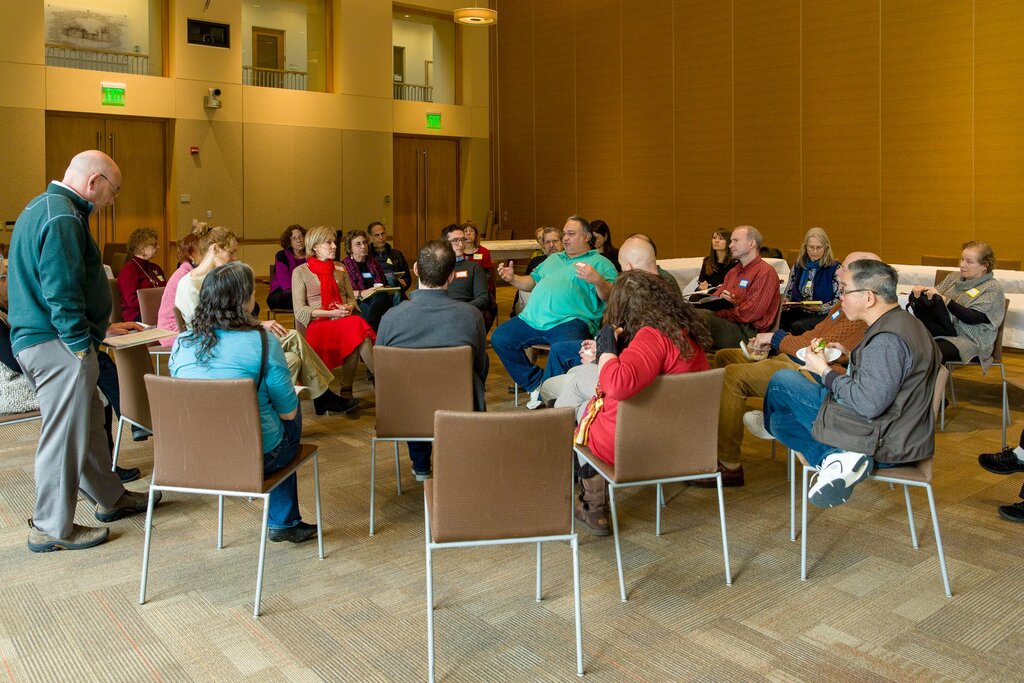
Your timing is critical. Don't interrupt a deeply personal story or the punchline of a joke. Wait for a natural lull. A moment when the group laughs together, or when the conversation briefly pauses, is an ideal entry point. This shows you have social awareness and respect the existing flow.
Green Lights and Red Lights
As you observe, you're looking for non-verbal signals. These are the green and red lights that tell you whether to approach or wait. A green light is an invitation. A red light is a clear 'do not disturb' sign.
| Signal Type | Green Lights (Approach) | Red Lights (Wait) |
|---|---|---|
| Body Language | Open posture, uncrossed arms, bodies angled slightly outward. | A tightly closed circle, bodies facing inward, crossed arms. |
| Eye Contact | Members periodically scan the room or make brief eye contact with outsiders. | Intense, unbroken eye contact between members. No one looks away. |
| Conversation Flow | Natural pauses, shared laughter, lighthearted topics. | Rapid, overlapping speech, serious or emotional topics. |
| Physical Space | There is a physical opening in the group's formation. | No physical space to enter the circle without pushing in. |
These cues are more reliable than anything you could overhear. Learning to read them accurately is the core of social calibration. It transforms social interaction from a game of chance into a skill of observation and timing.
Ready to test your understanding?
What is the primary goal of social calibration, as described in the text?
According to the text, the 'pre-approach phase' involves:
By mastering these observational skills, you can ensure your presence is always a welcome addition, not an interruption.