Conceptual Functions and Formulas
Understanding Functions
What is a Function?
Think of a function as a simple machine. You put something in, the machine follows a specific rule, and something new comes out. For example, you could have a machine whose rule is "add 2 to any number you put in."
If you put in a 3, it spits out a 5. If you put in a 10, it gives you a 12. The important part is that for any single input, you always get the exact same, single output. A 3 will always produce a 5 from this machine. It will never give you a 7, or a 5 sometimes and a 9 other times. This reliability is the core idea of a function.
A function is a rule that assigns each input to exactly one output.
In mathematics, we write this relationship using a special notation. If we call our "add 2" function , we would write the rule as . The is a placeholder for whatever input we choose. So, .
This basic structure allows us to model all sorts of relationships in the world, from calculating the cost of a taxi ride to predicting how a population of bacteria will grow.
The Set of All Possibilities
A function doesn't just have one input; it has a whole set of possible inputs. This collection of all valid inputs is called the domain. For our function , the domain could be all whole numbers, or all decimals, or even just a specific list like {1, 2, 3}.
The set of all possible outputs is called the codomain. This is like a list of everything the function is allowed to produce. For , if our domain is all whole numbers, our codomain could also be all whole numbers.
There's one more key term: the range. The range is the set of all the actual outputs the function produces. Sometimes, the range is the same as the codomain, but not always. Imagine a function that takes any whole number and always outputs 7. Its domain is all whole numbers, its codomain could be all whole numbers, but its range is just {7}.
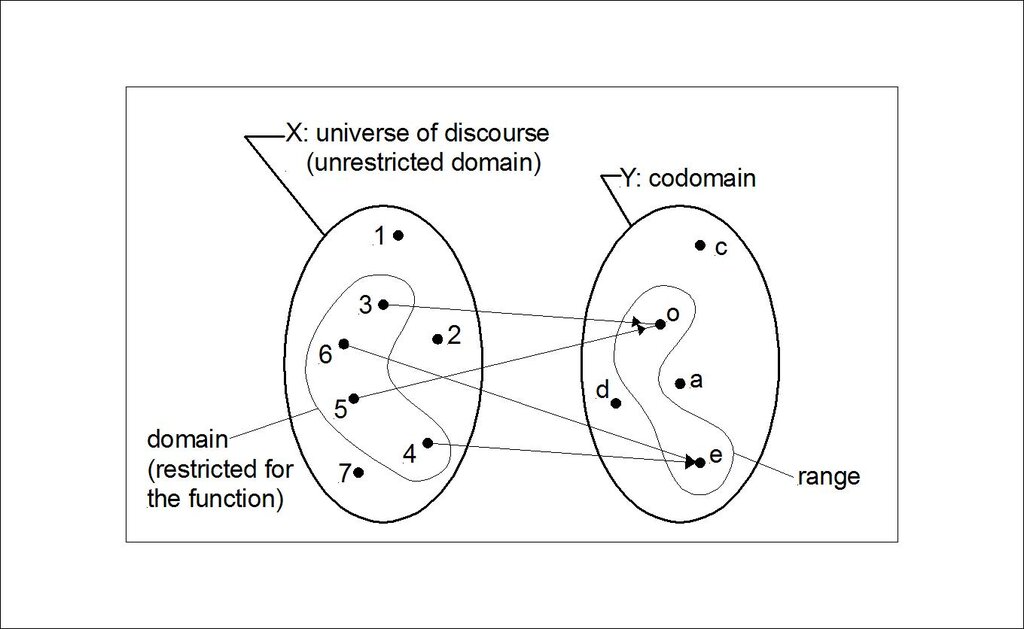
In the image above, notice how two different inputs (3 and 6) from the domain both point to the same output (c). This is perfectly fine for a function. The key rule is that one input cannot lead to multiple outputs.
Functions in Everyday Life
Functions aren't just for abstract math problems. We use the same logic all the time.
Consider a vending machine. The domain is the set of codes for each snack (like B4 or C1). When you input a valid code, the function of the machine is to dispense one specific snack. The codomain is every type of snack stocked in the machine, and the range is the snacks that are actually available (not sold out).
Or think about converting temperatures. There's a function to convert Celsius to Fahrenheit: . The domain is any valid temperature in Celsius, and the function gives you the single, corresponding temperature in Fahrenheit. A temperature of 20°C will always convert to 68°F, never anything else.
Anything that reliably maps a set of inputs to a set of unique outputs can be described as a function.
Understanding this input-rule-output structure is the first step. Once you see relationships this way, you can start to analyze them, predict outcomes, and see the mathematical patterns that shape our world.
Now, let's test your understanding of these core concepts.
What is the fundamental rule that a relationship must follow to be considered a function?
If a function is defined by the rule , what is ?
Great work. You've now learned the fundamental concept that underpins much of algebra and beyond.