Computer Science for Data Professionals
Computer Architecture Foundations
How Code Meets Hardware
As a data scientist, you write code that manipulates data. But how does a line of Python actually make a physical machine do something? The answer lies in the computer's architecture, the fundamental design of its hardware. Understanding this bridge between software and silicon is what separates writing code that works from writing code that works fast and efficiently.
At the heart of it all is the Central Processing Unit (CPU), the brain of the computer. It doesn't understand pandas or scikit-learn; it understands a very specific set of simple instructions. Your high-level code gets translated down into these basic commands, which the CPU then executes one by one at incredible speeds.
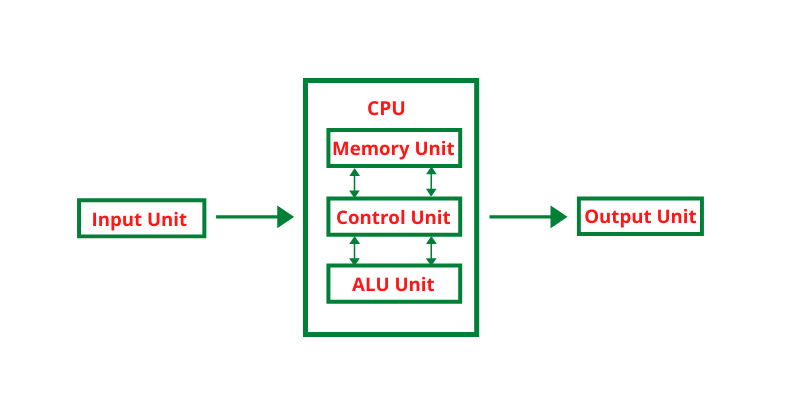
To understand how this process works, we need to look at the blueprint most modern computers follow.
The Von Neumann Blueprint
Nearly every computer you've ever used, from your laptop to a massive cloud server, is based on the Von Neumann architecture. The core idea is simple but revolutionary: the instructions your code needs to run and the data it operates on are stored in the same memory.
Think of a chef (the CPU) working in a kitchen. The recipe book (memory) contains both the cooking instructions (add flour, stir, bake) and the list of ingredients (flour, sugar, eggs). The chef reads an instruction, grabs the necessary ingredients from the same book, and performs the action. This unified memory model simplifies the design, but it also creates a key bottleneck. The CPU can't fetch an instruction and data at the exact same moment; it has to use the same pathway, or bus, for both.
This constant back-and-forth between the CPU and memory is the fundamental rhythm of computation.
The CPU's Rhythm
To execute your code, the CPU performs a continuous loop called the fetch-decode-execute cycle. It's the computer's heartbeat.
- Fetch: The CPU fetches the next instruction from memory.
- Decode: The Control Unit figures out what the instruction means.
- Execute: The Arithmetic Logic Unit (ALU) performs the operation, like adding two numbers or comparing values.
But fetching from main memory (RAM) is slow in CPU terms. To speed things up, the CPU has its own tiny, extremely fast memory locations right on the chip itself.
Register
noun
A small, high-speed storage location directly inside the CPU. Registers hold the data and instructions the CPU is currently working on, providing the fastest possible access.
Think of registers as the CPU's hands. It's much faster to work with something you're holding than to walk over to a bookshelf to get it. The whole game of performance optimization is about keeping the CPU's hands full with the right data at the right time. But since registers are so small, the CPU needs a bigger, slightly slower workspace to pull from.
The Memory Pyramid
Computer memory isn't one monolithic thing. It's a hierarchy, a pyramid of storage layers. At the top, you have the fastest, smallest, and most expensive memory. As you go down, it gets slower, larger, and cheaper.
- Registers: At the very top. Blazing fast, but there are only a handful.
- L1/L2/L3 Cache: A small amount of super-fast memory built right into the CPU. It acts as a buffer for RAM.
- RAM (Main Memory): Where your program and its data live while running. It's much larger than cache, but also much slower.
Imagine you're a researcher. The books you have open on your desk are your cache. The entire library is your RAM. It's much faster to find information in the books on your desk than to walk through the stacks. When the CPU needs data, it first checks the cache. If the data is there (a cache hit), great. If not (a cache miss), it has to make the long, slow trip to RAM, stalling its work.
For data scientists, cache misses are a silent performance killer. When you process a massive dataset, if the data isn't laid out in memory in a predictable, sequential way (cache locality), the CPU spends more time waiting for data from RAM than actually computing. This is why a simple loop in Python can be orders of magnitude slower than an optimized function from a library like NumPy.
Vectorization and SIMD
So why is numpy.sum(my_array) so much faster than a Python for loop? The secret is a hardware feature called SIMD, which stands for Single Instruction, Multiple Data.
Standard CPU instructions are scalar: they operate on one piece of data at a time. add 1, 2. Then add 3, 4. SIMD instructions are different. They are vector operations. A single SIMD instruction can tell the CPU to perform the same operation on an entire block of data at once.
Libraries like NumPy are written in low-level languages like C and Fortran, allowing them to directly access these SIMD instructions. When you perform an operation on a NumPy array, you're not just running a faster loop. You're executing a single, powerful hardware instruction that processes chunks of your data in parallel. This leverages the memory hierarchy effectively—loading a contiguous block of data into cache and then operating on it all at once—which is the key to high-performance scientific computing.
Now, let's test your understanding of these core architectural concepts.
What is a defining characteristic of the Von Neumann architecture?
Arrange the following memory types from fastest to slowest.
Understanding how your code interacts with the CPU and memory is a big step toward writing more performant software. By thinking about data locality and leveraging vectorized operations, you can ensure your programs aren't just correct, but also fast.