Computer Operations at the Assembly Level
Introduction to Computer Architecture
The Computer's Blueprint
Every computer, from the phone in your pocket to a massive supercomputer, is built on the same fundamental design. This design is called the Von Neumann architecture. It’s a simple but powerful idea: both the program's instructions and the data it works on are stored together in the same memory.
Think of it like a kitchen. Your recipe (the instructions) and your ingredients (the data) are both laid out on the same countertop (the memory). This makes it easy for the chef (the processor) to grab whatever is needed next, whether it’s an instruction or a piece of data.
This setup allows a computer to be a general-purpose machine. By simply changing the program in memory, the same hardware can switch from being a word processor to a video game console. This flexibility is what makes computers so versatile.
The Brains of the Operation
The Central Processing Unit, or CPU, is the engine that drives the computer. It's responsible for executing the instructions from a program. It does this by repeating a simple, three-step process called the fetch-decode-execute cycle, thousands of millions of times per second.
| Step | Action | Analogy |
|---|---|---|
| 1. Fetch | The CPU retrieves the next instruction from memory. | Reading the next line of a recipe. |
| 2. Decode | The CPU figures out what the instruction means. | Understanding that "dice the onion" means to chop it. |
| 3. Execute | The CPU performs the action. | Actually chopping the onion. |
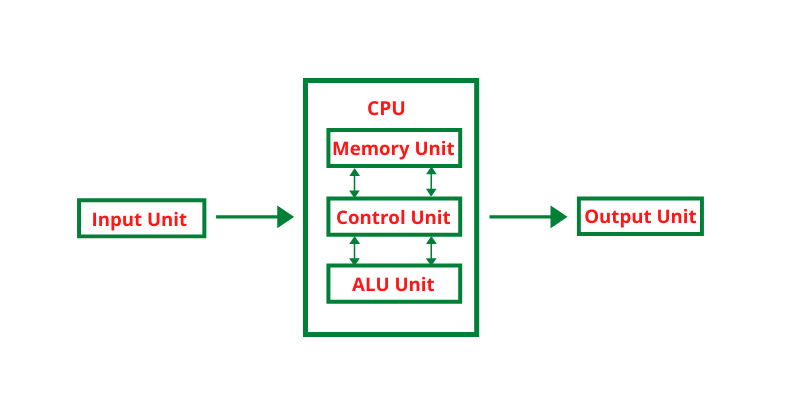
To perform these steps, the CPU has two key parts:
The Control Unit (CU): This is the director. It fetches instructions from memory and decodes them, telling the other parts of the computer what to do and when.
The Arithmetic Logic Unit (ALU): This is the calculator. It performs all the math (like addition and subtraction) and logical operations (like comparing if one number is greater than another).
A Place for Everything
Memory is where the CPU keeps the data and instructions it needs to access quickly. But not all memory is created equal. Computers use a tiered system called the memory hierarchy, which balances speed, cost, and size.
Imagine your own memory. Some thoughts are right at the front of your mind (super fast), some you need a second to recall (fast), and others are stored away in a diary you have to go find (slow).
The computer's memory hierarchy works in a similar way:
- Registers: Tiny, ultra-fast storage locations right inside the CPU. They hold the single piece of data the CPU is working on at that exact moment.
- Cache: A small amount of very fast memory that's a bit bigger than registers. It stores frequently used data and instructions to avoid fetching them from slower memory.
- RAM (Random Access Memory): This is the computer's main workspace. It's where your applications, documents, and operating system are stored while you're using them. It's much larger than cache but also slower.
- Storage (Hard Drive/SSD): This is long-term storage. It holds your files and programs when the computer is off. It’s the largest and slowest level of the hierarchy.
Talking to the World
A computer wouldn't be very useful if it couldn't interact with us or the outside world. That's the job of input and output (I/O) devices. They are the bridges between the digital world inside the computer and the physical world outside.
Input Devices send data into the computer. Examples include your keyboard, mouse, microphone, and camera.
Output Devices receive data from the computer. Examples include your monitor, speakers, and printer.
When you type on your keyboard, the keyboard sends signals to the computer. The CPU processes these signals and then sends instructions to the monitor to display the characters you typed. This constant flow of data in and out allows us to use computers to create, communicate, and learn.
Now, let's test your understanding of these core components.
What is the defining characteristic of the Von Neumann architecture?
Which of the following correctly lists memory types from fastest to slowest?
These building blocks—the Von Neumann architecture, the CPU, the memory hierarchy, and I/O devices—form the foundation of every modern computer. Understanding them is the first step to understanding how these powerful machines truly work.