Computer Networking Fundamentals
Networking Basics
What is a Network?
At its heart, a computer network is just a group of devices that can talk to each other. Think of it like a conversation between friends. For them to chat, they need to be close enough to hear one another and speak the same language. Similarly, for computers to communicate, they need a connection and a common set of rules.
The main purpose of a network is to share things. This could be an internet connection, a printer, files, or even processing power. In your home, your phone, laptop, and smart TV might all be on a network to share the same Wi-Fi connection. In an office, dozens of computers might be networked to access shared files on a server and print documents on a single printer.
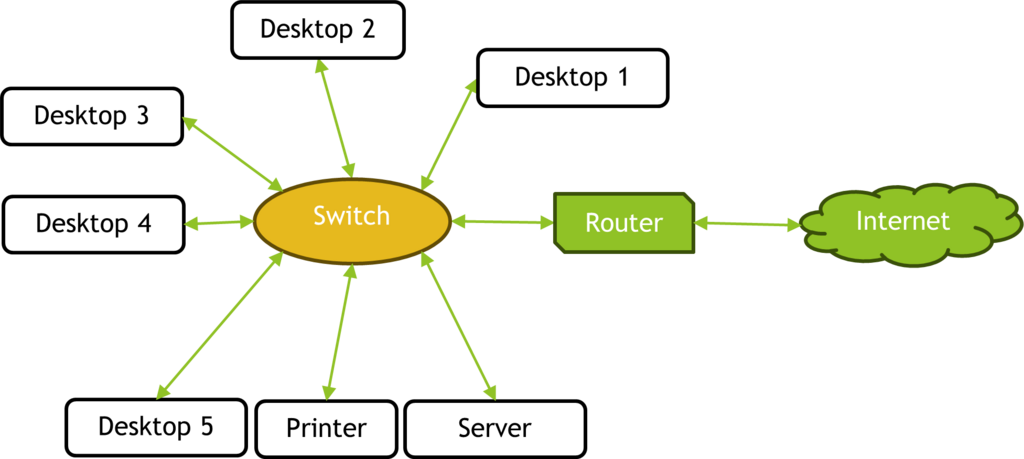
By connecting devices, we make them more useful. We can send an email from our phone, stream a movie on our tablet, or back up our laptop's files to a separate drive, all thanks to the power of networking.
The Building Blocks
Every network, from the tiny one in your home to the global internet, is built from the same fundamental components. Let's break them down.
Node
noun
Any individual device connected to a network.
Nodes are the endpoints of the network. They are the devices that send, receive, or forward information.
Link
noun
The communication pathway that connects two or more nodes.
Links are the highways for our data. They can be physical, like copper wires or fiber-optic cables, or they can be wireless, using radio waves like Wi-Fi and Bluetooth.
Finally, for nodes to communicate successfully over their links, they need to agree on a set of rules.
Protocol
noun
An established set of rules that determines how data is transmitted between different devices in the same network.
Think of a protocol as the grammar and vocabulary of a language. If two people want to communicate, they must speak the same language. If one speaks only French and the other only Japanese, no conversation can happen. Protocols ensure every device on the network is speaking the same 'language'.
Sending the Message
When you send a large file, like a photo, from your phone to your computer, it doesn't travel across the network as a single, giant block of data. Instead, the network breaks it down into small, manageable pieces called packets.
Each packet is like a single page of a long book being mailed to a friend. Along with a piece of the photo, each packet contains a label with important information, such as the destination address (your computer) and its own page number. This ensures that even if the packets arrive out of order, your computer can reassemble them correctly to reconstruct the original photo.
This method has two big advantages. First, if a small packet gets lost or corrupted during transmission, only that tiny piece needs to be sent again, not the entire file. Second, it allows the network to handle traffic from many different devices at once. Packets from your photo transfer can be interleaved with packets from a video someone else is streaming, making the network efficient.
Networks Big and Small
Networks come in various sizes, each suited for a different purpose. The most common types you'll encounter are defined by their geographical reach.
LAN (Local Area Network): This is a network confined to a small area, like a single building, office, or home. LANs are typically used to connect personal computers and shared resources. Most LANs today use Wi-Fi, creating a WLAN (Wireless Local Area Network).
WAN (Wide Area Network): A WAN spans a large geographical area, often a country or even a continent. A WAN connects multiple LANs together. The most famous example of a WAN is the internet itself, which is a global network of networks.
Other types exist too. A MAN (Metropolitan Area Network) covers an area larger than a LAN but smaller than a WAN, like a city or a university campus. And a PAN (Personal Area Network) is even smaller, connecting devices within an individual's workspace, like a wireless mouse and keyboard connected to a single computer.
Ready to check your understanding?
What is the primary purpose of a computer network?
In a network, what is a 'node'?
These core concepts—nodes, links, protocols, and network types—are the foundation for understanding how all digital communication works, from sending a text message to connecting with servers around the globe.