Computer Networking Fundamentals
Introduction to Computer Networks
What Is a Computer Network?
At its core, a computer network is simply a collection of devices connected together so they can share information. Think of it like a conversation. For a conversation to happen, you need at least two people who can send and receive messages. A network does the same for our computers, phones, printers, and servers.
The main purpose of networking is to share resources. This could be a file, a printer, or an internet connection. By connecting devices, we avoid having to buy a separate printer for every computer or use a flash drive to move a file from a laptop to a desktop.
Computer networking is the interconnection of computing devices that exchange data and share resources using communication protocols over wired or wireless technologies.
The Core Components
Every network, from the tiny one connecting your headphones to your phone to the massive global internet, is built from a few basic parts.
End Devices: These are the devices you interact with directly. Your laptop, smartphone, smart TV, and even a modern refrigerator can be end devices. They are the originators or the final destination of any data sent across a network. They are also sometimes called hosts.
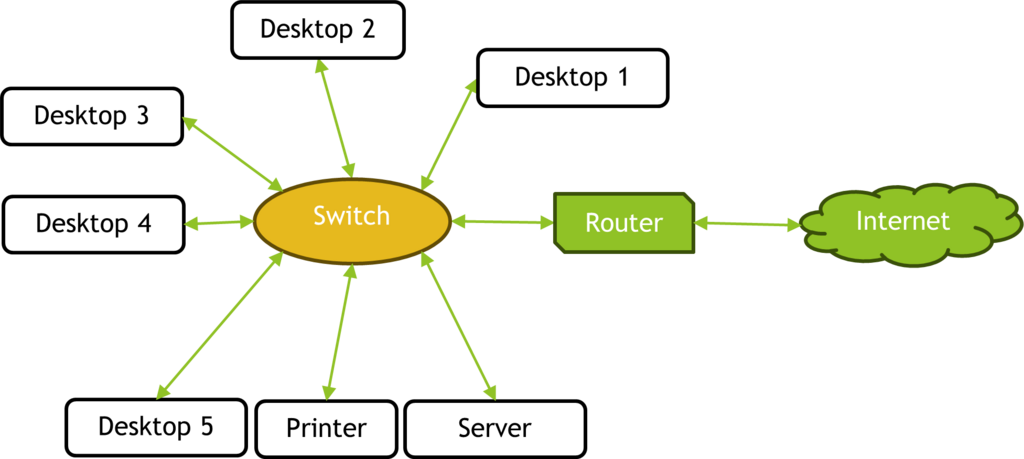
Intermediary Devices: These gadgets work behind the scenes to connect the end devices. They ensure data gets from its source to its destination efficiently. Two of the most common are:
-
Switches: A switch connects multiple devices on the same network, like in a single office or home. It's like a local traffic coordinator, making sure a message from your computer goes directly to the printer, not to your roommate's tablet.
-
Routers: A router's job is to connect different networks together. Your home router, for instance, connects your private home network to the internet. Routers are the great connectors, figuring out the best path for data to travel across the globe.
Network Media: This is the physical path over which the data travels. It's typically one of two types: wired connections using Ethernet cables or wireless connections using radio waves, which we know as Wi-Fi.
Networks of Different Sizes
Networks are categorized based on the geographical area they cover. The three main types you'll encounter are PAN, LAN, and WAN.
Personal Area Network (PAN) This is the smallest type of network, designed for one person. When you connect your wireless earbuds to your smartphone with Bluetooth, you’ve created a PAN. It’s a short-range network that links your personal devices.
Local Area Network (LAN) A LAN covers a small area, such as a single building or a school campus. The network in your home that connects your computers, phones, and smart TV to your Wi-Fi router is a LAN. It allows devices in a limited area to communicate with each other at high speeds.
Wide Area Network (WAN) A WAN spans a large geographical area, connecting multiple LANs together. A company with offices in New York, London, and Tokyo would use a WAN to connect its employees. The largest and most well-known WAN is the internet itself, which is a global network of interconnected computers.
To sum up, a network connects devices to share resources. Whether it's the PAN in your pocket, the LAN in your home, or the global WAN of the internet, these connections are what make our digital world possible.
What is the primary purpose of a computer network?
Which device's main job is to connect different networks together, such as your home network to the internet?