Computer Networking Fundamentals
Introduction to Computer Networks
What Is a Network?
At its heart, a computer network is just a group of devices connected so they can talk to each other. Think of it like a group of friends. For them to communicate, they need to be able to hear each other and have a shared language. Computers are the same. They need a connection and a common set of rules to share information.
A computer network is a group of computers and other hardware devices linked together to process communication and share resources.
These aren't just limited to desktop computers. A network can include laptops, phones, printers, servers, smart TVs, and even your refrigerator. If a device can connect to another to send or receive data, it can be part of a network.
Why Bother Networking?
The two main reasons to create a network are to share resources and to share information.
Sharing resources is about efficiency. Imagine an office with ten employees, each with their own computer. Buying ten separate printers would be expensive and wasteful. With a network, all ten employees can share a single printer. The same goes for sharing a single internet connection or a central storage server.
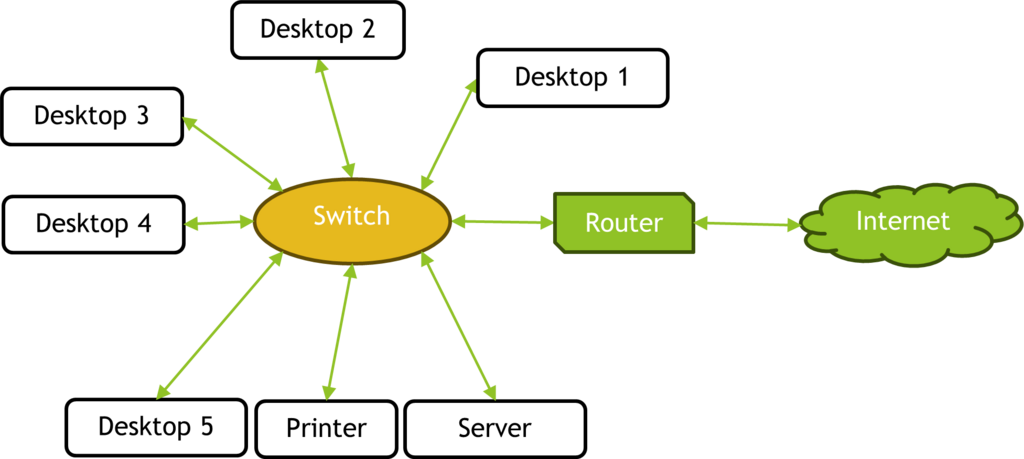
Sharing information is even more powerful. It's how we send emails, collaborate on documents, and access websites from servers across the globe. When you stream a video, you're requesting information from a computer (a server) that might be thousands of miles away. That's only possible because of a massive, interconnected network of networks: the internet.
The Building Blocks
Every network, from the simple one in your home to the global internet, is built from the same basic parts: nodes, links, and transmission media.
Node
noun
Any device connected to a network that can send, receive, or forward data.
The connections between nodes are called links. These links are the pathways that data travels along. But what are these pathways actually made of? That's where transmission media come in.
A transmission medium is the physical material used to carry data from one node to another. This falls into two broad categories:
- Wired: Uses physical cables. Common examples include copper Ethernet cables and fiber optic cables, which transmit data as electrical signals or pulses of light.
- Wireless: Transmits data through the air using radio waves. Wi-Fi and Bluetooth are the most familiar examples.
How Data Travels
So how does a photo from your phone get to your friend's laptop? It doesn't travel as one big file. Instead, the network breaks it down into small pieces of data called packets.
Think of it like sending a book through the mail. You wouldn't mail the whole book in one giant, flimsy envelope. Instead, you might send it one chapter at a time in separate, sturdy packages. Each package would be labeled with the destination address and information about which chapter it contains so they can be reassembled correctly.
Computer networks do the same thing. Each packet of data is labeled with information like the destination address (where it's going) and its sequence number (its place in the overall message). These packets then travel across the network's links from node to node until they reach their destination. Once they all arrive, the receiving device puts them back together in the correct order to reconstruct the original photo.
This process of breaking down and reassembling data allows for efficient and reliable communication, even over long distances and complex networks. It's the fundamental principle that makes our modern digital world possible.