Computer Networking Fundamentals
Introduction to Computer Networks
What Is a Network?
At its core, a computer network is just a group of devices connected to share information and resources. Think of it like a conversation. You can talk to one person, or you can be in a room full of people sharing ideas. A network allows devices like computers, phones, and printers to have that conversation.
Computer Network is a group of computers and other hardware devices that are linked together via communication channels to process communication and enable resource sharing among a wide range of users.
The main purpose is efficiency. Instead of putting a file on a flash drive and walking it over to another computer, you can send it instantly over the network. Instead of buying a printer for every single computer, you can connect one printer to the network for everyone to share. This sharing of resources and data is what makes networks so powerful.
The Basic Building Blocks
Every network, from the simple one in your home to the global internet, is built from the same fundamental components. Understanding these parts is key to understanding how networks function.
Node
noun
Any device on a network that can send, receive, or forward information.
Nodes are the endpoints of a network. This includes the obvious things like your desktop computer and laptop, but also printers, servers, smartphones, and even smart home devices like a thermostat or a lightbulb. If it can connect to the network, it's a node.
Of course, these nodes need a way to talk to each other. That's where transmission media come in.
Transmission media are the physical or wireless pathways that carry data between nodes. They come in two main flavors:
- Wired: These use physical cables. The most common is the Ethernet cable, which you might plug into your laptop or desktop for a fast, stable connection. Fiber optic cables are another type, using light to transmit data at incredibly high speeds over long distances.
- Wireless: These use radio waves. Wi-Fi is the one we all know, creating a wireless local network in homes and offices. Bluetooth is for shorter-range connections, like connecting your phone to headphones or a wireless speaker.
The Traffic Cops
With all these nodes trying to talk, a network needs devices to manage the flow of traffic. These network devices act like traffic cops, making sure data gets where it needs to go efficiently and without collisions.
Hubs are the simplest of these devices. They are an older technology you won't see very often anymore. When a hub receives data from one node, it simply broadcasts it out to every other node connected to it. It's like a person shouting in a crowded room, hoping the right person hears them. It's not very efficient.
Switches are much smarter. A switch knows the specific address of each node connected to it. When it receives data, it sends it directly to the intended node, not to everyone. This is like passing a note directly to your friend instead of yelling across the room. It creates less unnecessary traffic and makes the whole network faster.
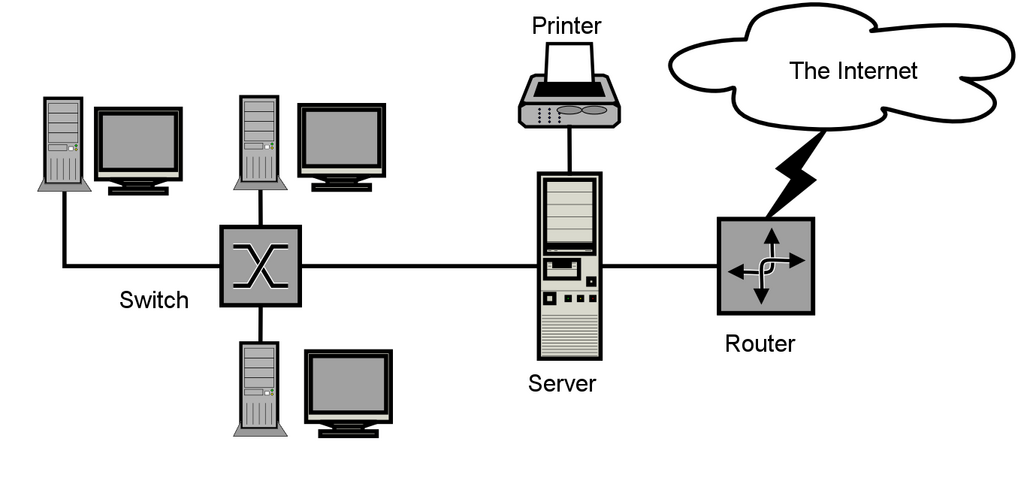
Routers have a different, very important job. While a switch connects nodes on the same network, a router connects different networks together. The router in your home connects all your local devices (your personal network) to the internet (a massive, global network). It acts as a gateway, directing traffic in and out.
Finally, a Wireless Access Point (AP) is a device that allows wireless nodes, like your phone or tablet, to connect to a wired network. Often, the box your internet provider gives you is a combination device that acts as a router, a switch, and a wireless access point all in one.
Switches create a network. Routers connect networks.
Now that you know the basic pieces, let's test your understanding.
What is the primary purpose of a computer network?
An office has 10 computers that need to share files and a single printer. Which device would manage this local traffic most efficiently by sending data only to the intended recipient?
These components form the foundation of all computer networking, from a simple home setup to the complex infrastructure that powers the internet.