Computer Evolution: Abacus to AI
Mechanical Origins
The Clockwork Computer
Before the age of silicon chips, the word "computer" referred to a person, not a machine. These human computers, often working in teams, would spend thousands of hours calculating mathematical tables for navigation, astronomy, and engineering. The work was tedious and, more importantly, prone to error. A single mistake in a logarithm table could lead a ship astray or a bridge to fail.
Charles Babbage, a 19th-century English mathematician, was frustrated by these errors. He envisioned a machine that could automate this work, calculating and printing tables with perfect accuracy. His first major design was the Difference Engine, a massive mechanical calculator designed to tabulate polynomial functions.
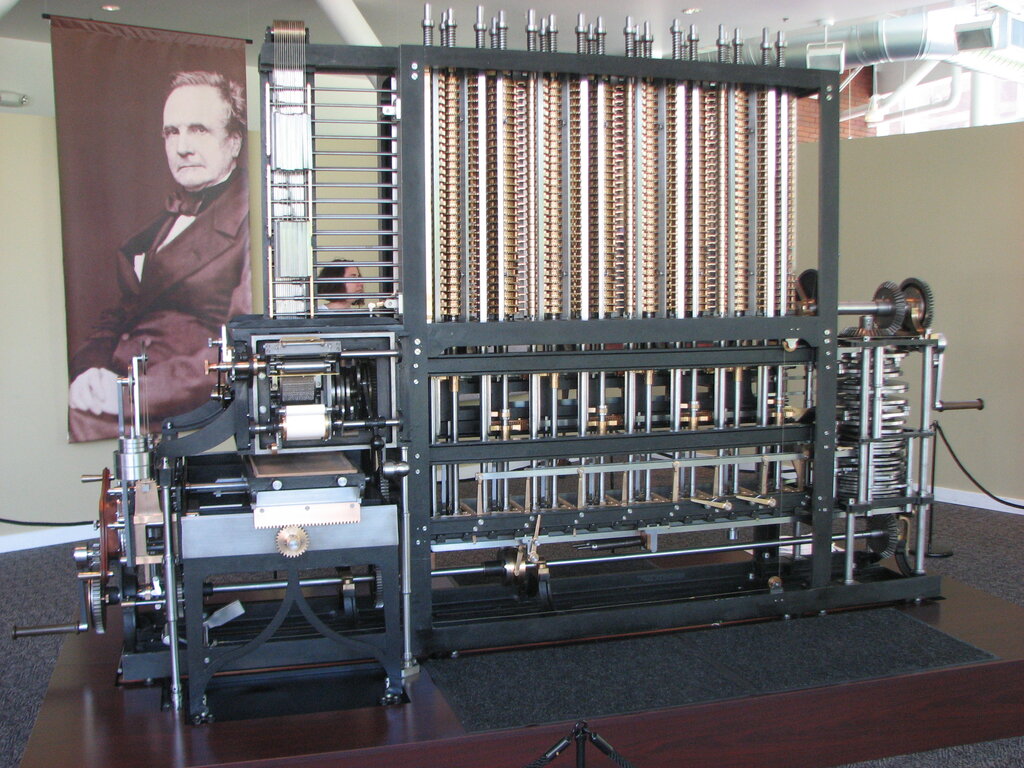
The engine worked using the method of , a clever mathematical trick that simplifies complex calculations. Instead of solving a polynomial like directly for each value of , the machine calculates the differences between consecutive values. For a polynomial, these differences eventually become constant, turning multiplication and division into simple, repeatable addition—something a machine of gears and levers could handle easily.
A More Ambitious Machine
While the Difference Engine was specialized, Babbage's next idea was revolutionary. He designed the Analytical Engine, a general-purpose mechanical computer. This machine had a structure that is strikingly similar to modern computers. It featured a 'mill' for processing calculations (like a CPU) and a 'store' where numbers could be held for later use (like memory).
Babbage's proposed Analytical Engine, considerably more ambitious than the Difference Engine, was to have been a general-purpose mechanical digital computer.
To feed instructions into this machine, Babbage took inspiration from the Jacquard loom, which used cards with punched holes to control the patterns woven into fabric. The Analytical Engine would read a sequence of operations from similar punched cards, allowing for complex, programmable calculations.
The First Programmer
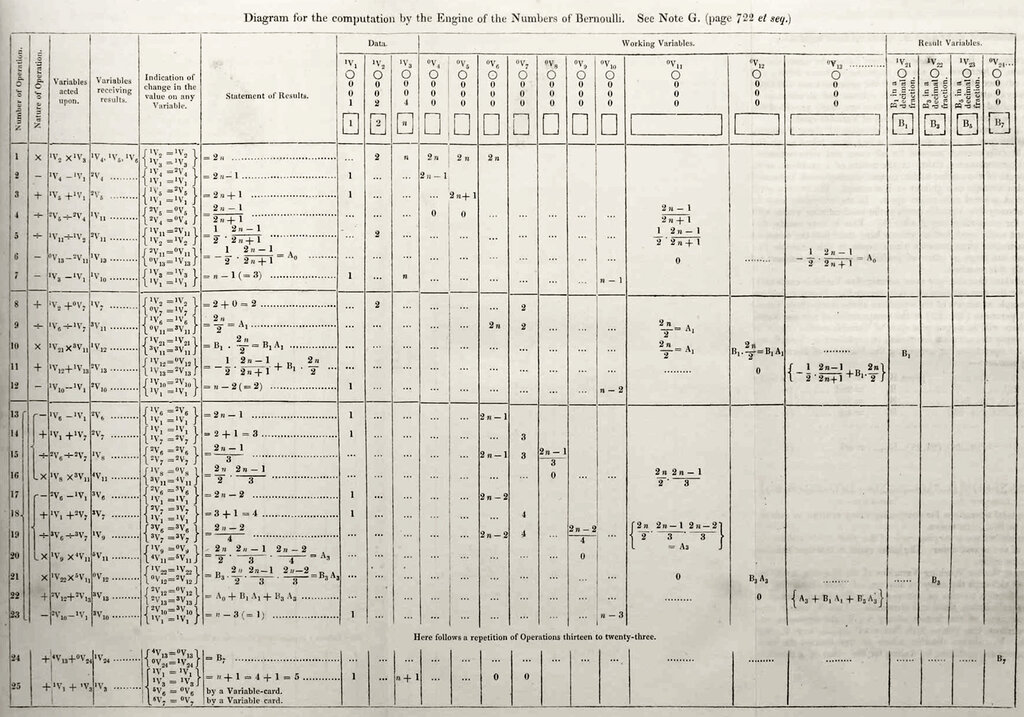
The true potential of the Analytical Engine was recognized not by Babbage, but by his collaborator, . While translating a paper on the engine, she added her own extensive notes, which were three times longer than the original text. In these notes, she described how the engine could go beyond simple number-crunching.
Lovelace saw that if the machine could manipulate numbers, it could also manipulate symbols representing other things, like musical notes or letters. This conceptual leap from calculation to computation is fundamental to all modern computing. She outlined a detailed method for using the engine to calculate a sequence of Bernoulli numbers, which is now widely considered the world's first computer program.
Despite these brilliant designs, neither the Difference Engine nor the Analytical Engine was fully built in Babbage's lifetime. The main obstacle was mechanical precision. The thousands of interlocking gears and levers required a level of metalworking skill and consistency that was almost impossible to achieve in the 19th century. Even a tiny imperfection in a single gear could jam the entire machine.
The engines also lacked a key feature of modern computers: a stored-program concept. The instructions were on external cards, read one by one. The machine couldn't store its own program in memory and modify it, a limitation that would only be overcome with the advent of electronic computers a century later. But the foundational ideas—of a processor, a memory, and a programmable instruction set—had been born.
What was the primary motivation for Charles Babbage to design his calculating engines?
The Difference Engine used the method of finite differences to simplify the calculation of polynomial functions. What did this method effectively reduce complex operations like multiplication into?