Computer Chip Manufacturing Explained
Introduction to Semiconductors
The In-Between Material
At the heart of every smartphone, computer, and digital gadget is a special class of materials known as semiconductors. As the name suggests, they aren't quite conductors, which let electricity flow freely, nor are they insulators, which block it completely. They sit somewhere in the middle, with an electrical conductivity that can be precisely controlled.
Think of it like a dam on a river. A conductor is like an open floodgate, letting water (or electrical current) rush through. An insulator is like a solid concrete wall, stopping the flow entirely. A semiconductor is like a gate that can be opened just a little or a lot, giving you fine control over how much water gets through.
This ability to switch between conducting and insulating states is what makes semiconductors the foundation of all modern electronics.
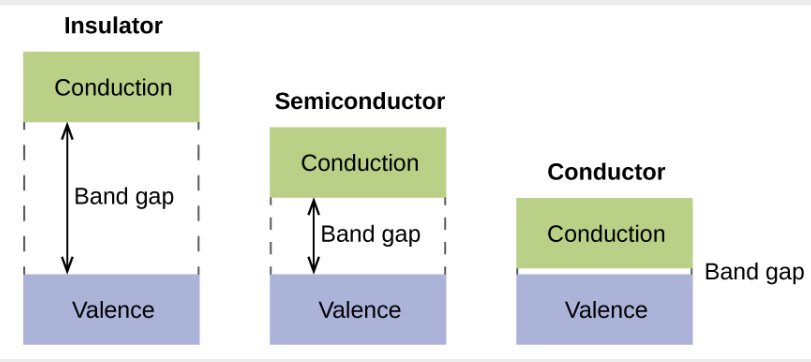
The difference between these materials comes down to their atomic structure and how their electrons behave. Electrons in an atom exist in energy levels, or bands. For a current to flow, electrons must be free to move into a higher energy state called the conduction band.
In a conductor like copper, the highest energy band containing electrons (the valence band) overlaps with the conduction band. Electrons can jump between them with almost no effort, allowing current to flow easily.
In an insulator like glass, there's a huge energy gap, called the band gap, between the valence and conduction bands. It takes a massive amount of energy to push an electron across this gap, so for all practical purposes, no current flows.
Semiconductors have a small, manageable band gap. A little bit of energy, like from heat or an applied voltage, is enough to kick an electron into the conduction band, allowing a current to flow. We can control this flow by carefully managing that energy input.
Silicon Valley's Star
While several materials can act as semiconductors, one element reigns supreme: silicon. It's the second most abundant element in the Earth's crust (after oxygen), making it cheap and plentiful. But its real advantage lies in its atomic structure.
Silicon has four electrons in its outermost shell, called valence electrons. In a pure silicon crystal, each atom forms strong covalent bonds by sharing these four electrons with four of its neighbors. This creates a stable, orderly lattice structure. At absolute zero, all valence electrons are locked in these bonds, and silicon acts like an insulator.
However, at room temperature, thermal energy is enough to break a few of these bonds, freeing an electron to move into the conduction band. When an electron leaves its bond, it leaves behind a vacant spot, called a "hole." This hole acts like a positive charge and can also move through the crystal as neighboring electrons jump in to fill it. This process creates a small current.
The true power of silicon is realized when we intentionally introduce impurities into the crystal, a process called doping. This allows us to dramatically increase the number of free electrons or holes, giving us precise control over the material's conductivity. We'll explore doping in more detail later.
The Electronic Switch
Controlled conductivity is the key, but how do we use it? The answer is in tiny semiconductor devices that act as switches or amplifiers. The most fundamental of these is the transistor.
A transistor is a microscopic switch with no moving parts. It can turn a current on or off, or amplify a small current into a larger one. A small voltage applied to one part of the transistor controls a much larger current flowing through another part. This is like using a tiny push on a lever to control a massive floodgate.
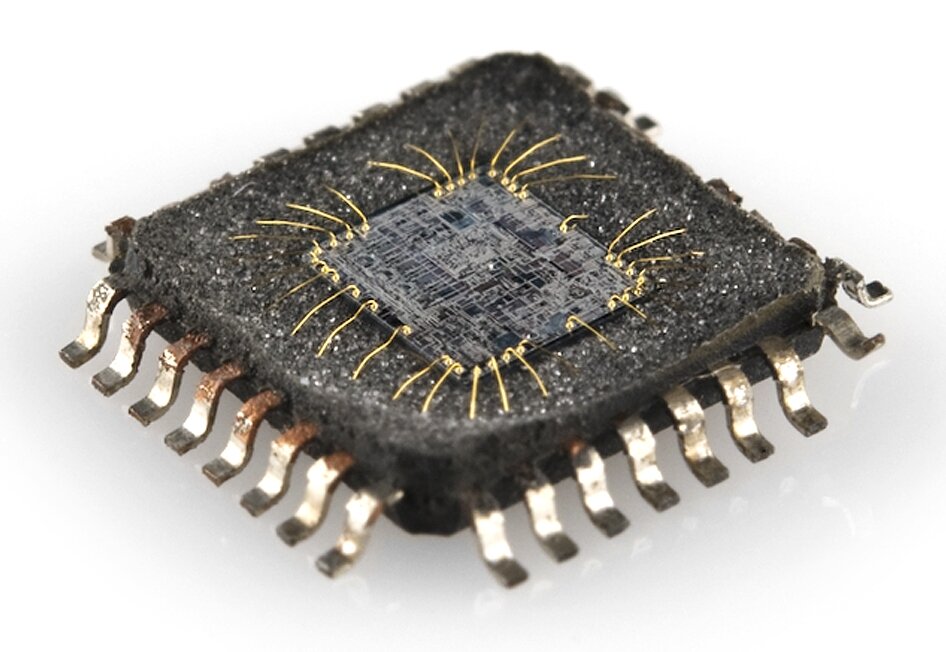
By combining millions or even billions of these tiny transistors onto a single chip of silicon, we create an integrated circuit (IC), also known as a microchip. These ICs are the "brains" of all our electronic devices. The transistors, switching on and off at incredible speeds, perform the logical operations and calculations that make our technology work.
From simple logic gates to complex microprocessors, everything is built from these fundamental semiconductor switches. Their invention revolutionized electronics and paved the way for the digital age.
Let's test your understanding of these core concepts.
What is the key property of a semiconductor that makes it fundamental to modern electronics?
In the context of electron energy bands, what is the main difference between an insulator and a conductor?