Computer Architecture Fundamentals
Introduction to Computer Architecture
The Blueprint of a Computer
Think of computer architecture as the blueprint for a house. It defines where the rooms go, how they connect, and what each room is for. It’s not about the brand of paint on the walls or the type of wood for the floors, but the fundamental design that makes the house work.
At its core, a computer has three main parts that work together: a processor, memory, and a way to interact with the outside world.
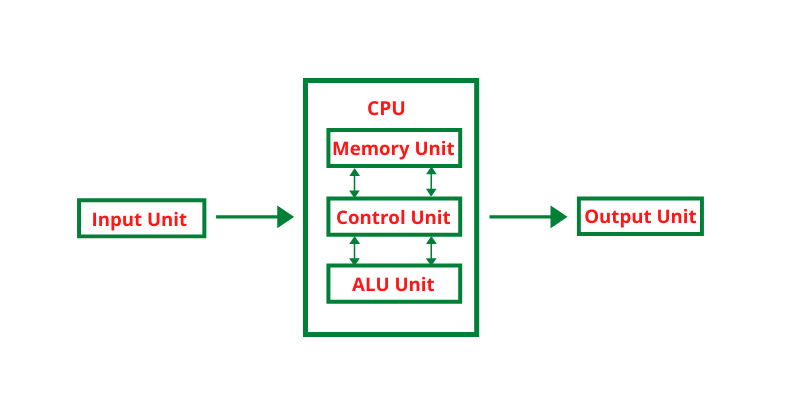
The Central Processing Unit, or CPU, is the brain. It does the thinking and executes commands. Memory is the computer's short-term workspace, holding the information the CPU needs right now. Input and Output (I/O) devices are the computer's senses, letting it communicate with us and other devices. Let's look at each of these more closely.
The Core Components
The CPU is where the magic happens. It fetches instructions from memory and performs the operations they describe. Inside the CPU, two smaller units do most of the work. The Arithmetic Logic Unit (ALU) handles all the math and logical comparisons, like addition or checking if one number is greater than another. The Control Unit (CU) acts like a traffic cop, directing the flow of information between the CPU and other parts of the computer.
Memory, often called RAM (Random Access Memory), is the computer's scratchpad. It's a temporary storage area for the data and instructions that are currently in use. This allows the CPU to access them almost instantly. Think of it like the top of your desk. You keep the papers you're working on right there for easy access, while everything else is filed away in a cabinet. The desk is your RAM; the cabinet is long-term storage like a hard drive.
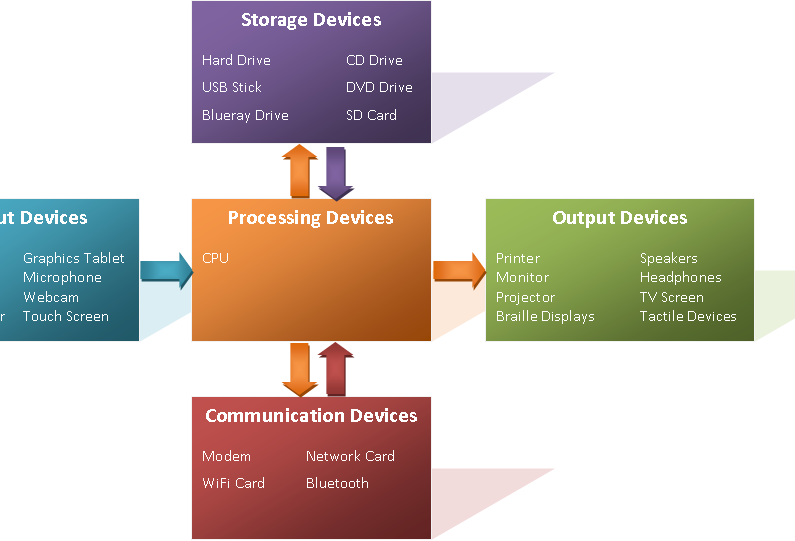
Input/Output (I/O) systems are the bridge between the computer and the world. Input devices bring information in, while output devices send it out. A keyboard and mouse are classic input devices. A monitor and printer are common output devices. Some devices, like a touchscreen, do both.
The Von Neumann Model
How do all these pieces know what to do? The answer lies in a foundational concept called the Von Neumann architecture. Before this model, early computers often had to be physically rewired to perform a different task. The great innovation of this design was the idea of a stored-program computer.
This means both the program's instructions and the data the program uses are stored together in the same memory. The CPU pulls both instructions and data from this single memory space as needed. Think of it like a recipe. The instructions ("mix flour and sugar") and the ingredients list (the data) are written on the same piece of paper, and the chef (the CPU) reads from that one source.
This simple but powerful idea is the basis for nearly every computer, smartphone, and tablet you use today. It makes them flexible and easy to reprogram for countless different tasks.
Instructions and Implementation
A CPU understands a specific set of commands, like ADD, STORE, or LOAD. This vocabulary of commands is called the Instruction Set Architecture (ISA). The ISA is the contract between the software and the hardware. It defines what operations the processor is guaranteed to be able to perform.
For example, the ISA might define an ADD R1, R2 instruction, which tells the processor to add the numbers stored in two locations (registers R1 and R2) and store the result.
The instruction set is the language the CPU speaks. All software must ultimately be translated into this language to run.
While the ISA tells us what the processor does, the microarchitecture describes how it does it. This is the specific, internal design of the processor. Two different CPUs can have the same ISA—meaning they can run the exact same software—but have completely different microarchitectures. One might be designed for high performance in a supercomputer, while another is optimized for low power consumption in a smartwatch.
Think of it this way: the ISA is like the sheet music for a song. Any orchestra can play it. The microarchitecture is the orchestra itself—the specific instruments and musicians who bring that music to life. The performance might sound different, but it's still the same song.
Now that we have a high-level view of a computer's blueprint, let's test your understanding.
Which statement best describes the primary role of the Central Processing Unit (CPU)?
The core principle of the Von Neumann architecture is the concept of a 'stored-program computer', where program instructions and data are held in the same memory space.
Understanding these basic building blocks is the first step to seeing how modern computers accomplish their amazing feats.